For B2B pipeline attribution in 2026, the top three tools are AttributeIQ (fastest, most affordable for HubSpot/GA4), Heeet (CRM-native for Salesforce/HubSpot), and HockeyStack (enterprise GTM intelligence). Fibbler, Ruler Analytics, and SegmentStream round out the list for LinkedIn/Google Ads, offline calls, and AI-driven paid media optimisation respectively.
Best Pipeline Attribution Software Comparison Table for 2026
If you’re evaluating pipeline attribution software in 2026, the right choice depends on how your team measures marketing impact. Whether you need content influence, account-level visibility, CRM-native reporting, or paid media optimisation, the best fit depends on your specific revenue motion.
Here is how the leading platforms compare.
1. AttributeIQ
Best for: Marketing leaders using HubSpot and GA4 who need pipeline attribution defensible enough to prove which content and channels are influencing open deals and closed revenue.
AttributeIQ is a multi-touch attribution platform built for B2B marketing teams that need a consistent, defensible view of how marketing activity contributes to revenue. It combines website engagement, content interactions, campaign data, and HubSpot deal records to show which touchpoints influence opportunities, pipeline stages, and closed-won revenue.
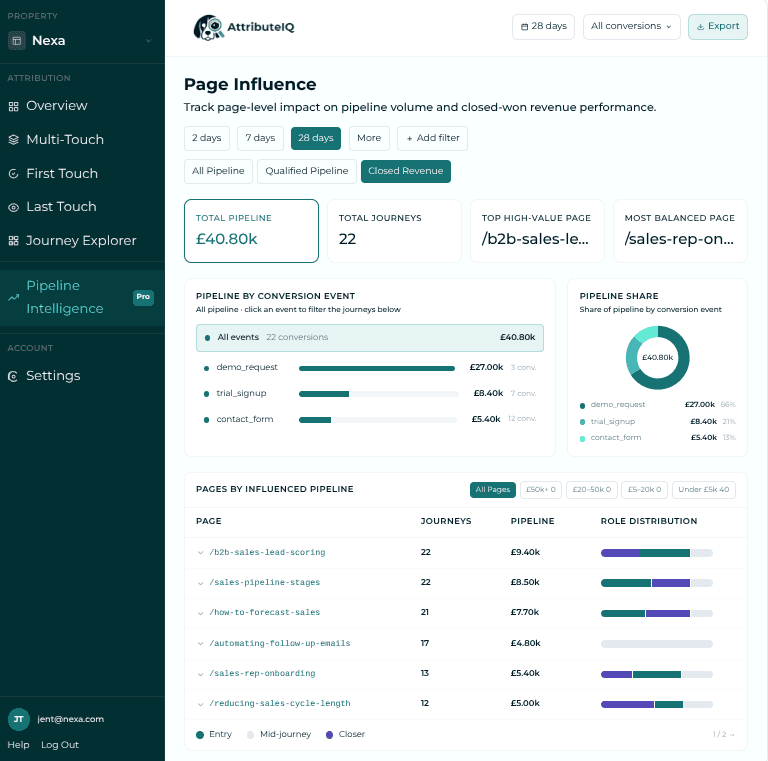
Pricing starts at £89/month on the Starter plan, which covers multi-touch pipeline attribution across your full funnel. The Pro plan at £149/month adds CRM-connected revenue attribution, qualified deal stage tracking, Board Summary with PPTX exports, and buyer intent tracking. Both plans include a 14-day free trial with no credit card required. See full pricing.
Core Pipeline Features
Journey Explorer lets you trace the full contact-level path from the very first touchpoint to pipeline creation. See exactly which website behaviors and content interactions moved a deal from marketing-sourced, to sales-qualified, and ultimately to closed-won.
Board Summary rolls page, channel, and campaign attribution into one executive-ready view. Marketing leaders can walk into a board meeting and confidently show holistic pipeline influence without manually aggregating numbers from three different systems.
Property
Attribution
Management
Account
jane@nexa.com

Board Summary
Export a board-ready summary of marketing’s influence on pipeline and revenue.
Q2 2026 · Board Summary · 1 Apr 2026 – 30 Jun 2026
Qualified Pipeline
£4.1M
from 47 contacts
Total Revenue
£1.27M
from 14 closed deals
Avg Closed Deal
£90.7k
from 14 closed deals
Top Account
Nexa
£340k influenced
Deal Tracking & Alerts is a real-time buyer intent tracking feature that fires the moment a contact tied to an open deal exhibits high-intent website behavior (e.g., revisiting security documentation or pricing). This gives sales reps critical pipeline-stage context exactly when it matters.
Pros
- Live pipeline attribution in under 24 hours. Enterprise attribution platforms often require weeks of data engineering, custom tracking, and RevOps resources before producing useful insights. AttributeIQ connects directly with GA4 and HubSpot, allowing teams to start analysing buyer journeys and pipeline influence almost immediately.
- Flexible attribution models. AttributeIQ lets marketing teams compare first-touch, last-touch, and multi-touch views across opportunities and revenue, giving a clearer picture of how marketing activity contributes to pipeline.
- Accessible pricing for growing teams. Starting at £89/month, AttributeIQ provides multi-touch attribution and pipeline reporting without the five-figure annual contracts common among enterprise platforms.
- No dashboard dependency for revenue questions. Pro users can query attribution data conversationally through Claude-powered analytics instead of manually building reports.
Cons
- No historical pipeline attribution before installation Because the software ties web behavior to HubSpot contacts moving forward, it can’t magically attribute deals that were already in flight before you installed it. If your B2B sales cycle is 90 days, just know it will take about that long to see full, end-to-end buyer journeys populate in your reports.
- Built specifically for HubSpot environments. AttributeIQ’s CRM attribution workflows are designed around HubSpot data structures. Organisations running Salesforce, Dynamics, or other CRM systems will need a different attribution solution.
- Starter plan limits multi-property tracking. Starter tier supports a single GA4 property, which may not fit organisations managing multiple regional websites, brands, or product domains. Teams with broader web footprints will need the Pro plan.
Measure marketing impact beyond traffic and engagement
AttributeIQ connects buyer interactions with HubSpot opportunities to reveal which campaigns, content, and channels influence qualified pipeline and closed-revenue.
Try 14 days for free →2. HockeyStack
Best for: Enterprise B2B teams that need account-level pipeline attribution, GTM intelligence, and AI-powered insights across complex marketing and sales cycles.
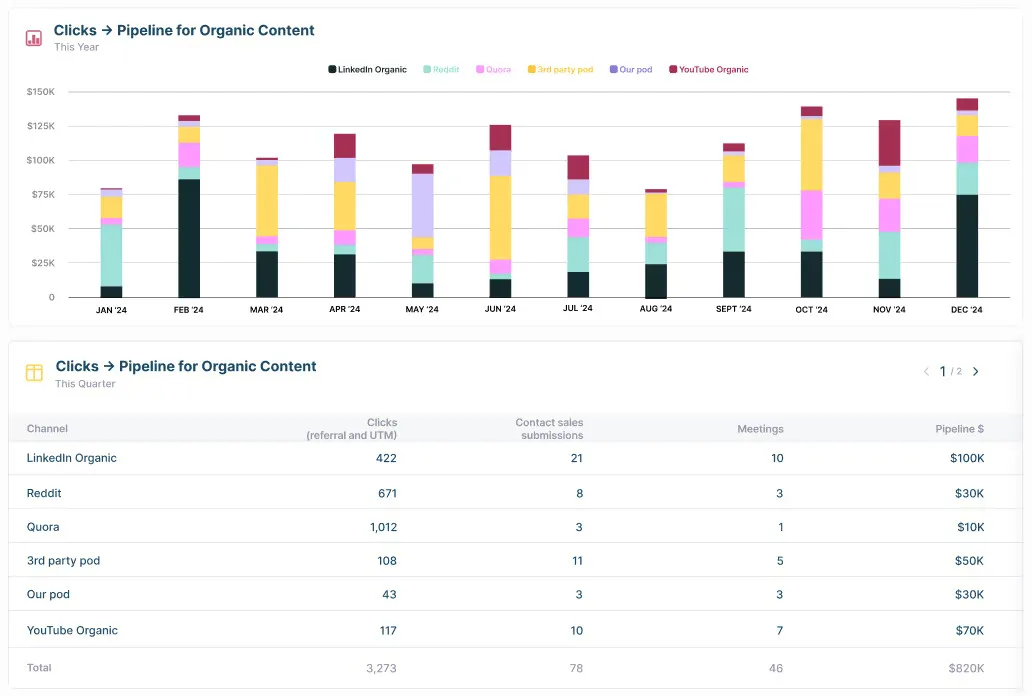
HockeyStack is a go-to-market intelligence platform that weaves pipeline attribution, account analytics, and sales activity into a single revenue reporting system. Because enterprise B2B deals rarely follow a linear path, HockeyStack connects marketing, sales, CRM, and product data to show exactly how disparate channels combine to generate pipeline and closed-won revenue.
Pricing
HockeyStack does not publish standard pricing. Plans are custom-quoted based on tracked accounts, connected data sources, and modules required. Procurement data shows annual contracts typically range from $15,000 to $50,000+ (median ~$28,000).
Recommended Reading: HockeyStack Pricing Review 2026: Plan, Costs, & ROI
Core Pipeline Features
- Account-level pipeline journey mapping. HockeyStack connects anonymous digital interactions with CRM account records to show how multiple stakeholders, campaigns, and sales engagements contribute to pipeline creation across complex B2B buying journeys.
- AI-powered pipeline querying. Revenue leaders can interrogate their pipeline data using natural language. Instead of building custom dashboards, you can ask the AI exactly which ad campaigns drove the most enterprise-tier pipeline this quarter and get immediate answers.
- Unified GTM pipeline layer. It stitches together ad platform data, website behavior, product usage, and CRM deal stages. This ensures sales and marketing are looking at the exact same pipeline attribution reality, rather than arguing over separate tool silos.
Cons
- Enterprise pricing barriers. Five-figure annual costs make HockeyStack unviable for mid-market teams that just need clean pipeline attribution without a massive RevOps budget.
- Heavy RevOps implementation. Connecting multiple product, sales, and marketing data sources into a unified pipeline workflow takes significant technical heavy lifting, usually requiring a 4-to-6-week deployment window.
- Bloated for pure pipeline needs. Because it is a massive GTM intelligence suite, teams looking strictly for a dedicated pipeline attribution tool may find they are overpaying for sales enablement and product analytics features they don't need.
3. Heeet
Best for: B2B teams on Salesforce or HubSpot who want pipeline attribution running natively on CRM deal objects, without ever logging into a separate reporting tool.
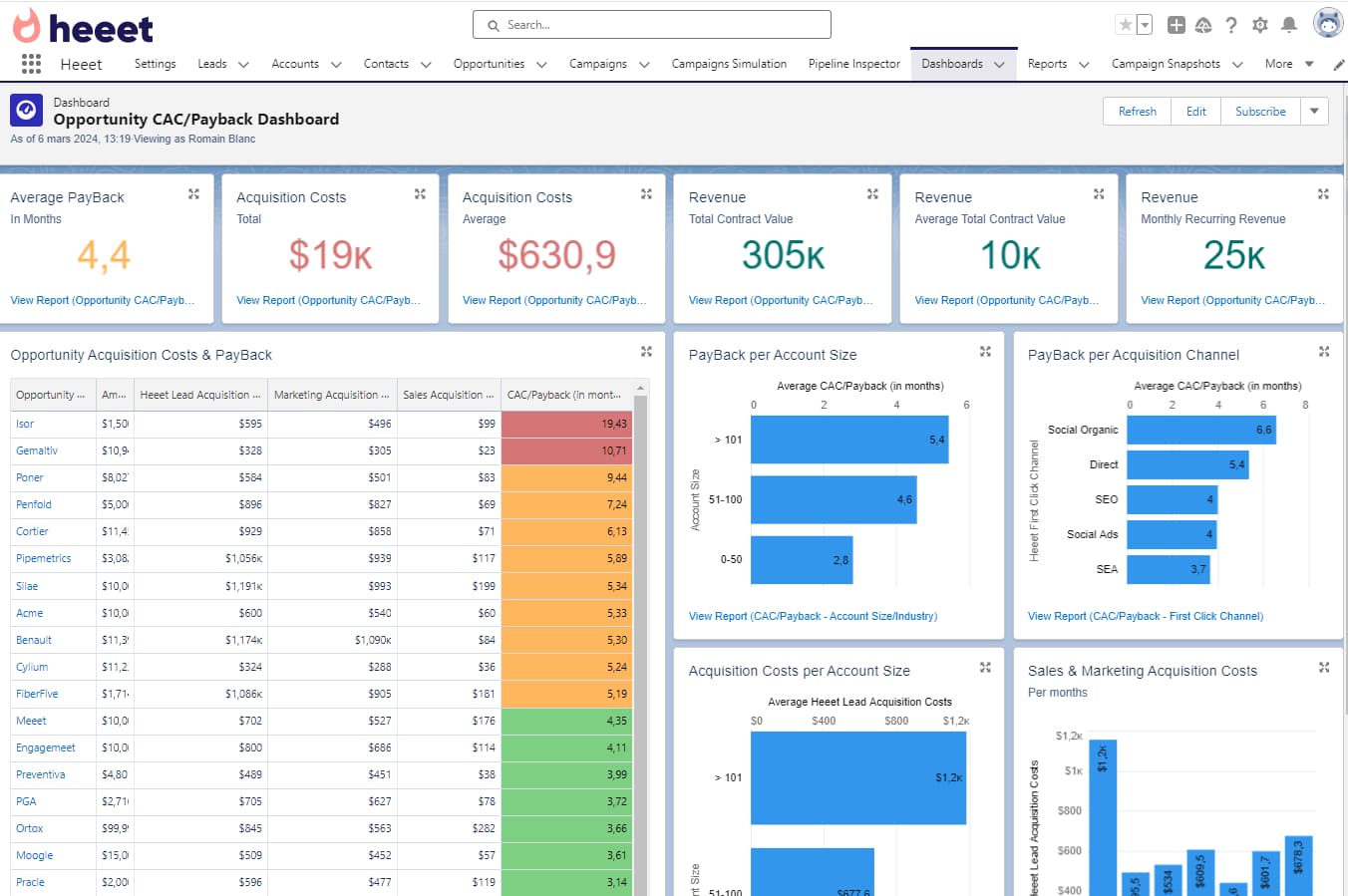
Heeet is a CRM-native pipeline attribution platform that lives entirely inside Salesforce or HubSpot. Rather than pulling your CRM data into an external dashboard, it pushes ad platform, content, and offline event data directly onto your CRM’s pipeline and closed-won revenue records.
Pricing
Heeet’s Native Edition starts at $1,490/month for teams on Salesforce or HubSpot. Custom Editions for other CRMs are priced individually. Flat pricing makes budgeting predictable, but the entry point is significantly higher than mid-market pipeline tools.
Core Pipeline Features
- Native CRM Pipeline Writing. Heeet writes attribution data directly into custom fields on your Salesforce Opportunities or HubSpot Deals. You can see exactly which Google Ad campaign or LinkedIn touchpoint generated a specific deal without ever leaving your CRM interface.
- Multi-Model Deal Tracking. Run first-touch, last-touch, linear, and U-shaped pipeline attribution models directly against your CRM’s open pipeline and closed-won amounts, proving exactly how budget maps to revenue.
- Rapid Pipeline Time-to-Value. Because it’s a managed CRM package and a JavaScript snippet rather than a standalone data warehouse, setup is measured in hours. You can start mapping marketing touches to CRM pipeline much faster than standard enterprise deployments.
Cons
- Steep entry cost. At $1,490/month just to start, Heeet is priced for teams with mature, established pipeline attribution budgets.
- Penalises non-standard CRMs. If your pipeline lives outside of Salesforce or HubSpot, you are forced into custom, individually negotiated pricing contracts.
- No standalone interface. Because the pipeline attribution lives entirely within your CRM, you are at the mercy of Salesforce or HubSpot’s reporting limitations and mobile app constraints.
4. SegmentStream
Best for: Paid-media and growth teams who want AI-driven pipeline attribution combined with incrementality testing to optimise massive ad budgets.
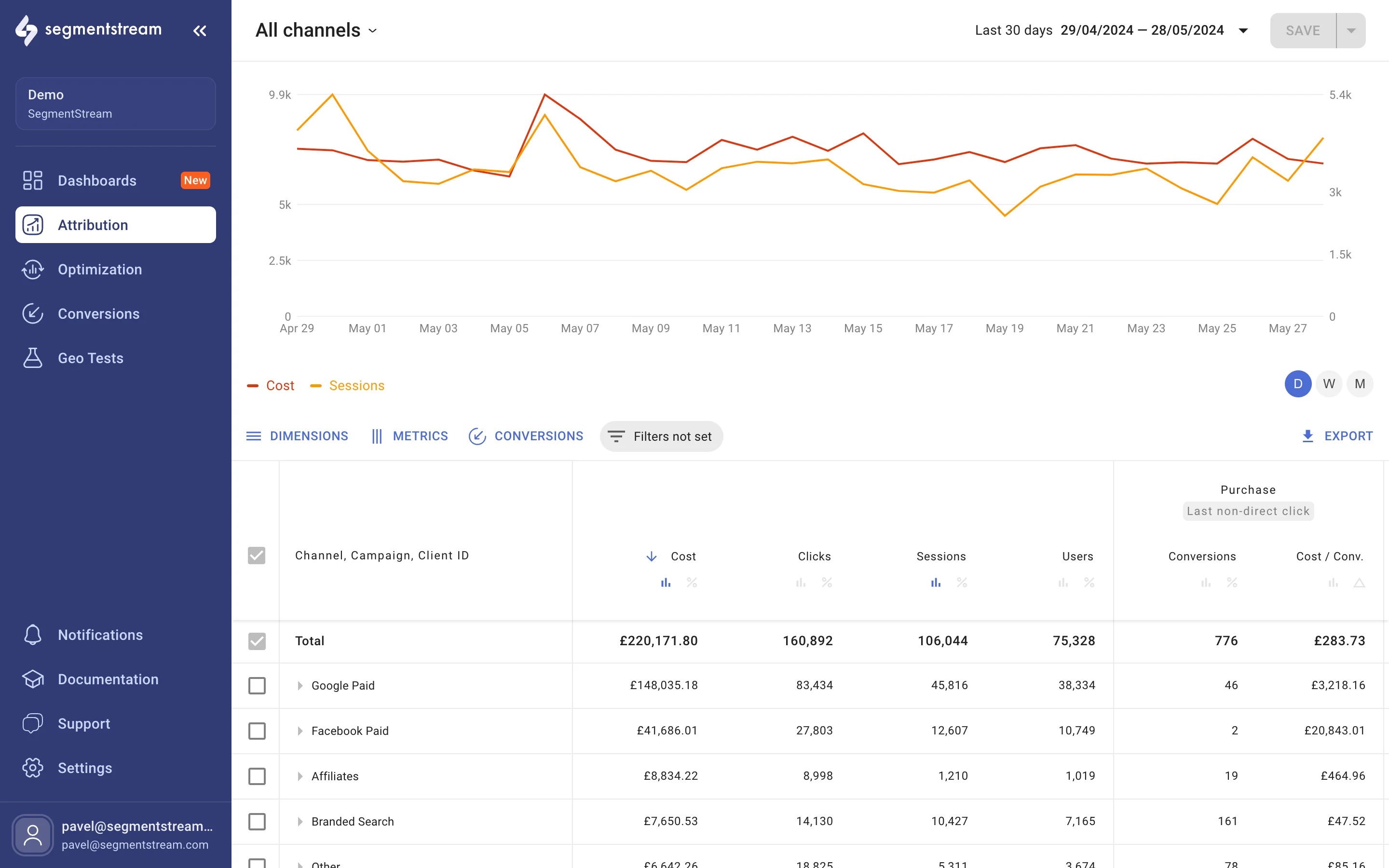
SegmentStream is an AI-powered conversion modeling platform that replaces multi-touch attribution with machine-learning pipeline attribution. It models the incremental pipeline value each channel generates, so budget only goes to ads driving net-new CRM deals.
Pricing
SegmentStream does not publish pricing. Quotes are heavily customised based on ad spend volume and required add-ons. Partner-led implementations typically land between $1,250 and $7,000/month, requiring a rigorous sales conversation to validate.
Core Pipeline Features
- ML-Driven Pipeline Contribution. SegmentStream’s proprietary post-click and post-view models evaluate the statistical likelihood that a specific top-of-funnel ad impression actually contributed to CRM pipeline creation, bypassing the flaws of rigid rule-based attribution.
- Pipeline Incrementality Testing. Runs geo-lift and causal experiments to prove whether a channel actually created net-new pipeline, or simply claimed credit for a CRM deal that was already going to close anyway.
- Automated Pipeline Budgeting. Rather than leaving pipeline attribution as a static RevOps report, the platform automatically recommends and shifts ad spend toward the campaigns statistically proven to generate incremental pipeline.
Cons
- Built for ROAS, not deal stages. SegmentStream’s core DNA is ad-spend optimisation. While it overlaps with pipeline attribution, it lacks the granular, deal-stage CRM tracking (e.g., tracking a deal from MQL to Contract Sent) that B2B marketing leaders usually need.
- Opaque budgeting. The lack of transparent pricing means teams cannot quickly benchmark the cost of their pipeline attribution initiative without committing to a sales cycle.
- UI performance issues. Reviewers frequently note interface slowdowns and loading lags when processing massive ML-driven pipeline datasets.
5. Fibbler
Best for: B2B marketing teams heavily invested in LinkedIn and Google Ads who need company-level ad engagement tied directly to CRM pipeline generation.
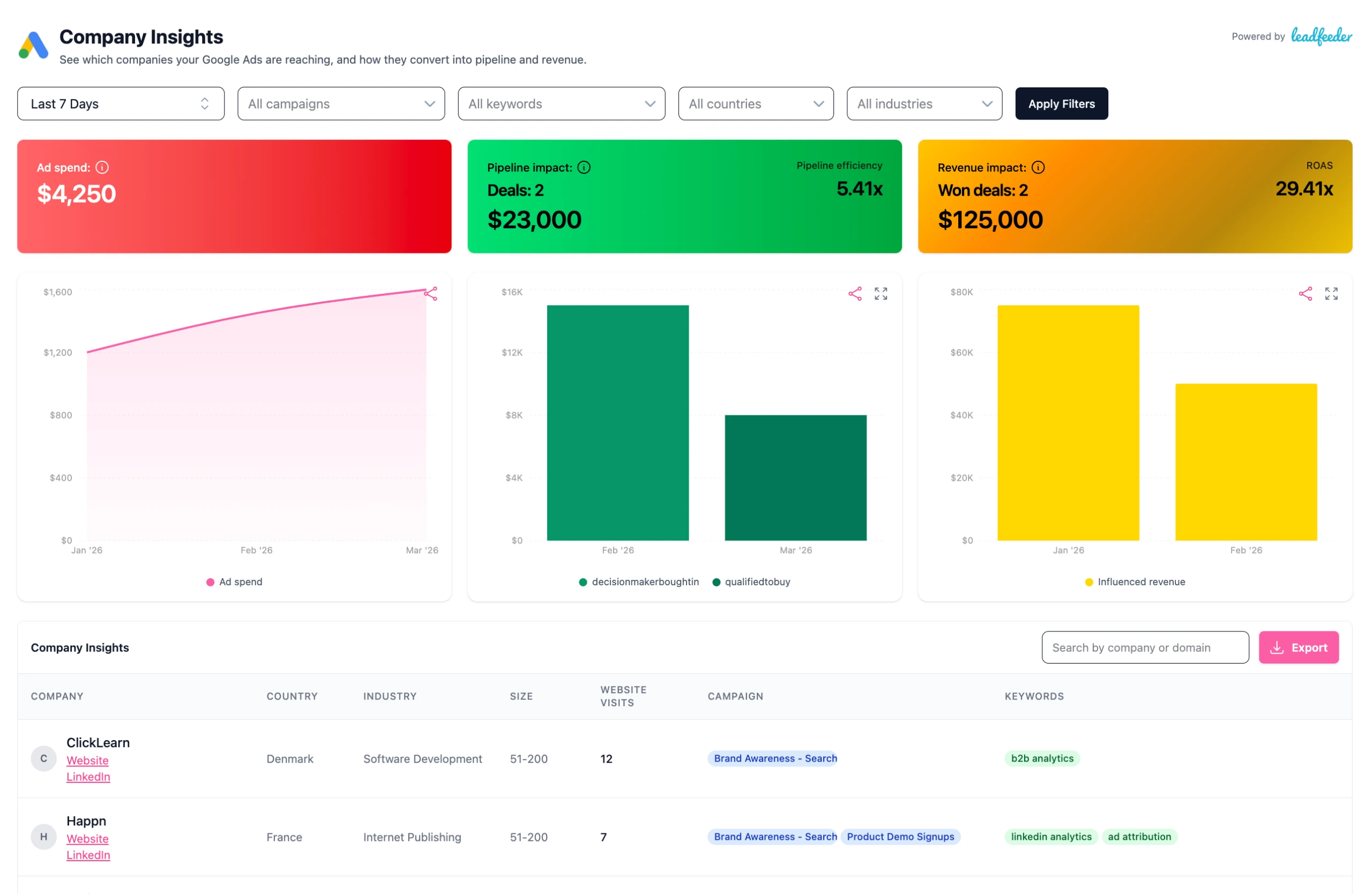
Fibbler is a highly specialised pipeline attribution tool designed specifically for paid channels. Rather than tracking anonymous clicks, it de-anonymises the companies engaging with your LinkedIn and Google Ads and syncs that intent directly to your CRM.
Pricing
Fibbler’s transparent Growth plan starts at $89/month for LinkedIn Ads company-level attribution, HubSpot CRM sync, and Slack alerts (capped at 3 campaigns). The Unlimited plan ($129/month) adds full Salesforce integration. Google Ads pipeline attribution requires a $59/month add-on. A 30-day free trial is available.
Core Pipeline Features
- Ad-to-Pipeline Match Rates. Identifies exactly which companies are viewing or clicking your ads and connects that top-of-funnel engagement directly to the pipeline value and closed-won revenue associated with that company inside your CRM.
- Cross-CRM Pipeline Sync. Pushes attribution intent data directly into HubSpot, Salesforce, Attio, and Copper. Sales reps can see which target accounts are actively engaging with ads right next to the open deal record.
- Instant Pipeline Intent Alerts. Triggers Slack notifications the second an account with an open pipeline deal clicks a LinkedIn or Google Ad, allowing sales to follow up with perfect timing.
Cons
- Strictly limited to paid ads. Fibbler only attributes pipeline from LinkedIn and Google Ads. It completely ignores organic search, email, direct traffic, and webinars, making it incomplete as a holistic pipeline attribution platform.
- Google Ads is gated. Basic pipeline attribution for Google Ads isn’t included in the base price; it requires an ongoing $59/month upcharge.
- Lacks multi-touch modeling. It is built to flag account engagement from ads, not to run full first-touch, linear, or U-shaped pipeline models across the entire buyer journey.
6. Ruler Analytics
Best for: Lead-gen agencies and B2B services where offline phone calls, form fills, and live chat are the primary entry points for CRM pipeline.
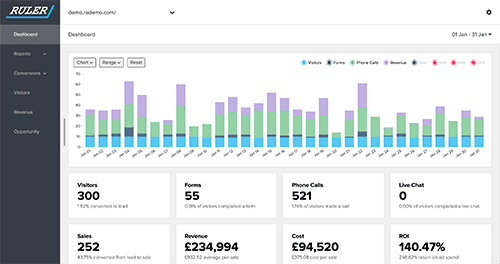
Ruler Analytics is a call-tracking and pipeline attribution platform designed to close the massive data gap between digital marketing activity and offline sales conversations. It captures website visitors, maps their form fills and inbound phone calls, and links those exact interactions directly to CRM deal opportunities and closed-won pipeline.
Pricing
Ruler Analytics scales pricing by monthly website visits. Small Business starts at £199/month (up to 5,000 visits), Medium Business is £649/month (up to 50,000 visits), and Large Business hits £1,149/month (up to 100,000 visits). High-end pipeline models require custom Advanced tiers. Sign-up requires a demo.
Core Pipeline Features
- Call-to-Pipeline Match. Uses Dynamic Number Insertion (DNI) to trace an inbound phone call back to the exact digital campaign and keyword that drove it. It then pushes that data into the CRM to prove exactly how much pipeline that specific phone call generated.
- Multi-Touch Pipeline Modeling. Allows teams to toggle between first-click, last-click, linear, U-shaped, W-shaped, and full-path models, mapping these rules directly against CRM opportunity and revenue values.
- Broad Pipeline Integration. Pushes web and offline conversion data into over 1,000 endpoints, seamlessly bridging digital activity to pipeline systems like Salesforce, HubSpot, and Pipedrive.
Cons
- Traffic-based penalty pricing. Because pricing scales with raw website visits rather than CRM deal volume, a high-traffic B2B site with a small number of massive deals will overpay drastically for pipeline attribution.
- High friction evaluation. There is no self-serve free trial to test data accuracy. You must endure a sales demo before you can see if the tool maps your pipeline correctly.
- Heavy onboarding lift. Users consistently report that getting the tool to properly map digital conversions to CRM pipeline requires significant internal tracking validation and manual conversion mapping during setup.
How to Choose the Best Pipeline Attribution Software for Your Team
Now that you’ve seen how these six platforms stack up, here’s how to pick the right one for your team, without getting swayed by feature lists alone.
1. What is your primary CRM?
Attribution tools need to easily read and update your deal data. Which CRM you use determines whether a tool will plug in instantly or require an expensive custom build.
- HubSpot-centric teams: Look for lightweight tools like AttributeIQ, Heeet, or Fibbler.
- Salesforce-centric teams: Require deep, custom-object mapping found in platforms like Heeet or HockeyStack.
- Non-standard / Custom CRMs: Require flexible webhook setups or call-tracking specialists like Ruler Analytics.
2. Who owns reporting and implementation?
The best attribution platform is one your team can actually maintain. A feature-rich tool is not useful if it creates a reporting process nobody owns.
- Marketing team (No RevOps support): Choose plug-and-play, self-serve solutions like AttributeIQ or Fibbler that require zero engineering overhead.
- Dedicated RevOps / Marketing Ops: Deploy customisable multi-touch systems like Heeet or HockeyStack that need ongoing maintenance.
- Data Engineering / BI team: Build around machine-learning frameworks like SegmentStream or custom enterprise attribution data warehouses.
3. What channels drive most of your pipeline?
Different attribution platforms are built around different types of customer journeys. Start with the channels that actually influence your pipeline.
- Content & Organic Search: Select tools with deep multi-session tracking like AttributeIQ to measure organic touchpoints.
- LinkedIn & Paid Search: Opt for target-account engagement tracking with Fibbler.
- Phone Calls & Inbound Forms: Require Dynamic Number Insertion (DNI) through Ruler Analytics.
- Paid Media at Scale: Utilise machine-learning incrementality modeling with SegmentStream.
- Complex Omnichannel B2B: Invest in full-path account intelligence with HockeyStack.
4. How fast do you need actionable reporting?
Setup times vary wildly depending on the tool’s complexity and your current data setup.
- Immediate (Under 24 hours): AttributeIQ or Fibbler install via simple tracking script or instant API authentication.
- Short-term (1 to 7 days): Heeet (CRM-native package setup) or Ruler Analytics (guided phone/form mapping).
- Long-term (4 to 6+ weeks): HockeyStack or SegmentStream require extensive RevOps alignment, data cleaning, and ML training periods.
5. What is your actual monthly software budget?
Ensure software pricing aligns with your marketing spend and anticipated deal sizes.
- Under $150/month: AttributeIQ or Fibbler offer high-ROI entry points for growing teams.
- $200 – $1,500/month: Ruler Analytics accommodates mid-market lead-generation operations.
- Over $1,500/month: Heeet or HockeyStack cater to enterprise RevOps budgets.
- Ad-Spend Scaled: SegmentStream scales pricing based on overall ad volume and statistical models needed.
6 Mistakes That Undermine Every Pipeline Attribution Tool Evaluation
Choosing the wrong pipeline attribution software can lead to messy reporting, endless onboarding, and wasted budget. Before you sign a contract, make sure your B2B team isn’t making one of these six common evaluation errors.
The First 90 Days: Proving ROI with Your Pipeline Attribution Platform
A pipeline attribution platform only creates value when your team turns data into better decisions. The first 90 days should focus on validating tracking, proving insights are accurate, and building a workflow where attribution influences marketing and revenue decisions.
Frequently Asked Questions
The easiest way to choose an attribution platform is to test drive it on your own data. Plug in your CRM, look at how it maps your actual buyer journeys, and make sure it delivers actionable data before buying. Try AttributeIQ free for 14 days.