Dreamdata is one of the most capable attribution platforms on the market. If you’re running a sophisticated revenue operation with multiple acquisition channels, large datasets, and a dedicated RevOps function, it makes a compelling case for itself.
The challenge is that content teams are often trying to answer a much narrower question. They don’t need another dashboard showing that Organic Search influenced pipeline. They need to know which blog posts influenced pipeline. Which case studies consistently appear in closed-won journeys. Which assets deserve another six months of investment and which ones are just generating traffic.
That’s where many content-led teams start looking beyond Dreamdata. Not because it’s lacking capability, but because they need attribution built around content influence rather than channel attribution. This guide covers the platforms that do that best.
Our Top 6 Dreamdata Alternatives for Content-Led Revenue Attribution (2026)
1. AttributeIQ
Property
Attribution
Management
Account
jane@nexa.com
 AttributeIQ
Page Influence
Track influenced pipeline from first touch to closed deal, page by page.
Influenced Pipeline
£2.4M
+18% vs last period
Closed Revenue
£890k
28% pipeline-to-close
Top Asset Value
£312k
/pricing · last 28d
Avg. Touchpoints
5.2
per converting journey
If you’ve ever sat in a marketing review knowing that your best piece of content is driving real pipeline, because every qualified call mentions it, because your sales team forwards it, but you can’t prove it in a number your CMO will accept, that’s the exact problem AttributeIQ was built to close.
The platform connects to your existing GA4 data via BigQuery and begins tracing buyer journeys from first touch to closed deal within 24 hours. For content and SEO teams that have spent months producing assets they can’t attribute, the time to value alone is a meaningful differentiator.
Core Features
Pricing Structure
Three plans, flat monthly pricing, and every single one includes a 14-day free trial. No credit card required. Full breakdown on the pricing page →
- Starter (£89/mo): Supports one GA4 property with standard multi-touch tracking.
- Pro (£149/mo): Unlocks the Pipeline Intelligence module, HubSpot Deal Sync, and executive reporting capabilities across up to three web properties.
- Agency (£299/mo): Provides unlimited properties and individualised client alerting.
See which content pieces
actually influenced your deals.
AttributeIQ shows page-level pipeline attribution natively over your existing GA4 and HubSpot stack, live within 24 hours.
Try 14 days for free →2. HockeyStack
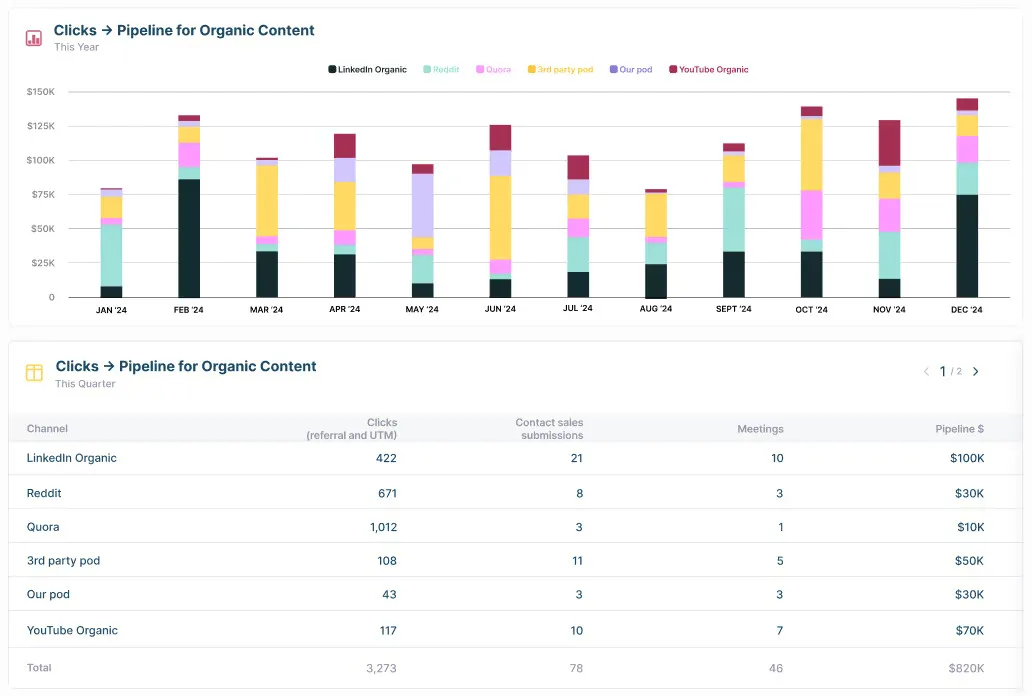
HockeyStack has gone through an interesting identity evolution in the last two years. It started as a clean multi-touch attribution tool for B2B SaaS teams, then expanded into a full GTM intelligence platform: AI agents, account scoring, intent data, the whole thing.
That expansion has made it considerably more powerful and considerably more expensive, but if you’re running a content-led enterprise GTM motion and you need attribution that spans the full buying committee, it’s still one of the most complete options on the market.
Key Strengths
- Identifies up to 2x more content-attributed opportunities than standard CRM-native reporting, according to user reviews.
- Account-level dashboards that let you filter content performance by segment, company size, industry, or deal tier, so instead of knowing that a blog post got 4,000 sessions, you know it was read disproportionately by companies in the $50M–$200M revenue band that went on to close.
- Odin, HockeyStack’s native AI analyst, answers plain-English questions about content performance (“what content do our highest-ACV customers read before closing?”)
The limitation for content-first teams is cost. HockeyStack doesn’t publish pricing transparently, but based on G2 data and market estimates, the Growth plan starts around $1,399/month and the full GTM Intelligence tier runs closer to $2,200+/month. There’s no free tier. The platform also requires a meaningful implementation investment before the data becomes reliable, and you’ll need CRM data that’s reasonably clean before it starts telling you things you can act on.
3. Factors.ai
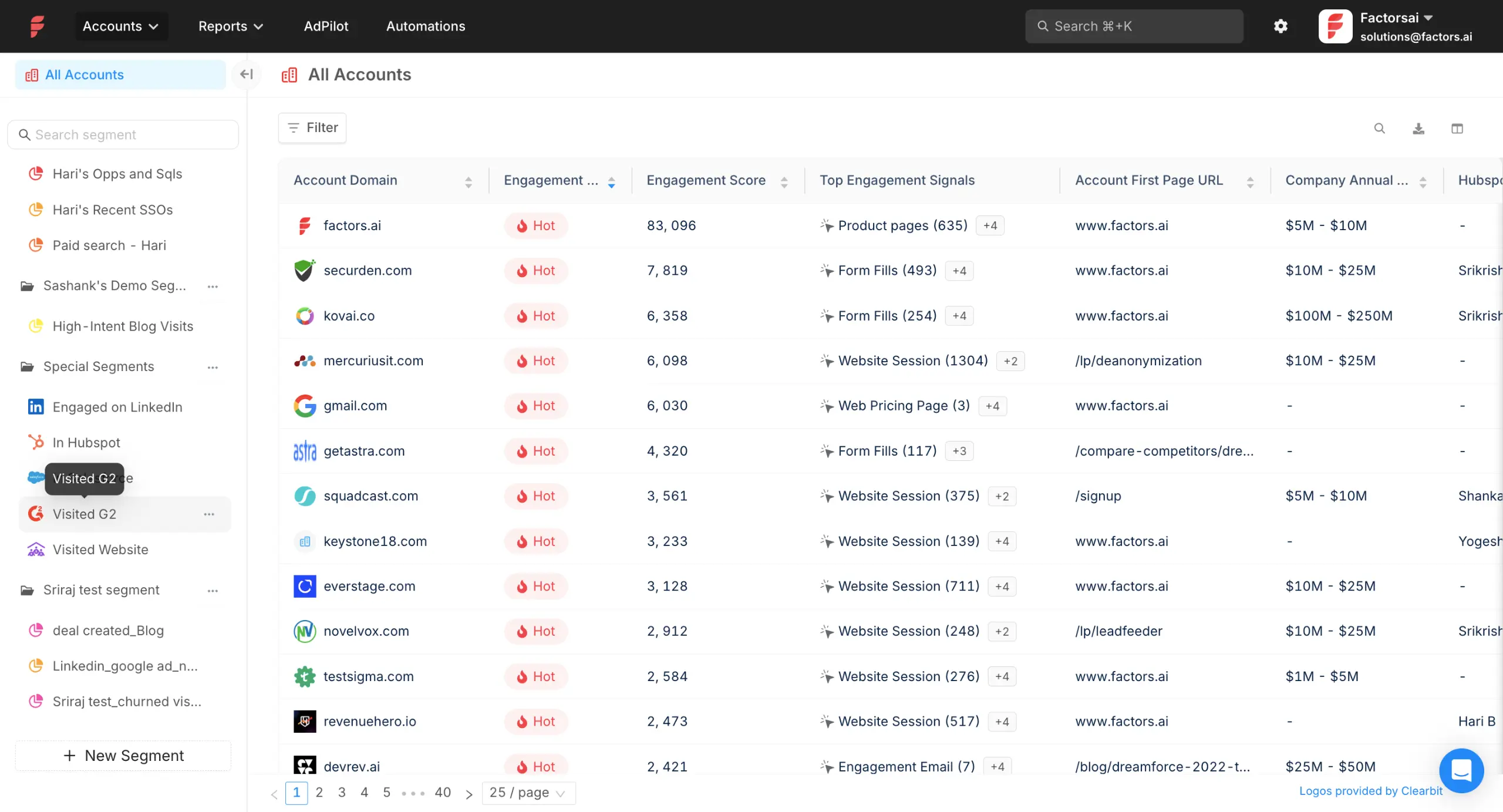
If your content strategy is generating real organic traffic but you have essentially no visibility into who’s reading it before they convert, which describes approximately every B2B content team operating on GA4 alone, Factors.ai addresses a specific and annoying problem.
It identifies the companies visiting your site even before they fill out a form, using IP-based account identification (with claimed coverage above 75% of B2B traffic), and then maps those accounts’ behaviour across your content, your LinkedIn presence, G2 intent signals, and your CRM.
Key Strengths
- Company-level identification on anonymous organic sessions: firmographics, engagement depth, and content consumption patterns, visible before a form is ever submitted
- Multi-touch attribution stitched across organic search, LinkedIn, email nurture, and CRM activity, so revenue credit reflects the full journey rather than whoever happened to book the call
- High-intent routing to sales via Slack when a target account crosses a behavioural threshold: three blog posts in a week, a pricing page visit, a return session from a known opportunity
The honest limitation here is that Factors.ai is structured around account-level identification, not person-level. You’ll know Acme Corp is reading your content; you may not know which person at Acme Corp is doing the reading. That’s a structural limitation of IP-based identification, and worth understanding before you position it internally as a complete attribution solution.
Pricing is genuinely accessible for mid-market: the free forever tier covers basic account identification; the Basic paid tier runs approximately $5K/year based on public notes; full enterprise pricing scales with data volume and integration complexity.
4. CaliberMind
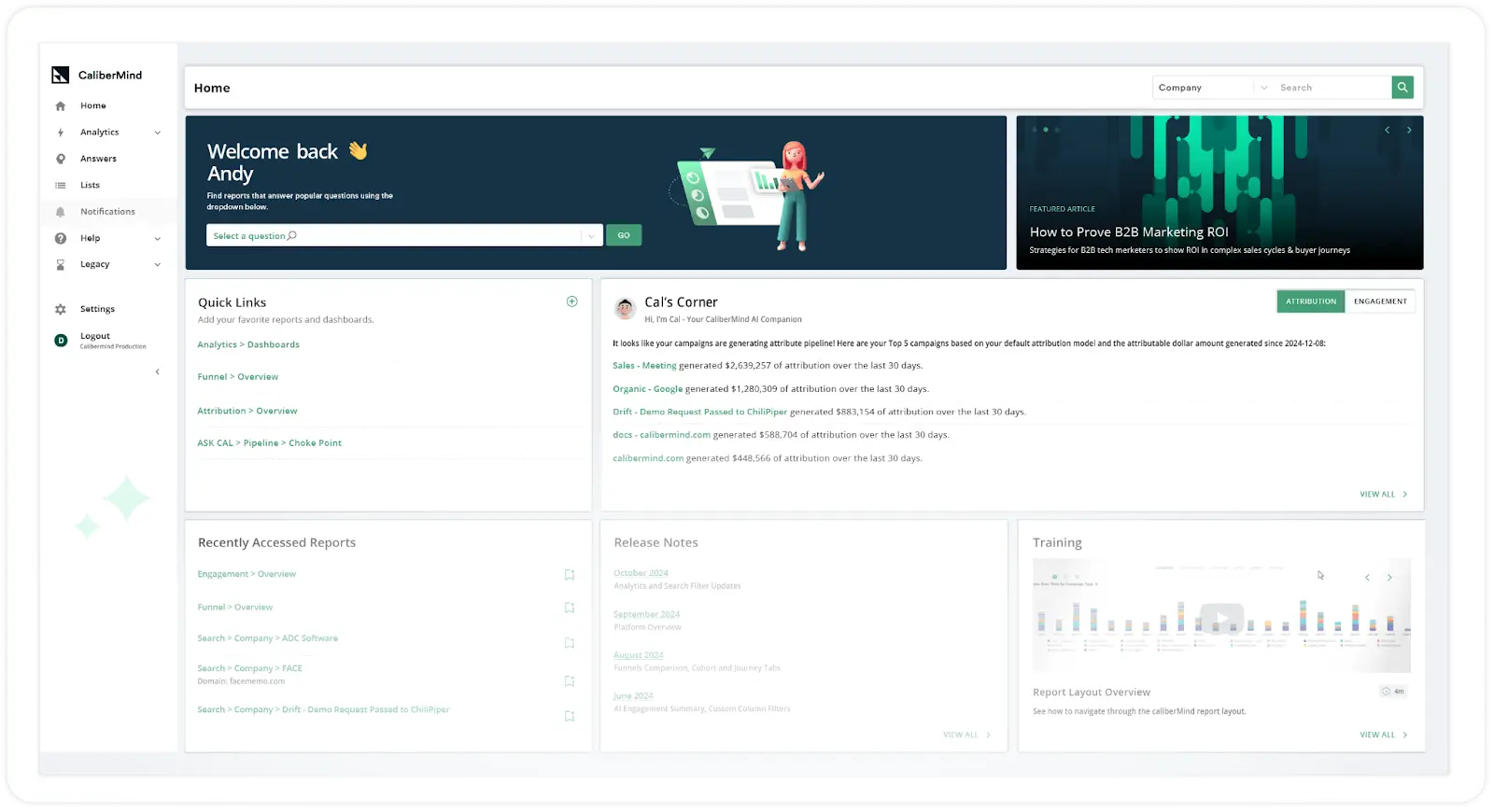
CaliberMind sits in a slightly different part of the map than the other tools here. It’s less a standalone attribution product and more a marketing data unification layer with attribution baked into it, built specifically for mid-market and enterprise B2B teams.
The reason it belongs on a content-led attribution list is that it explicitly supports content syndication attribution: you can connect syndicated content engagement (third-party content runs, gated asset downloads, content networks) to pipeline and revenue inside the CRM.
Key Strengths
- Attribution sliced by content type, channel, campaign, and funnel stage within a single report, without needing to export anything or build a custom view in a BI tool.
- ACV impact, sales cycle compression, and expansion revenue all surfaced as attribution outputs, rather than stopping at initial conversion the way most tools do
- AskCal, the platform’s AI reporting layer, generates custom attribution reports from plain-English inputs, which matters in practice because content teams shouldn’t need a RevOps intermediary to answer a straightforward question about pipeline influence
The limitation is cost. CaliberMind is custom-priced and typically runs $30,000–$80,000 annually, which puts it firmly in the mid-to-enterprise bracket. There’s no self-serve path, no trial you can sign up for without talking to sales, and implementation requires meaningful setup investment. G2 rates it consistently at 4.5/5, with particular praise for the CRM-native insight depth and the customer success team’s willingness to get in the weeds on attribution configuration.
5. Usermaven
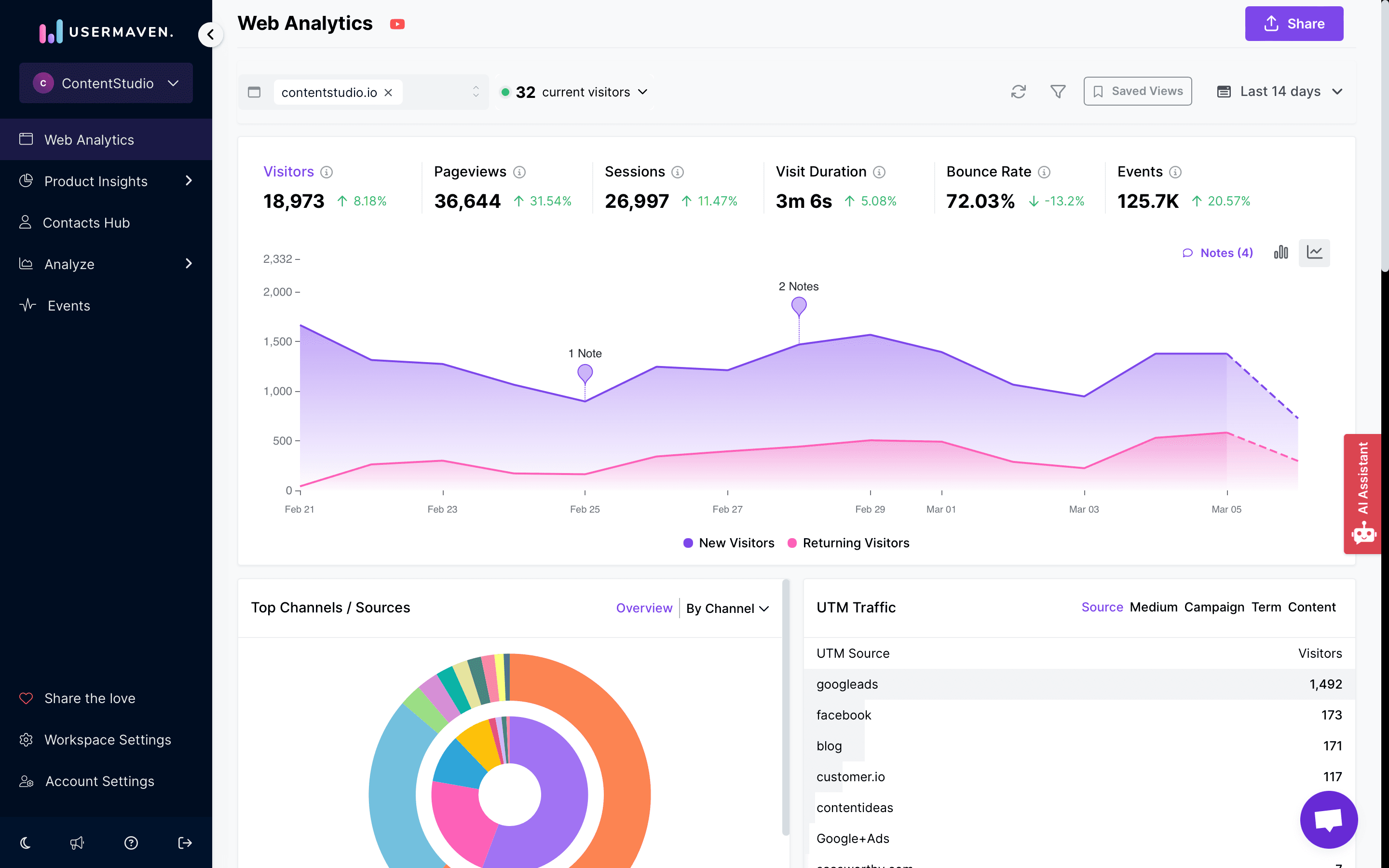
Usermaven is probably the most underrated tool on this list, and the one most likely to surprise you when you see what it actually does relative to what it costs. It’s a privacy-first analytics platform with multi-touch attribution baked in: seven attribution models, individual contact-level journey tracking, funnel analysis, and a mini-CRM called Contacts Hub that lets you view each user’s complete journey from first visit to conversion. And it starts at $84/month.
Key Strengths
- Cookieless, GDPR-compliant tracking architecture built in from the start rather than retrofitted, relevant if any meaningful share of your organic audience is European and you’d prefer not to think about consent mode edge cases
- Contacts Hub functions as a lightweight CRM layer inside the platform, meaning the content team has a usable view of individual buyer journeys without needing a HubSpot login or a sales ops handoff to pull the data
The honest limitation is scale and depth. Usermaven is excellent for individual-level journey tracking but doesn’t do the account-level aggregation or buying committee analysis that Dreamdata or HockeyStack offer. It also doesn’t have a native CRM integration at the same depth as the enterprise tools, the HubSpot and Salesforce connectors are available but you won’t get the same deal-level revenue matching that a tool like AttributeIQ offers on the Pro plan.
6. InfiniGrow / Amplitude
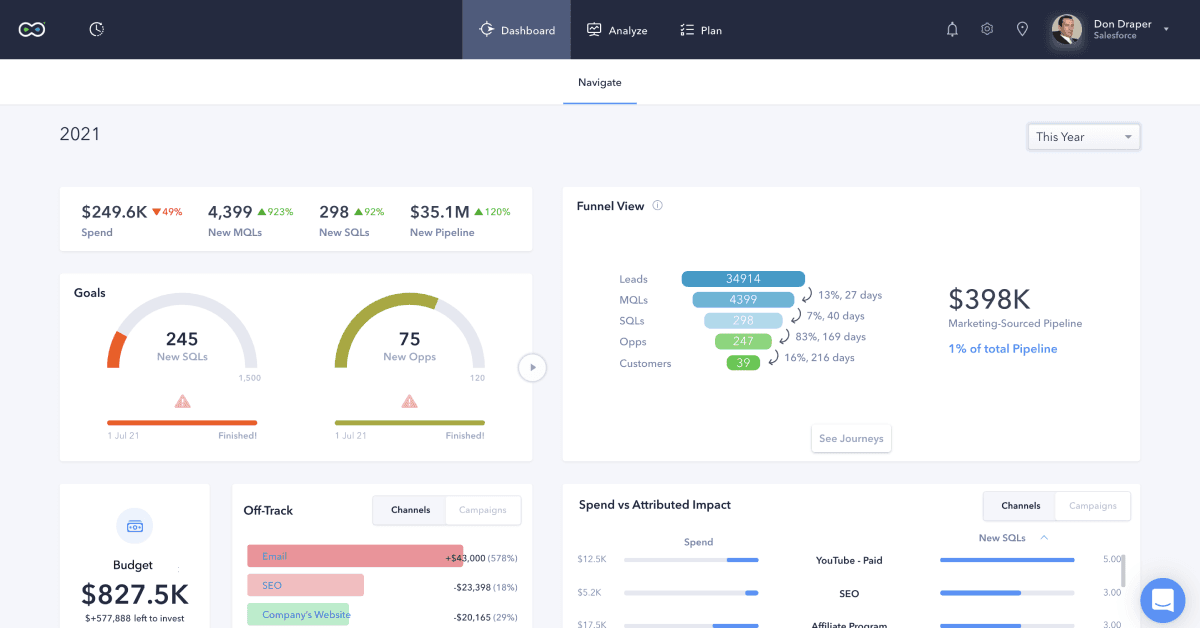
InfiniGrow spent several years building a solid reputation as an AI-driven revenue marketing platform, focused specifically on helping B2B marketing teams connect spend to revenue with predictive analytics layered on top. In early 2026, Amplitude acquired InfiniGrow, rolling its revenue attribution capabilities into the Amplitude platform.
The practical effect is that you now get product analytics, marketing attribution, and AI-powered revenue forecasting in one place, which is either very appealing or mildly confusing depending on what you actually needed.
Key Strengths
- AI-powered budget forecasting and scenario planning: you can model what happens to pipeline if you shift content spend from SEO to thought leadership or vice versa
- Full-funnel analytics that connect product usage (through Amplitude) to marketing touchpoints, which is rare and useful if you’re running a PLG motion alongside content
The limitation is that the Amplitude acquisition is still settling, and reviews from 2025–2026 note some interface inconsistency as the InfiniGrow product gets absorbed into the broader Amplitude platform. Pricing is custom and starts around $1,500/month for meaningful attribution features, which is consistent with the rest of the enterprise tier but higher than most content teams can justify without a mature analytics function already in place.
Choosing the Best Content-Focused Attribution Platform
Instead of comparing every feature, answer these three questions; they’ll usually tell you which attribution platforms belong on your shortlist.
Proving Content’s Pipeline Impact Without Rebuilding Your Stack
For content-led teams, the real objective usually isn’t to “swap out Dreamdata,” it’s to answer a sharper question with the same level of rigour: which specific pieces of content are genuinely moving pipeline, and which are just stealing credit or generating noise.
Instead of reorganising your entire attribution stack around that hypothesis, a lower-friction path is to run a page-level tool like AttributeIQ alongside what you already have, pointed squarely at blog posts and SEO pages. Because it connects directly to GA4 and HubSpot and spins up within roughly 24 hours, you can use the 14‑day free trial to see, using only your own journeys, whether a content-first view materially changes how you talk about pipeline in the next board or leadership review.