This 30+ question RFP checklist covers the key criteria for evaluating multi-touch attribution software vendors before purchase, including native CRM and analytics integrations, identity resolution, attribution methodology, pipeline and revenue reporting, historical data, implementation requirements, pricing, data ownership, GDPR, and ongoing vendor support.
What to Evaluate When Comparing Multi-Touch Attribution Software Vendors
In my experience, attribution RFPs tend to spend too much time on what is easy to demonstrate in a 30-minute demo: integrations, dashboards, attribution models, reporting. Those things matter, but they rarely tell you whether the numbers coming out of the platform will actually hold up when you start using them to make budget and pipeline decisions.
A better RFP digs into the less visible parts of the product: what data the vendor captures, how touchpoints are connected to contacts and revenue, how attribution credit is calculated, what limitations exist, and how the resulting analysis can be used by your team.
These are the questions this guide covers, with each section focused on a specific area you should evaluate before selecting a vendor.
Data Integration Questions for Attribution Software Vendors
This is where I would start any attribution RFP. Before comparing models or reporting features, I want to know whether the vendor can actually work with the data the business already has. If the underlying connections are incomplete, everything built on top of them becomes questionable.
Which CRMs and ad platforms does the integration support natively?
Why it matters
The first mistake I see buyers make is checking a box just because a vendor claims they “integrate with everything.” A vendor that connects to everything usually connects to nothing particularly well, and you usually won’t find out until months into the contract, once the reports are already being used to make bad financial decisions.
AttributeIQ’s Native Support
At AttributeIQ, we deliberately chose not to be the platform that connects to everything. We connect to GA4 and HubSpot, deeply. This means you get higher match rates and cleaner reporting than a platform spreading itself thin across fifteen integrations.
What to avoid
Vendors relying entirely on third-party middleware (like Zapier or generic data connectors) to handle core attribution data syncs. If it isn’t native, it isn’t reliable enough for revenue attribution.
What data does each native integration actually sync?
Why it matters
“Native integration” does not tell you much on its own. Two vendors can both claim a HubSpot integration while one pulls contacts and deals and the other only imports basic campaign data.
For the RFP, I would ask vendors to specify exactly what comes across from each system. That gives you something concrete to compare rather than relying on integration logos on a pricing page.
AttributeIQ’s Data Sources
AttributeIQ uses GA4 for behavioural data and HubSpot for CRM and revenue data.
Is the integration one-way or bi-directional?
Why it matters
The direction of data flow affects what the platform can actually do with the systems around it. A tool that only pulls data into its own database is very different from one that can also write information back into the CRM.
I would ask vendors to spell this out for every integration rather than accepting “two-way integration” as a generic capability.
AttributeIQ’s Data Flow
AttributeIQ primarily reads data from GA4 and HubSpot for attribution analysis, with a specific write-back from AttributeIQ to HubSpot: the GA4 client ID is stored against the HubSpot contact.
In practical terms:
So I would describe the architecture as primarily inbound, with a targeted write-back to HubSpot for identity matching, rather than calling it a fully bi-directional integration.
How frequently does data sync between connected systems?
Why it matters
Sync frequency can have a bigger practical impact than it first appears. If attribution data is updated once a day, that may be perfectly adequate for strategic reporting but less useful for teams expecting near-real-time campaign or pipeline visibility.
The RFP should establish the normal refresh interval, whether it varies by data source, and what happens when a sync fails.
AttributeIQ’s Data Sync
AttributeIQ syncs with HubSpot every six hours, pulling in updated pipeline stages and deal records automatically. If you need the numbers sooner, for example ahead of a pipeline review, you can trigger a manual sync from the dashboard rather than waiting for the next scheduled run.
Can we connect custom data sources or APIs that aren’t natively supported?
Why it matters
This matters if important marketing, customer or revenue data sits outside the vendor’s standard integrations. I would want a clear answer on whether that means a genuine API connection, a manual import, or a separate implementation project.
AttributeIQ’s Native Limits
AttributeIQ doesn’t offer custom connections to CRMs, ad platforms, or data sources outside GA4 and HubSpot. If your attribution model depends on data from anywhere else, that’s a disqualifier to work out before you shortlist the platform.
Multi-Touch Attribution Methodology and Model Questions for Vendors
Once I know the data is getting into the platform correctly, this is where I start pushing vendors harder. “Multi-touch attribution” can mean very different things depending on how a platform defines a touchpoint, assigns credit, or handles conversions before and after a deal is created.
Which attribution models are supported?
Why it matters
I would not give much weight to a vendor simply because it offers six or seven attribution models. What matters is whether the models give your team the views it actually needs to understand acquisition, conversion and pipeline contribution.
AttributeIQ’s Attribution Models
AttributeIQ provides first-touch, last-touch and multi-touch attribution views, so you can compare how different parts of the journey receive credit rather than relying on a single model.
How exactly does the platform calculate attribution credit?
Why it matters
This is one of the questions I would insist on getting a precise answer to. Vendors can use the same label: “multi-touch attribution”, while applying very different rules to the underlying data.
Ask what counts as a touchpoint, which interactions are excluded, how credit is divided, what happens when there are multiple contacts on a deal, and whether the methodology changes between leads, opportunities and closed revenue.
AttributeIQ’s Methodology
AttributeIQ calculates credit from the qualifying marketing touchpoints recorded across the customer journey. First-touch assigns 100% of the credit to the first qualifying touchpoint, while last-touch assigns 100% to the final qualifying touchpoint before conversion. The multi-touch model takes a broader view, showing which touchpoints were present in the journey and associated with the resulting conversion or revenue rather than splitting a fixed percentage of credit between them.
Can we see the touchpoints behind an attribution result?
Why it matters
I would not want to make a budget decision based on an attribution number I cannot verify. If a report says a piece of content influenced £50,000 of pipeline, I want to be able to see the customer activity behind that result and understand why it was included.
AttributeIQ’s Journey Visibility
AttributeIQ lets you move from the aggregated attribution view into the underlying customer journey and see the touchpoints recorded for that contact or deal.
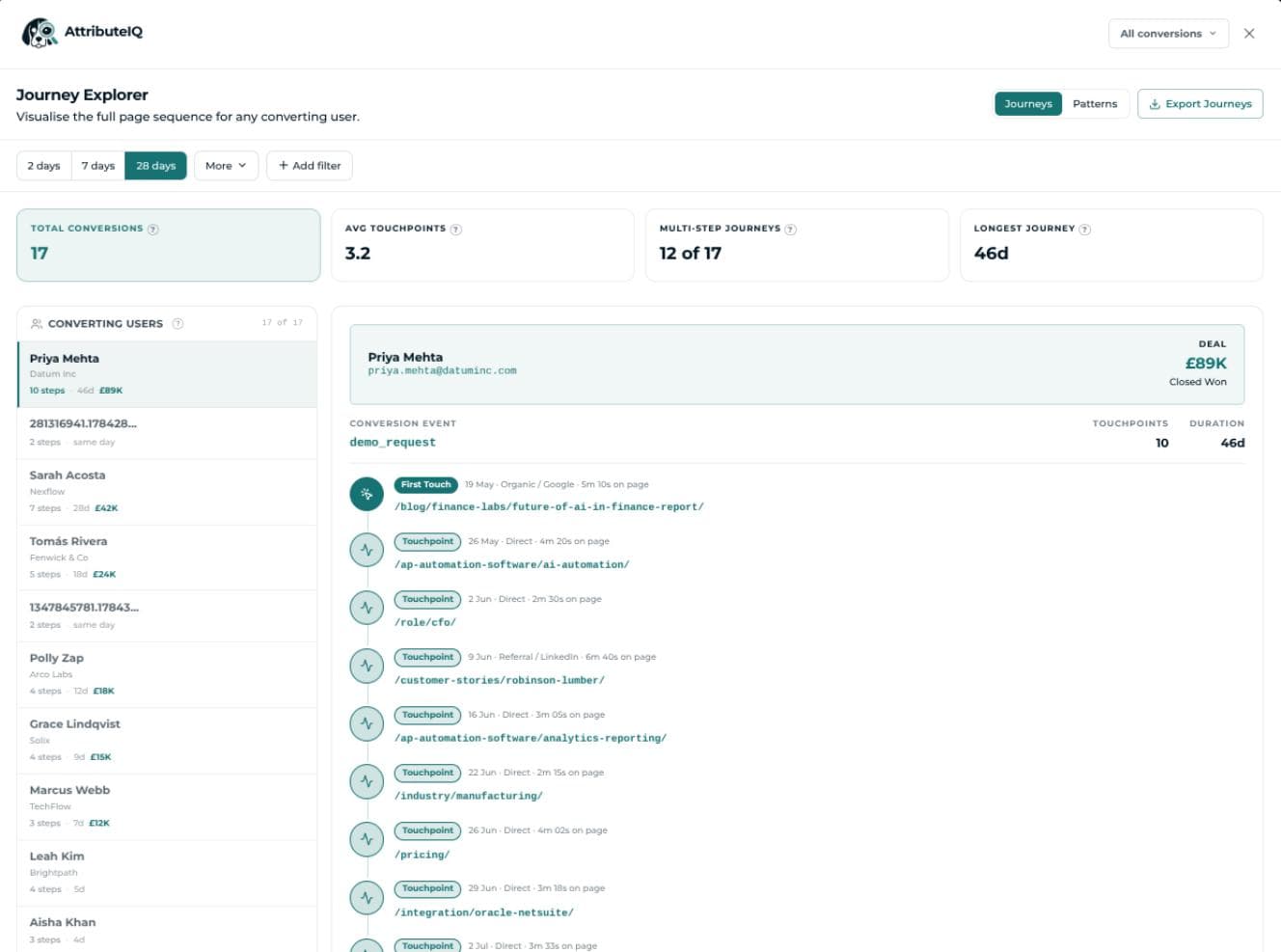
That means you can check the result for yourself. If a piece of content is shown as influencing a deal, you can see that interaction in the journey and understand where it sits in the path to conversion.
Can we customise the attribution model around our sales cycle?
Why it matters
A six-week sales process and a nine-month enterprise buying cycle should not necessarily be analysed in exactly the same way. The same applies to businesses with multiple conversion points, long periods of anonymous research, or several people involved in one deal.
I would ask vendors which parts of the attribution methodology you can configure and which are fixed by the platform.
AttributeIQ’s Approach
AttributeIQ does not let users rewrite the weighting logic of the attribution models themselves. Instead, the platform is configured around the conversion events, HubSpot deal data and reporting structure that reflect your actual sales process.
If you need a completely bespoke weighting model built around your own statistical assumptions, AttributeIQ is not designed for that. If you need attribution connected to your actual pipeline and customer journey without building your own model, the standard models cover that use case.
How does the platform handle multiple products, brands or business entities?
Why it matters
If several products or brands share the same attribution platform, I want to know whether their data can be kept separate. A blended report across unrelated products can make marketing performance difficult to interpret, particularly when different teams own different parts of the business.
The RFP should establish whether separation happens at the property, account or reporting level, and whether users can be restricted to the data relevant to their product or business unit.
AttributeIQ’s Structure
AttributeIQ separates attribution environments at the GA4 property level. Each GA4 property has its own attribution data and reporting, so businesses running separate properties for different brands, products or entities do not have to combine them into one reporting environment.
Access can then be assigned at the property level, with different user roles controlling what each person can view or manage.
So, for example, a business running separate GA4 properties for three brands can keep the attribution reporting for each separate while giving the relevant teams access to the property they manage.
Data Accuracy and Identity Resolution Questions for MTA Vendors
This is where I would start challenging the attribution data itself. Getting GA4 and HubSpot connected is one thing; being able to reliably join the activity between them is another. If important parts of the customer journey cannot be matched to the right person or deal, even a well-designed attribution model will be working with an incomplete picture.
How does the platform match anonymous website visitors to known contacts?
Why it matters
A prospect can spend weeks reading your content before they ever fill in a form. If that earlier activity cannot be connected to the contact they eventually become, you lose the evidence of what influenced them before they entered your CRM.
AttributeIQ’s Identity Matching
AttributeIQ stores the GA4 client ID against the HubSpot contact once a visitor becomes known. From that point, everything they did anonymously under that client ID, earlier sessions, page views, content they read, gets linked to the contact and, from there, to the deal.
Anonymous visit
GA4 client ID
Fills a form
Visitor converts
HubSpot contact
ID written back
ID stored on contact
AttributeIQ
Journey merges
Full journey visible
Deal record
The practical benefit is: the journey does not suddenly begin when someone fills out a form. Earlier visits, page views and content interactions can remain part of the attribution picture.
How does the platform handle duplicate touchpoints across sessions and devices?
Why it matters
A prospect rarely converts on their first visit. They may come back five or ten times, read different pieces of content, and use several devices before becoming a lead.
The RFP should establish whether the platform can connect those interactions, because otherwise the report can understate the activity that happened before the prospect converted.
AttributeIQ’s Approach
Once AttributeIQ can connect a visitor to a HubSpot contact, it can bring the relevant GA4 sessions together around that contact. That means a prospect who visits your site several times before converting does not have to start a new journey every time they return. Their earlier website activity can be carried through to the contact and the deal.
What AttributeIQ can’t do is identify anonymous people across devices before they’re known, GA4 simply doesn't give us enough to make that connection reliably. But once there’s a HubSpot contact to anchor the journey to, the matching gets much more solid.
How does the platform handle offline touchpoints such as calls, events and sales activity?
Why it matters
A B2B buying journey does not stop at the website. A prospect might read your content, attend an event, speak to a salesperson and then come back to the site before becoming an opportunity. I would want the RFP to establish whether those offline interactions can sit alongside the digital journey, rather than leaving a large part of the buying process outside the attribution picture.
AttributeIQ’s Approach
AttributeIQ uses HubSpot contact and deal data alongside GA4 activity, so sales activity already recorded in HubSpot can be considered alongside the website journey. The only limitation is: if a call was never logged, an event was never recorded, or important activity lives in another system, there is no reliable data for AttributeIQ to use. That is why I would check the quality and coverage of the CRM data before judging the completeness of the attribution report.
How can we identify gaps in the customer journey?
Why it matters
If a large share of website activity cannot be connected to contacts, or deals are missing the marketing activity that led to them, that should be obvious in the reporting rather than hidden behind a clean-looking attribution number.
AttributeIQ’s Approach
AttributeIQ only attributes activity that it can actually connect across GA4 and HubSpot. Where a visitor, touchpoint or deal cannot be reliably matched, it is not filled in with an assumption or presented as known.
Reporting, Dashboards, and Pipeline Visibility Questions for MTA Vendors
Once the data and methodology are sound, I want to know whether the reporting is actually useful for the decisions the business needs to make. A technically strong multi-touch attribution platform is not much use if the CMO cannot see where pipeline is coming from, the team cannot investigate the numbers, or the reports take hours to turn into something leadership can understand.
Can reports be filtered by pipeline stage or deal value?
Why it matters
A channel or piece of content can look strong across the entire pipeline and tell a very different story when you isolate qualified opportunities, closed revenue, or larger deals. I would want to see whether the platform can get beyond the blended number and let me analyse the parts of the pipeline that actually matter to the business.
AttributeIQ’s Pipeline Reporting
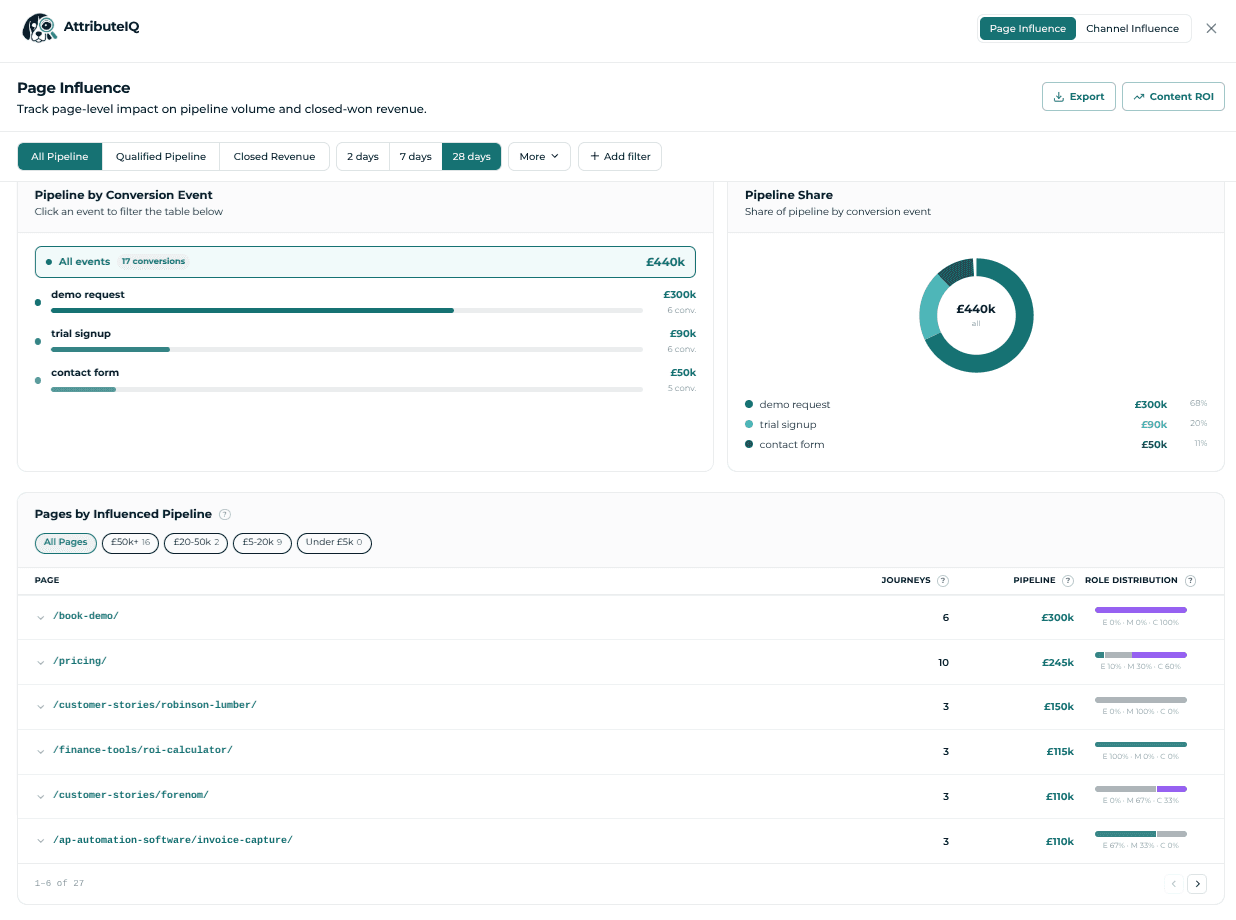
AttributeIQ pulls directly from HubSpot deal data, so you can break attribution down by stage, from all pipeline through to qualified and closed revenue. That’s what tells you if a channel is genuinely converting or just generating early-stage noise that never progresses.
How far back does historical data go once we connect our sources?
Why it matters
I would ask this before assuming you can use the platform to compare this quarter with what happened a year ago. Some attribution platforms can work with historical data already sitting in your systems; others only start building the attribution picture once they are connected.
AttributeIQ’s Historical Data
AttributeIQ does not provide retroactive attribution. The attribution journey starts once GA4 and HubSpot are connected and the platform begins collecting the relevant data. That means you should not expect AttributeIQ to reconstruct attribution for deals that happened before the connection date.
Can non-technical stakeholders understand the reports without training?
Why it matters
I care about this because attribution is ultimately there to support decisions, not just produce another marketing dashboard. The report needs to make sense to the person deciding whether to increase, reduce or move the budget.
AttributeIQ’s Reporting
AttributeIQ’s Board Summary is designed to give leadership a simpler view of attribution and pipeline performance, with PPTX export so the findings can be taken into a board or leadership meeting without rebuilding the report manually.
For day-to-day questions, AttributeIQ also supports Claude MCP, so instead of navigating a dashboard to find an answer, someone can just ask “which content drove the most closed revenue last quarter” in plain language and get a direct answer.
Can we export attribution data into our own BI and reporting tools?
Why it matters
I would not want the vendor dashboard to become the only place the business can use its attribution data. Marketing may need to take channel performance into a budget review, content teams may want to analyse content ROI, and leadership may want a board-ready view without rebuilding everything manually.
AttributeIQ’s Export Options
AttributeIQ has several export options depending on what you are trying to take out of the platform. That includes dedicated Content ROI and Channel ROI exports, Board Summary exports, and export options within other reporting features.
Can we compare attribution results over time?
Why it matters
A useful attribution platform should help you understand change, not just show a snapshot of where things stand today. If organic influence is climbing, paid influence is falling, or a piece of content is starting to show up in more high-value journeys, I want to see that shift clearly enough to connect it back to an actual marketing decision.
AttributeIQ’s Reporting
AttributeIQ reports across channels, pages and pipeline, so teams can compare how marketing activity contributes over whatever reporting periods are available.
One thing worth flagging: Attribution doesn’t work retroactively, so comparisons only become meaningful once data has been collecting consistently for a while. I’d get the historical start date from any vendor early, rather than assume they can hand you a clean multi-year trend from day one.
Implementation, Onboarding, and Time-to-Value Questions for MTA Vendors
A platform can look impressive, but the real test is what happens after the contract is signed: how much work sits on your team, how quickly useful data appears, and whether the setup creates confidence in the numbers or another reporting project to manage.
What’s the realistic timeline from contract signature to first usable report?
Why it matters
A lot of attribution projects get delayed because the timeline discussed during sales does not match the reality of connecting systems, cleaning data and validating the first reports.
I would separate the platform timeline from the business readiness timeline. A vendor may be able to connect your accounts quickly, but that does not mean the resulting attribution data is immediately ready to influence budget decisions.
AttributeIQ’s Setup Timeline
Once GA4 and HubSpot are connected, AttributeIQ can begin processing data and initial reporting becomes available within 24 hours.
The bigger variable is the quality of the data coming in. If UTM tracking is inconsistent, important HubSpot fields are incomplete, or deals are not linked correctly to contacts, those issues will affect the quality of the reporting regardless of the attribution platform being used.
What internal resources will our team need to provide?
Why it matters
Rollouts stall for boring reasons more often than technical ones, usually because nobody assigned the admin access or the CRM cleanup work before the kickoff call happened.
AttributeIQ’s Requirements
The initial setup requires someone with the correct permissions for GA4 and HubSpot to approve the connection.
Pricing, Contract, and Scalability Questions for MTA Software Vendors
I would leave pricing until the technical fit is clear. There is little point negotiating a good price for a platform that cannot handle your data or answer the questions that matter.
How does pricing scale as our marketing activity grows?
Why it matters
Some platforms charge based on contacts, sessions, events or other usage metrics, so the cost can rise simply because the business is getting more traffic or generating more data.
That can make pricing difficult to forecast, particularly for a growing marketing team.
AttributeIQ’s Pricing
AttributeIQ uses three pricing tiers based on property access and feature availability rather than charging more as your session or contact volume increases.
Are there overage fees, and what triggers them?
Why it matters
Overage clauses buried in a contract are one of the more common sources of billing disputes in SaaS procurement, and they’re easy to miss when you’re focused on the headline price.
AttributeIQ’s Overage Policy
Pricing is set by tier and property access, not metered by session or event volume, so there’s no overage line item that shows up as a surprise on a growth month. If your evaluation checklist includes a hard “no usage-based surcharges“ requirement, that’s a box AttributeIQ ticks by design.
What’s the contract length, and what happens if we decide to leave?
Why it matters
I would be cautious about signing a long contract before the platform has been tested against your actual data. You can learn a lot from a demo, but you cannot properly validate the quality of your attribution until the platform is connected to the systems that contain your real customer journeys.
AttributeIQ’s Contract Terms
AttributeIQ is available on monthly billing, so you do not need to commit to a long-term contract to get started. There is also an annual billing option with a discount for organisations that are comfortable making a longer commitment.
For an RFP, I would still ask vendors to put the notice period, cancellation terms, renewal terms and any annual commitment requirements in writing rather than relying on what was discussed during the sales process.
Is the trial long enough to validate the platform against real data?
Why it matters
I would be cautious about any attribution platform that asks you to commit before you have had a chance to test it against your own data. Some SaaS vendors do not offer trials because the product needs implementation, onboarding or a sales-led setup before it can show useful results.
That is not automatically a red flag, but it does mean you need another way to validate the platform before signing a long-term contract.
AttributeIQ’s Trial
AttributeIQ offers a 14-day free trial, which gives you enough time to connect your GA4 and HubSpot data and check that the platform is working with actual customer journeys.
Security, Compliance, and Data Ownership Questions for MTA Vendors
Security questions tend to arrive late in the buying process, usually when IT or procurement gets involved and starts asking where the data lives, who controls it, and what happens when the contract ends. I would get those answers before the shortlist is finalised, because a platform can be a perfect marketing fit and still fail the security review.
Who owns the data once it is in the platform?
Why it matters
I would want this answered in plain English. Your attribution vendor is processing your marketing, customer and revenue data, but that does not mean it should become the owner of it. The contract should make clear what the vendor can do with your data, what you can export, and whether the vendor can use it for anything beyond providing the service.
AttributeIQ’s Data Ownership
Your GA4 and HubSpot data remains yours. AttributeIQ connects to those systems to analyse the data and produce attribution reporting; it does not replace them as your systems of record or claim ownership of the underlying customer and revenue data.
What happens to our data if we cancel?
Why it matters
Cancellation should not create a second problem. I would want to know what happens to the data you supplied, what happens to the reports and attribution history built inside the platform, and what you can take with you before the account is closed.
AttributeIQ’s Approach
Your underlying GA4 and HubSpot data remains in those systems because AttributeIQ does not become the primary home for it. If you cancel, you can also export your attribution data and reports from AttributeIQ rather than leaving that history behind.
Is the platform GDPR/CCPA compliant, and where is data hosted?
Why it matters
This isn’t optional for most procurement teams, and a vague or evasive answer here can single-handedly stall or kill a deal that was otherwise a strong fit.
AttributeIQ’s Compliance
AttributeIQ uses Supabase and BigQuery infrastructure and is designed with GDPR requirements in mind. If your organisation has specific requirements around data residency, subprocessors or data-processing agreements, ask us directly.
Vendor Support and Long-Term Viability Questions for MTA Vendors
Support is easy to ignore when you are comparing demos and features. It matters a lot more six months later, when something breaks, the team needs an answer, or you are deciding whether the platform is still keeping pace with the business.
What does support actually look like after onboarding?
Why it matters
Support becomes much more important once the platform is part of your regular reporting. If a sync fails, a journey looks incomplete, or your team cannot explain a result, waiting several days for a generic support response is not particularly useful. I would want to know who you can actually reach, how issues are handled, and whether the person responding understands the product well enough to investigate the underlying data.
AttributeIQ’s Support
At AttributeIQ’s current stage, customers can reach the founder directly rather than going through multiple support tiers. That gives customers a direct line to someone who understands the product and can deal with questions without passing them between teams.
There is also an AttributeIQ community where customers can connect, ask questions and share ideas with other users. So support is not limited to a private ticket or email thread; there is also a shared space for product questions and discussion.
How active is the product roadmap, and how often does the vendor ship?
Why it matters
A product can look like a strong fit during procurement and still become a poor fit if development slows down after you sign. I would look at what the vendor has actually shipped recently, how regularly meaningful improvements appear, and whether those changes reflect real customer needs rather than minor feature releases dressed up as progress.
AttributeIQ’s Product Development
Frequently. Recent shipped work includes Stripe billing, team-based access controls, Slack attribution summaries, and Claude MCP, all delivered in relatively close succession, which reflects an actively maintained product rather than one coasting on its initial build.
what to avoid
Taking “we ship constantly” as a self-reported claim with nothing behind it. Ask to see the actual changelog or recent release history from any vendor, not a marketing summary of it.
How long has the vendor been operating, and who is the platform actually built for?
Why it matters
Vendor maturity matters, but so does fit. A large, established platform may give you more resources and a longer track record, while a younger product may be much more focused on the problem you are actually trying to solve. I would want to know which trade-off I am making.
AttributeIQ’s Market Fit
AttributeIQ is an early-stage product, founded out of direct frustration running a B2B SEO agency and being unable to prove which content and channels actually drove closed deals for clients.
Complete RFP Checklist for Evaluating Multi-Touch Attribution Software Vendors
Buying multi-touch attribution software should not come down to which vendor gives the best demo. Use this 30+ question RFP checklist to put every vendor to the same test, from data and integrations to attribution, reporting, pricing, security and support.
The Full RFP Checklist: 31 Questions
0/31
- ✓Which CRMs and ad platforms does the integration support natively?
- ✓What data does each native integration actually sync?
- ✓Is the integration one-way or bi-directional?
- ✓How frequently does data sync between connected systems?
- ✓Can we connect custom data sources or APIs that aren’t natively supported?
- ✓Which attribution models are supported?
- ✓How exactly does the platform calculate attribution credit?
- ✓Can we see the touchpoints behind an attribution result?
- ✓Can we customise the attribution model around our sales cycle?
- ✓How does the platform handle multiple products, brands or business entities?
- ✓How does the platform match anonymous website visitors to known contacts?
- ✓How does the platform handle duplicate touchpoints across sessions and devices?
- ✓How does the platform handle offline touchpoints such as calls, events and sales activity?
- ✓How can we identify gaps in the customer journey?
- ✓Can reports be filtered by pipeline stage or deal value?
- ✓How far back does historical data go once we connect our sources?
- ✓Can non-technical stakeholders understand the reports without training?
- ✓Can we export attribution data into our own BI and reporting tools?
- ✓Can we compare attribution results over time?
- ✓What’s the realistic timeline from contract signature to first usable report?
- ✓What internal resources will our team need to provide?
- ✓How does pricing scale as our marketing activity grows?
- ✓Are there overage fees, and what triggers them?
- ✓What’s the contract length, and what happens if we decide to leave?
- ✓Is the trial long enough to validate the platform against real data?
- ✓Who owns the data once it is in the platform?
- ✓What happens to our data if we cancel?
- ✓Is the platform GDPR/CCPA compliant, and where is data hosted?
- ✓What does support actually look like after onboarding?
- ✓How active is the product roadmap, and how often does the vendor ship?
- ✓How long has the vendor been operating, and who is the platform actually built for?
You now have the questions to ask, the areas to evaluate, and the red flags to watch for. The next step is simple: put the checklist into practice, compare the vendors, and if AttributeIQ looks like the right fit, try it with your own data. Start your 14-day free trial →