The best GA4 alternatives in 2026 are AttributeIQ for B2B pipeline and revenue attribution, Fibbler for LinkedIn attribution, Ruler Analytics for calls and offline conversions, Factors.ai for account-based marketing and buyer intent, and Usermaven for privacy-focused website and product analytics.
Why B2B Teams OutGrow GA4 for Pipeline and Revenue Reporting
GA4 is great for understanding website activity, but B2B teams eventually need answers it wasn’t built to provide. What happens after a lead converts? Which accounts are actually behind the activity? And which touchpoints influenced the revenue that followed?
The examples below show where GA4 starts to fall short.
1. Visibility Ends When the Lead Leaves Your Website
GA4 can tell you someone converts, but not the sales process that follows. Once someone submits a form, you lose visibility into whether they become an SQL, enter an opportunity, move through the pipeline, or eventually become a customer.
As one B2B marketer on r/GoogleAnalytics put it:
“I can track which channel provides me a majority of leads, but I can’t understand the numbers after.” — Reddit
2. Aggregate Data Doesn’t Show the Account Behind the Conversion
You can see traffic and conversions at the website level, but you can’t tell whether that activity came from a target enterprise account, an existing customer, or an unqualified lead. For B2B teams, that account context is essential when evaluating the value of a conversion.
As one marketer on r/MarketingAnalytics put it:
“GA4 and GSC will slowly take a back seat if your company will be B2B and it’s much more important to know the full marketing and sales funnel... Blending GA4 data with customer data will be the sweet spot.” — Reddit
3. Attribution Gets Difficult to Configure and Defend
GA4’s event-based reporting and data-driven attribution can make longer B2B journeys difficult to analyse. Answering questions about pipeline influence often means building custom reports and stitching together data from different sources.
As one Google Ads manager on r/PPC noted:
“The algorithm is a black box and you cannot audit the logic. Cross reference with your actual revenue in Shopify or your CRM... that is the only number worth trusting right now.” — Reddit
Top 5 GA4 Alternatives for Pipeline and Revenue Attribution
If your goal is pipeline and revenue attribution rather than website analytics alone, there are better-suited GA4 alternatives for B2B. Here are five tools worth considering, from focused attribution platforms to broader revenue intelligence solutions.
1. AttributeIQ
Property
Attribution
Account
jent@nexa.com

Page Influence
Track page-level impact on pipeline volume and closed-won revenue performance.
Total Pipeline
£40.80k
Total Journeys
22
Top High-Value Page
/b2b-sales-lead-scoring
Most Balanced Page
/sales-rep-onboarding
Pipeline by Conversion Event
All pipeline · click an event to filter the journeys below
Pipeline Share
Share of pipeline by conversion event
£40.80k
Pages by Influenced Pipeline
Why AttributeIQ Is a Good GA4 Alternative
GA4 gives you detailed data on what happens across your site, but it stops short of connecting that activity to pipeline outcomes. For B2B teams with multiple marketing touchpoints and longer sales cycles, that leaves a gap between website analytics and revenue reporting.
AttributeIQ connects GA4 activity with HubSpot contacts, opportunities, and revenue, so you can see which channels, pages, and campaigns shaped the buyer journey and influenced deals. It also tracks post-conversion engagement, including repeat visits and high-value page activity, giving marketing and sales a clearer view of which contacts are actively engaging. Pricing starts at £149/month, with usable attribution data typically available within 24–48 hours.
Core Features
Journey Explorer gives you a timeline for every converting contact: which pages they visited, in what order, from which channel, with time-on-page for each. You can see that Daniel at Orbitly found your attribution guide via organic search on March 19th, came back through LinkedIn four days later to read a case study, then hit pricing directly before requesting a demo on March 24th.
Board Summary pulls page and channel attribution into one clean, exportable report. Instead of pulling numbers from GA4, HubSpot, and a spreadsheet and stitching them into a deck by hand, you get a clear view of which marketing activity influenced pipeline and revenue, ready to export as a PPTX for your next board meeting.
Property
Attribution
Management
Account
jane@nexa.com
Board Summary
Export a board-ready summary of marketing’s influence on pipeline and revenue.
Q2 2026 · Board Summary · 1 Apr 2026 – 30 Jun 2026
Qualified Pipeline
£4.1M
from 47 contacts
Total Revenue
£1.27M
from 14 closed deals
Avg Closed Deal
£90.7k
from 14 closed deals
Top Account
Nexa
£340k influenced
Buyer Intent Tracking adds real-time intent signals on top of your attribution data. You can set alert rules so that the moment a known HubSpot contact visits a high-intent page, like pricing for the third time, or a case study the night before a renewal, you get a Slack notification right away, no dedicated admin required to build or maintain the rule.
Pricing Structure
AttributeIQ offers simple flat monthly pricing across three tiers: Starter, Pro, and Agency. Every plan includes a 14-day free trial with no credit card required, allowing teams to evaluate attribution capabilities before committing. Full pricing breakdown →
See which channels and content influence pipeline and revenue
AttributeIQ connects every buyer touchpoint to closed-won deals, giving marketing teams full visibility into what’s actually driving pipeline and revenue.
2. Fibbler
Why Fibbler Is a Good GA4 Alternative
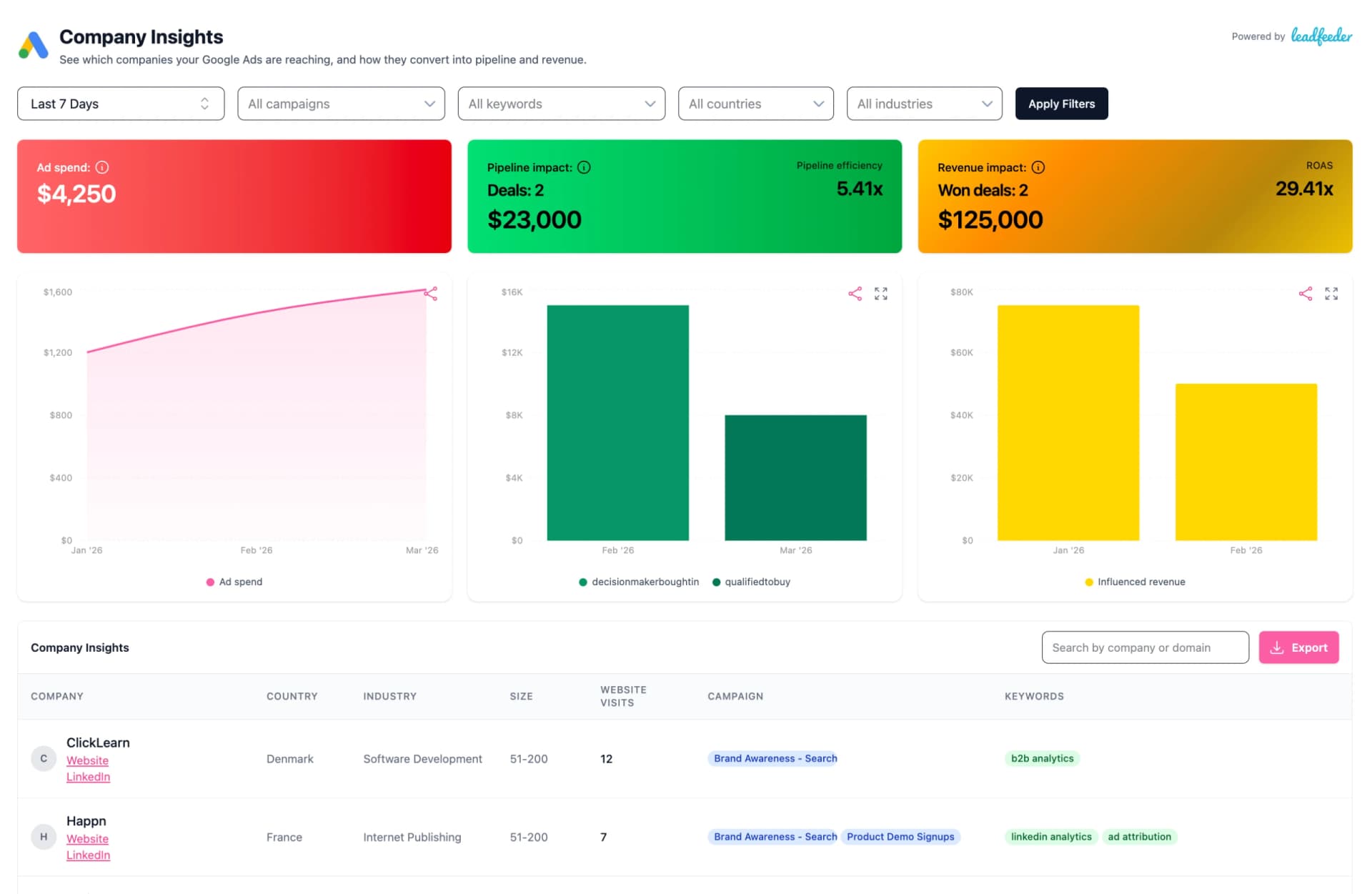
GA4 reports LinkedIn as a referral source at best, with no view-through data and no way to connect ad exposure to closed-won revenue at the account level. If LinkedIn is where most of your paid budget and pipeline actually comes from, that gap works against you. Fibbler exists specifically to answer that narrower, higher-stakes question.
Key Strengths
- Company-level LinkedIn engagement tracking: Measures which accounts viewed your ads, how often they engaged, and then connects that activity to closed-won deals.
- Customer journey timelines: Shows the full LinkedIn activity sequence for each account leading up to deal creation, including paid and organic touchpoints.
- Lift analysis: Compares close rate, ACV, and sales cycle length between LinkedIn-touched deals and untouched deals, so you can quantify channel impact.
- Native CRM sync: Integrates with HubSpot, Salesforce, Attio, and Pipedrive, with Clay, Slack, and Zapier support for routing account signals into outbound workflows.
Pricing
Fibbler starts at $89/month (Growth plan) and goes up to $159/month (Agency). Google Ads attribution is available as a separate add-on at $59/month. All plans include a 30-day free trial with no credit card required.
3. Ruler Analytics
Why Ruler Analytics Is a Good GA4 Alternative
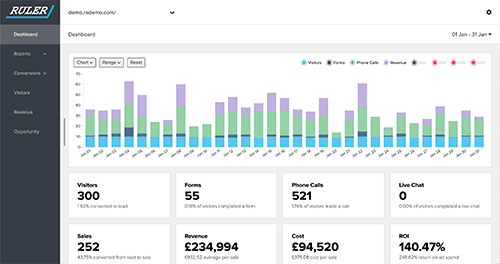
GA4 only sees digital interactions, and even then it can’t collect personally identifiable information, so a converting visitor stays anonymous. For businesses where qualified leads still convert through phone conversations, Ruler Analytics fills both gaps, attributing inbound calls back to the marketing source that generated them and syncing named outcomes into HubSpot or Salesforce.
Key Strengths
- Call tracking via dynamic number insertion: Attributes inbound phone leads to the channel and campaign that drove them, with call recordings and missed call alerts for faster sales follow-up.
- Multiple attribution models: Supports first-click, last-click, linear, and W-shaped models, with marketing mix modelling to capture offline and impression-based contribution.
- CRM writeback: Pushes revenue data into HubSpot, Salesforce, and other connected CRMs, attaching campaign and channel history to each contact and opportunity.
- Broad integrations: Connects with 1,000+ tools through Zapier, Webhooks, and SQL, with native support for Google Analytics, Google Ads, Bing Ads, Facebook Ads, LinkedIn, and Looker.
Pricing
Ruler Analytics pricing is tiered by monthly website traffic. The Small Business plan starts at £199/month for up to 5,000 visits, with Medium Business at £649/month (50,000 visits) and Large Business at £1,149/month (100,000 visits). Annual billing carries a roughly 10% discount. There is no free tier, but it layers directly on top of your existing GA4 setup rather than replacing it.
4. Factors.ai
Why Factors.ai Is a Good GA4 Alternative
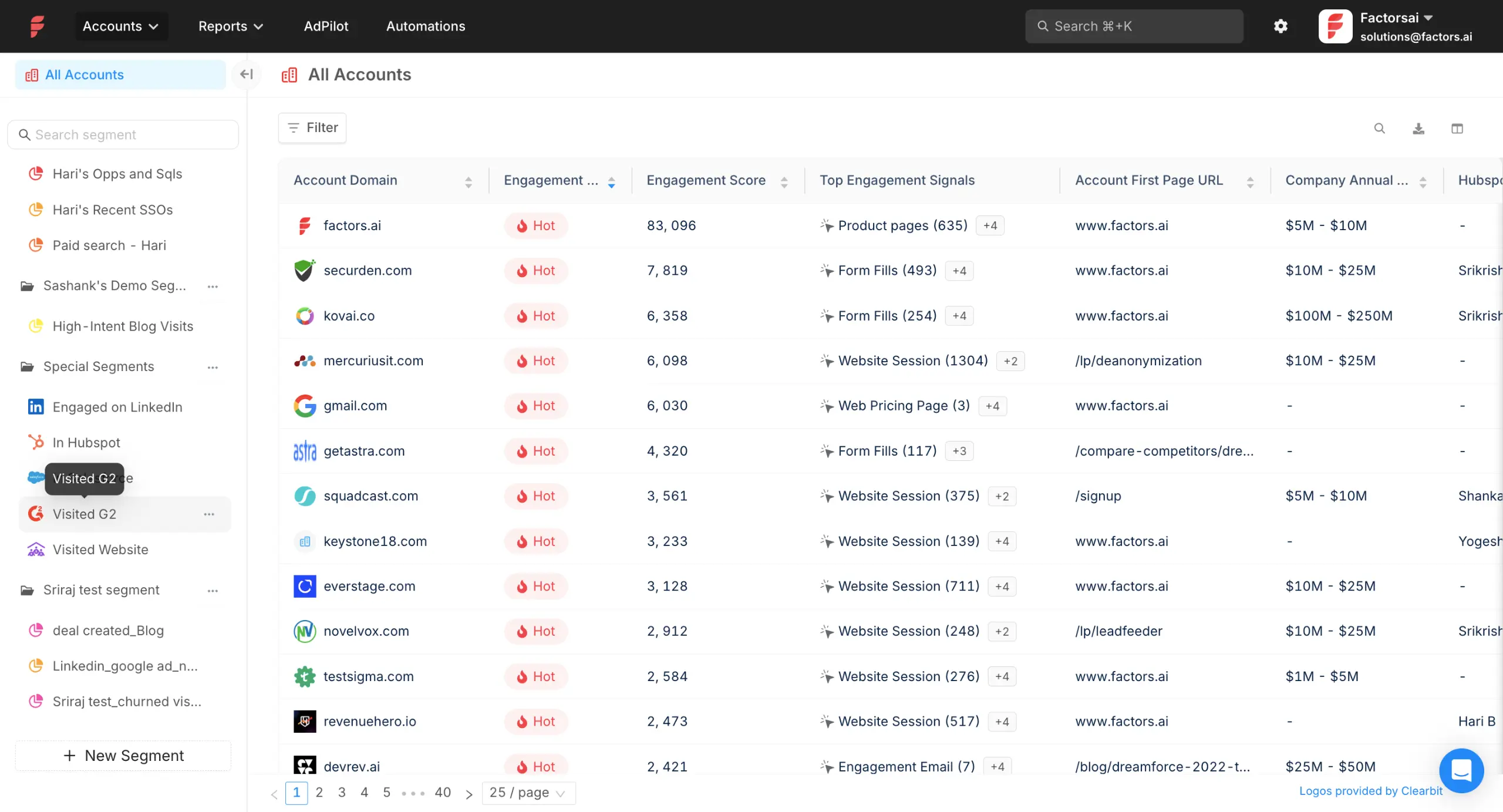
For ABM teams, GA4’s aggregate reporting is the exact opposite of what’s needed: identifying which specific accounts are showing buying intent before an opportunity even exists. Factors.ai extends beyond basic analytics by combining account-level journeys with intent data, enabling teams to detect active demand signals and trigger targeted engagement earlier in the sales cycle.
Key Strengths
- Website visitor identification: De-anonymises company-level traffic in real time, showing which organisations are on your site and which pages they are viewing before they ever convert.
- Buyer intent data: Pulls signals from G2, Bombora, and third-party sources, then combines them with first-party engagement to prioritise accounts actively researching a solution.
- AdPilot workflows: Pushes high-intent account lists into LinkedIn and Google Ads for retargeting, closing the loop between account intelligence and paid media execution.
- Native CRM sync: Integrates with Salesforce, HubSpot, Marketo, Pardot, and Outreach, with Slack alerts and workflow automation so sales teams act on high-intent signals without checking another dashboard.
Pricing
Factors.ai starts at $399/month for the Basic plan covering account identification. Multi-touch attribution and LinkedIn AdPilot sit behind higher tiers and paid add-ons, with a fully-loaded Growth setup running $2,000+/month depending on configuration. A free plan is available for basic website visitor identification. Annual contracts are standard.
5. Usermaven
Why Usermaven Is a Good GA4 Alternative
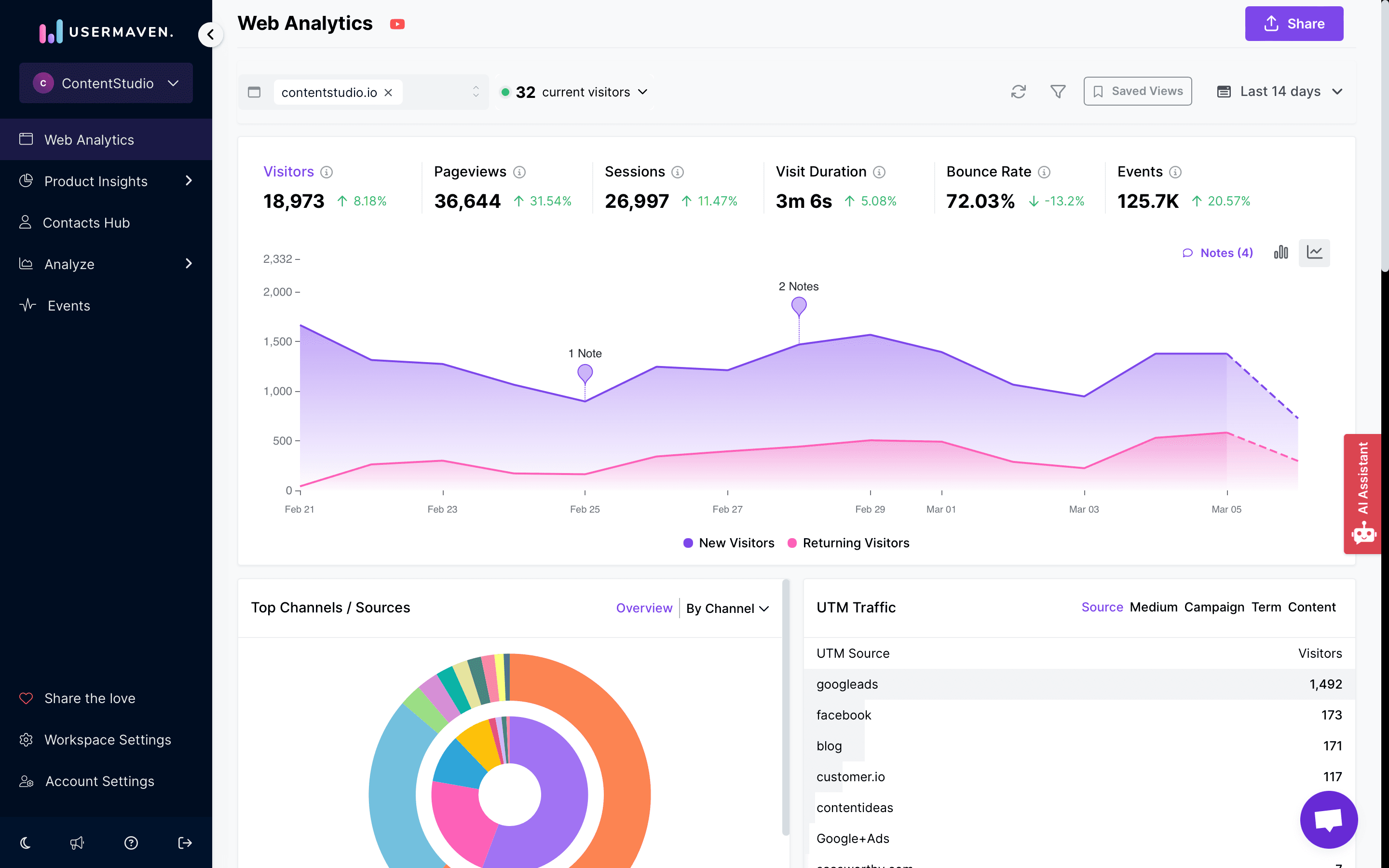
GA4 uses first-party cookies to identify users and sessions, but consent restrictions can prevent them from being stored, leaving gaps in the data available for measurement. Usermaven offers cookieless tracking, using fingerprinting rather than traditional cookies to identify visitors.
Key Strengths
- Cookieless tracking: Uses first-party data to deliver more reliable traffic and conversion data, especially in privacy-heavy environments and on iOS, where GA4 loses signal.
- Multiple attribution models: Offers seven models on the Scale plan, including first-touch, last-touch, linear, time-decay, U-shaped, W-shaped, and full-path, well beyond GA4’s default options.
- Product and website analytics: Combines acquisition and in-product behaviour in one interface, so SaaS teams do not have to stitch together separate tools.
- Unlimited seats: Gives every stakeholder access on paid plans without per-user cost pressure or licence negotiation.
Pricing
Usermaven has a free Starter plan (25,000 events/month). Paid plans start at $84/month (Growth) for website and product analytics, with the Scale plan at $199/month adding multi-touch attribution and ad integrations. All paid plans include unlimited users and a 14-day free trial.
How to Choose the Right GA4 Alternative for Marketing Attribution in 2026
You’ve just seen five of the strongest tools for filling the pipeline and revenue gap GA4 leaves open. Here’s how to actually choose the right one for your team, most of these sit on top of GA4 rather than replacing it outright.
Is your primary question about content performance or account intelligence?
- Content & pipeline performance: AttributeIQ or Usermaven are purpose-built for this, both trace which pages and channels influence pipeline and revenue.
- Account-level intent & ABM: Factors.ai is the closer fit. It layers real-time buyer intent and account identification on top of your traffic data.
Do you have meaningful offline conversions?
- Phone calls & offline conversions: Ruler Analytics is the only platform in this set built to attribute inbound calls back to their marketing source.
- Fully digital funnel: Ruler’s core differentiator doesn’t apply, focus on AttributeIQ, Fibbler, or Usermaven instead.
How reliant is your reporting on individual-level or company-level data?
Most site analytics only tells you that a conversion happened. If your team needs to know which named account is engaging, not just how many, that’s the gap to close first.
- Need named contacts and accounts: AttributeIQ and Factors.ai both de-anonymise activity down to the contact or company level, using your existing HubSpot data.
- Aggregate trends are enough: Any tool on this list works, though Usermaven is the lightest lift if aggregate reporting is really all you need.
Do you need attribution within days or weeks?
Because these tools plug into your CRM rather than replacing your tracking setup from scratch, most turn on far faster than a full attribution migration.
- Immediate (24–48 hours): AttributeIQ, Usermaven, and Fibbler produce usable attribution views within 24 to 48 hours of connecting your accounts.
- Short-term (1–2 weeks): Ruler Analytics typically takes 1 to 2 weeks to get call and offline tracking fully configured.
- Weeks to months: Factors.ai sits in the middle, faster to start than a data warehouse build but slower than the immediate-tier tools, depending on account-intent complexity.
Frequently Asked Questions
There’s no reason to throw out GA4 just because it doesn’t answer your revenue questions. Keep it for website analytics. Add the missing layer when you need to connect website activity to contacts, opportunities, pipeline, and closed-won deals.
For B2B teams using HubSpot, AttributeIQ does exactly that. It connects the GA4 data you already have with CRM outcomes, then shows the channels, pages, campaigns, and buyer journeys behind your pipeline. You can get started in 24–48 hours rather than spending months rebuilding your reporting infrastructure. Start your 14-day free trial here.