- •Bizible pricing is not published. Based on procurement data, contracts typically start at $20,000–$35,000/year for a single Salesforce + Marketo instance, rising to $35,000–$65,000/year for mid-market teams and $75,000–$150,000+/year once bundled into an Adobe Marketo Engage enterprise package. All plans go through a sales call, there is no self-serve pricing or free tier.
- •Realistic first-year TCO runs well above the quoted platform fee once Salesforce administration, campaign architecture, and internal validation are factored in.
- •Teams not standardised on Salesforce and Marketo often find better ROI in affordable alternatives like AttributeIQ, which starts at £149/month for revenue attribution, includes a 14-day free trial, and has no annual contract.
How Much Does Bizible Cost in 2026?
Bizible pricing is estimated to start at around $20,000 per year and can exceed $150,000+ annually, depending on CRM complexity, data volume, integrations, and whether it is purchased standalone or as part of Adobe Marketo Engage. Adobe does not publish official Bizible pricing, so all quotes are provided through an Adobe sales process.
Based on third-party procurement data and Adobe’s documented feature tiers, estimated annual costs typically fall into these ranges:
Note: The tier breakdown above is our estimate, based on third-party procurement research and Adobe’s documented Marketo Measure Ultimate features. Treat these figures as directional, not confirmed Adobe pricing.
Beyond the Subscription: Bizible First-Year Total Cost of Ownership
When budgeting for Bizible pricing, the software subscription fee represents only part of your first-year investment. Because Bizible operates as a native Salesforce package rather than an independent attribution layer, much of the implementation effort shifts into Salesforce administration, campaign architecture, data governance, and ongoing validation of attribution outputs.
Additional Cost Factors to Budget For:
- •Implementation & Onboarding: Standard Bizible implementations run four to eight weeks, although complex Salesforce environments involving custom lifecycle stages, account-based marketing programmes, or multiple business units can extend deployment into a multi-month project.
- •Reporting Ramp-Up Time: Teams typically spend several reporting cycles validating touchpoint creation, campaign tracking, form attribution, and opportunity influence against existing Salesforce reports before trusting the numbers.
- •CRM Data Cleanup: Bizible’s attribution model is tightly connected to Salesforce records, so output quality depends heavily on lead, contact, campaign, and opportunity data consistency. Duplicate records or incomplete lifecycle tracking require internal clean-up before the platform yields reliable numbers.
Illustrative First-Year Total Cost of Ownership
Takeaway: For most organisations, the real-world first-year investment ends up considerably higher than the quoted Bizible platform fee once Salesforce admin time and validation cycles are included.
Bizible Pricing Reviews: Common Complaints About Cost and ROI
Bizible (now officially known as Adobe Marketo Measure) is a powerful attribution platform for enterprise teams running complex Salesforce and Marketo environments. However, smaller and mid-market organisations frequently struggle to justify its Total Cost of Ownership (TCO).
Based on verified reviews across G2, independent research, and community discussions on Reddit, buyer frustration centers on the size of the initial commitment, the heavy implementation overhead, and its steep reliance on pristine CRM data.
1. Enterprise-Level Pricing and High Upfront Costs
Because Bizible is positioned at the top of Adobe’s enterprise suite, the financial commitment scales with the size of your marketing database and typically starts well into the five figures. For smaller and mid-market teams, that scale of investment is a tough pill to swallow, especially if it arrives bundled into a broader Marketo Engage contract rather than as a standalone line item.
What the research says:
“Marketo Measure can display the entire journey that lead to an oppty being created... but it’s expensive and requires you to have Marketo.” — Reddit User (r/salesforce)
2. The Implementation Tax and “Steep Learning Curve”
Buying Bizible is only the first financial hurdle. Configuring it requires a serious investment of internal time. Reviewers consistently flag that standing up the platform is far more complex than deploying a typical marketing analytics tool, a major bottleneck for teams lacking dedicated RevOps or Salesforce admin resources.
What the research says:
“Implementation was difficult, verification of data was difficult. Always finding issues where certain submissions aren’t showing up in the app or touchpoint.” — Verified User in Computer Software, Mid-Market (51-1000 emp.) (G2 review)
3. The Hidden Cost: Internal Team Time and Expertise
Bizible’s price tag doesn’t include the labor to actually stand it up. One G2 reviewer, an AVP of Digital Marketing, was explicit about the resourcing bar:
“This is an enterprise solution that requires a lot of time, energy, and testing to get right.” — Tyler M., AVP Digital Marketing, Mid-Market (G2 review)
Beyond time, it demands specific in-house skills: disciplined URL tagging across every channel, proficiency in Salesforce reporting (since that’s where you’ll live day to day), and, if you want offline touchpoints like tradeshows or list imports, a fairly mature Marketo setup already in place.
Bottom Line
Bizible is an enterprise attribution tool built for enterprise budgets and Salesforce-native workflows. But if you don’t have dedicated RevOps resources, months of implementation runway, and a marketing motion complex enough to need offline and sales-assisted touchpoint tracking, the entry price is difficult to justify against the incremental value it delivers.
When Bizible’s Pricing Make Financial Sense: Scenario Based ROI Examples
Bizible pricing makes the most financial sense for B2B companies with large marketing budgets, complex sales-assisted buyer journeys, and enough pipeline volume for small improvements in attribution to create meaningful revenue impact.
For smaller teams, a $20,000–$35,000+ annual subscription can be difficult to justify. For mid-market and enterprise companies spending hundreds of thousands of dollars on marketing, Bizible can pay for itself if native Salesforce attribution helps identify wasted spend, improve channel allocation, and increase marketing-influenced pipeline.
A simple way to evaluate whether Bizible is worth the cost is:
If the revenue recovered from better marketing decisions exceeds the annual Bizible cost, the investment is financially justified.
Bizible ROI Formula
ROI Formula:
Core assumptions (used in both scenarios)
- Marketing efficiency lift from better attribution: 10%-30% (conservative)
- Pipeline to revenue close rate: 20%
- Average contract value (ACV): $25,000
- Efficiency gain comes from reallocating spend (not adding budget)
- Year-1 cost includes software + implementation + basic analyst time where needed
Scenario A: $8M ARR, $200K Marketing Budget
Baseline: $200,000 annual marketing budget | $1,200,000 pipeline | $240,000 closed-won revenue
Likely Bizible tier: Standard ($20K–$35K/yr) · Estimated Year-1 TCO: ~$36,000 (including implementation)
Verdict:At $200K in annual marketing spend, a 10% efficiency gain from better attribution would still leave you $12,000 in the red after accounting for implementation costs. You’d need to improve marketing efficiency by at least 20% just to break even, a high bar for smaller teams with simpler funnels and limited channels to optimise.
Scenario B: $25M ARR, $750K Marketing Budget
Baseline: $750,000 annual marketing budget | $4,500,000 pipeline | $900,000 closed-won revenue
Likely Bizible tier: Professional ($35K–$65K/yr) · Estimated Year-1 TCO: ~$72,000 (including implementation)
Verdict:At $750K in annual marketing spend, the Professional tier starts to make financial sense. Even a modest 10% efficiency improvement from better attribution yields an $18,000 net positive return in year one. At 15% improvement, that jumps to $63,000. At this level of spend and channel complexity, the bigger question is whether your team can turn attribution insights into better budget decisions.
Bottom Line: Who Gets the Most Value From Bizible Pricing?
Bizible is most likely to deliver positive ROI for companies that:
- Spend enough on marketing for optimisation gains to move the needle (typically $500K+ in annual marketing spend)
- Run complex, multi-channel campaigns across Salesforce and Marketo Engage
- Have longer sales cycles with multiple stakeholders influencing deals
- Rely on offline, sales-assisted, and account-based touchpoints that require deeper attribution
- Need CRM-native reporting for marketing, sales, finance, and leadership teams
- Have dedicated RevOps or Salesforce resources to manage implementation and data quality
For companies below this threshold, it may be worth evaluating more affordable attribution platforms first, especially those that can provide revenue visibility, connect marketing activity to pipeline, and deliver value without the same level of investment or implementation overhead.
Recommended Reading: Affordable Bizible AIternatives for B2B in 2026
A More Affordable Bizible Alternative for B2B Revenue Attribution: AttributeIQ
For B2B marketing teams spending below the level where enterprise attribution creates clear ROI, Bizible’s $20,000–$150,000+ annual investment can be difficult to justify, especially when the main goal is connecting marketing activity to pipeline and revenue.
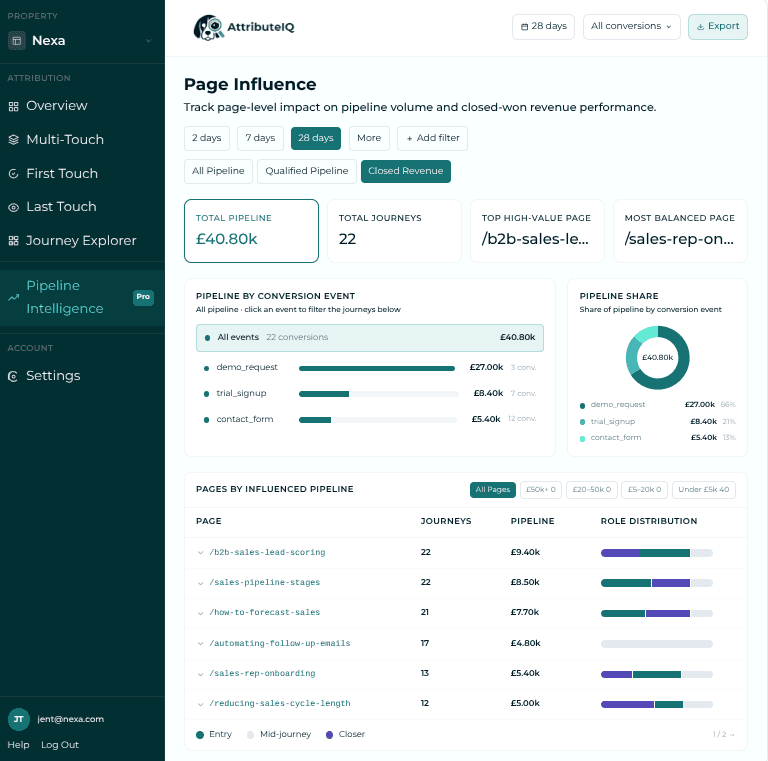
AttributeIQ provides a simpler way to track channel, campaign, and content impact without the Salesforce-native complexity, lengthy implementation, or operational overhead.
Core Features
Journey Explorer gives you a timeline for every converting contact: which pages they visited, in what order, from which channel, with time-on-page for each. You can see that Daniel at Orbitly found your attribution guide via organic search on March 19th, came back through LinkedIn four days later to read a case study, then hit pricing directly before requesting a demo on March 24th.
Board Summary pulls page and channel attribution into one clean, exportable report. Instead of building a Salesforce report and reformatting it for leadership, you get pipeline-by-content-and-channel numbers ready to export as a PPTX for your next board meeting.
Property
Attribution
Management
Account
jane@nexa.com

Board Summary
Export a board-ready summary of marketing’s influence on pipeline and revenue.
Q2 2026 · Board Summary · 1 Apr 2026 – 30 Jun 2026
Qualified Pipeline
£4.1M
from 47 contacts
Total Revenue
£1.27M
from 14 closed deals
Avg Closed Deal
£90.7k
from 14 closed deals
Top Account
Nexa
£340k influenced
Deal Tracking adds real-time intent signals on top of your attribution data. You can set alert rules so that the moment a known contact visits a high-intent page, like pricing for the third time, or a case study the night before a renewal, you get a Slack notification right away, no dedicated admin required to build or maintain the rule.
TCO Comparison: Bizible vs. AttributeIQ
The biggest cost difference between Bizible and AttributeIQ goes beyond the subscription price. Bizible’s enterprise pricing model, annual commitments, and additional setup requirements can push the true first-year cost significantly higher than the software fee alone.
AttributeIQ offers a more predictable cost structure with transparent pricing, lower upfront investment, and no enterprise-level commitment required.
Bizible vs AttributeIQ: What You Get for the Price
When analysing software ROI, it comes down to what you are actually paying for:
What you get with Bizible
- You are paying for attribution embedded natively inside Salesforce, with offline and sales-assisted touchpoint capture, custom weighting via Bizible Discover, and Adobe Experience Platform connectivity.
- It requires dedicated Salesforce admin and RevOps ownership to manage, meaning the platform is only financially viable for teams with the pipeline volume and CRM maturity to offset the overhead.
What you get with AttributeIQ
- You are paying strictly for multi-touch attribution and revenue reporting.
- While the Starter tier is £89/month, the £149/month Pro plan unlocks pipeline intelligence, HubSpot deal matching, and revenue influence reporting.
- You get the same core visibility: first-touch, last-touch, and multi-touch journey mapping tied directly to CRM deals, without the Salesforce infrastructure.
Frequently Asked Questions
Not every team needs a platform built for a $2M marketing budget. If yours is closer to $200K, AttributeIQ gives you the same pipeline and closed-won visibility, connected to GA4 and HubSpot, without the implementation timeline or dedicated RevOps hire that Bizible’s enterprise setup assumes. Try it free for 14 days →