The most affordable marketing attribution platforms in 2026 are AttributeIQ at £89/month for GA4 and HubSpot teams, Fibbler at $89/month for LinkedIn and Google Ads engagement tracking, and Usermaven at $84/month for product-led SaaS analytics.
- •AttributeIQ (£89/month): Best for GA4 and HubSpot teams that need full-funnel, CRM-connected multi-touch attribution, linking marketing activity directly to pipeline and closed-won revenue.
- •Fibbler ($89/month): Best for teams running LinkedIn and Google Ads who want to see how target accounts are engaging, without needing full end-to-end attribution.
- •Usermaven ($84/month): Best for product-led SaaS teams that want unified web analytics, product usage tracking, and multi-touch attribution in a single platform.
Most Affordable B2B Marketing Attribution Software Compared in 2026
Most B2B attribution platforms sit firmly in enterprise pricing bands once implementation, integrations, and usage are factored in. Even tools positioned as “mid-market” often escalate quickly once CRM sync, additional data sources, or reporting depth are required.
The comparison below narrows the market to attribution platforms that strike a practical balance between cost, implementation effort, and reporting capability. Each tool is affordable by B2B standards while still providing meaningful multi-touch or revenue-linked attribution.
1. AttributeIQ
Property
Attribution
Account
jent@nexa.com

Page Influence
Track page-level impact on pipeline volume and closed-won revenue performance.
Total Pipeline
£40.80k
Total Journeys
22
Top High-Value Page
/b2b-sales-lead-scoring
Most Balanced Page
/sales-rep-onboarding
Pipeline by Conversion Event
All pipeline · click an event to filter the journeys below
Pipeline Share
Share of pipeline by conversion event
£40.80k
Pages by Influenced Pipeline
AttributeIQ is a multi-touch attribution platform designed for B2B SaaS teams using GA4 and HubSpot as their core analytics and CRM stack. It connects website activity and marketing channels to CRM contacts, then carries that visibility through the full funnel, from first visit through to pipeline creation and closed-won revenue. This gives teams a direct line between marketing activity and actual deal outcomes, without needing to piece reports together across multiple tools.
Core Features
Journey Explorer gives a clear, chronological view of how each converting contact moved through your funnel. It shows the pages they visited, the sequence of those visits, the channels involved, and engagement time on each step.
Board Summary consolidates attribution data into a format designed for reporting and stakeholder updates. Instead of building custom CRM reports or stitching together datasets manually, it shows pipeline and revenue influence by channel and content in a structure that can be exported directly for board or leadership presentations.
Property
Attribution
Management
Account
jane@nexa.com
Board Summary
Export a board-ready summary of marketing’s influence on pipeline and revenue.
Q2 2026 · Board Summary · 1 Apr 2026 – 30 Jun 2026
Qualified Pipeline
£4.1M
from 47 contacts
Total Revenue
£1.27M
from 14 closed deals
Avg Closed Deal
£90.7k
from 14 closed deals
Top Account
Nexa
£340k influenced
Deal Tracking layers real-time behavioural signals on top of attribution data. It allows teams to define rules that trigger alerts when high-intent activity occurs, such as repeated visits to pricing pages or engagement with key case studies close to renewal or conversion.
Pros
- GA4-native means zero data warehouse debt. AttributeIQ connects directly to GA4 and HubSpot, so teams don’t need to build or maintain a separate data warehouse. This keeps the setup closer to marketing-owned tooling rather than engineering-led infrastructure, which reduces implementation overhead and ongoing maintenance.
- Fast path from setup to insight. Once tracking is connected, attribution data typically starts flowing within 24 hours, giving teams usable funnel and journey visibility without a heavy implementation cycle.
- Lower entry cost for attribution coverage. Starting at £89/month, AttributeIQ sits well below most enterprise attribution tools while still covering full multi-touch tracking across GA4 and HubSpot. This makes it more accessible for mid-market teams that want revenue-level visibility without committing to large annual enterprise contracts upfront.
Cons
- No retroactive attribution data. Tracking begins from the moment the system is installed. Past website journeys are not reconstructed, which means early reporting may not reflect full pipeline history until enough new data accumulates.
- Single-property limitation on entry tier. The Starter plan supports only one GA4 property, which can be limiting for companies running multiple products, brands, or regional websites. Teams with more complex setups typically need to move to higher tiers to avoid fragmented tracking.
- Strongest fit is HubSpot-based stacks. Integration depth is clearly optimised for HubSpot users. While GA4 connectivity is core, teams using Salesforce or more complex CRM setups may find they need additional workarounds to fully align attribution data with their revenue system.
Pricing Structure
Simple flat monthly pricing across three tiers. Every plan comes with a 14-day free trial and no card required. Full pricing breakdown →
- Starter (£89/mo): Supports one GA4 property with standard multi-touch tracking.
- Pro (£149/mo): Unlocks the Pipeline Intelligence module, HubSpot Deal Sync, and executive reporting capabilities across up to three web properties.
- Agency (£299/mo): Provides unlimited properties and individualised client alerting.
See every content interaction
from first visit to closed deal.
AttributeIQ gives your marketing team full-journey pipeline visibility across your existing GA4 and HubSpot stack, live in under 24 hours.
Try 14 days for free →2. Fibbler
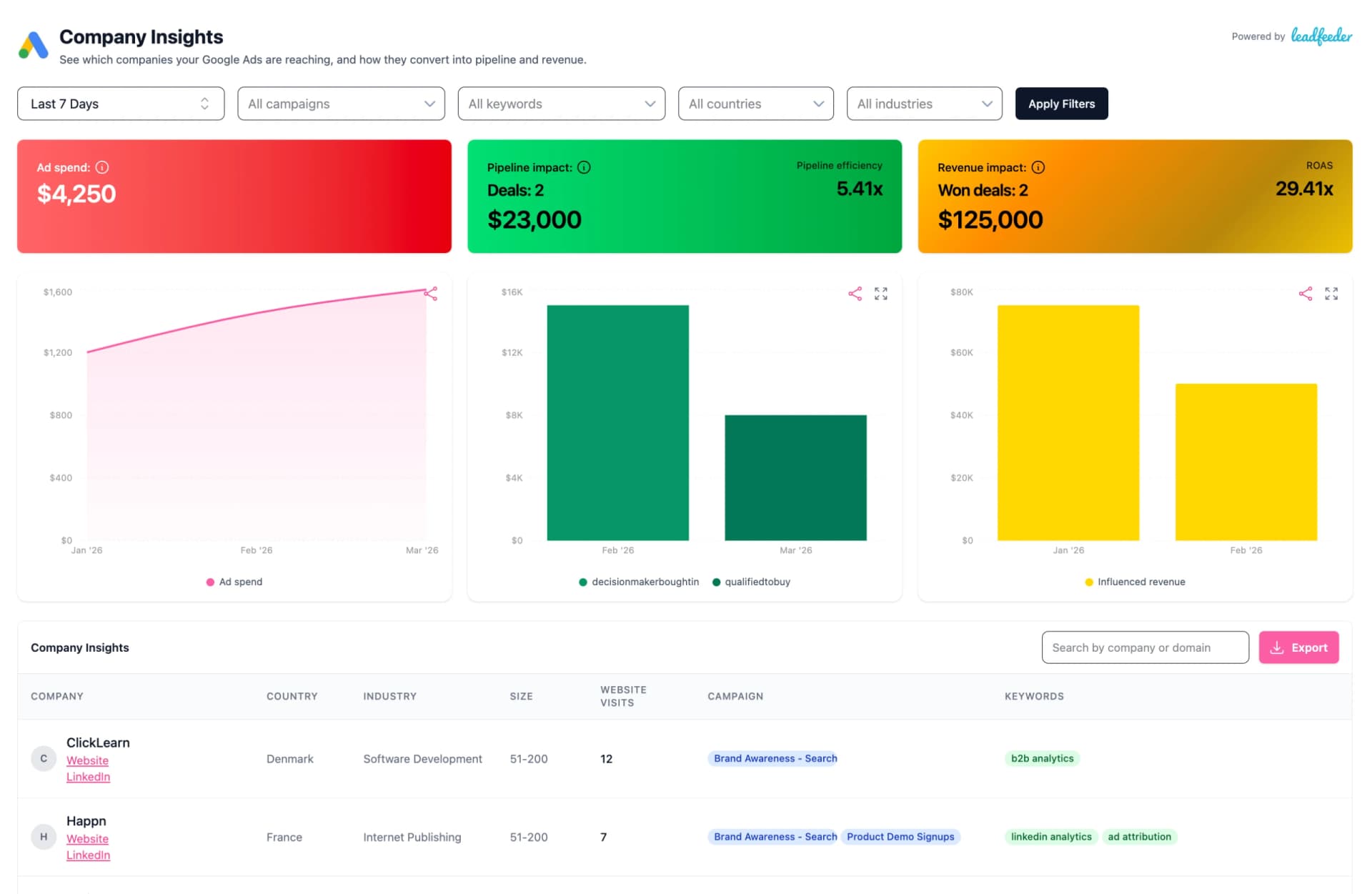
Fibbler occupies a narrower and more specific position in the category than a full multi-touch attribution platform: it identifies which companies are engaging with an organisation’s LinkedIn and Google advertising and synchronises that engagement data directly into the CRM.
As an official LinkedIn Marketing Partner, the platform draws on LinkedIn’s newer Company Intelligence API, which by LinkedIn’s own reporting shows a substantially larger set of engaged companies than the legacy API that many competing tools continue to rely on.
Core Capabilities
- Access to LinkedIn’s Company Intelligence API. This partner-tier API access materially expands the volume of identifiable engaged accounts compared to tools still operating on LinkedIn’s capped legacy reporting endpoint.
- Fully published, self-serve pricing. Fibbler is one of a small number of vendors in this category that lists exact dollar figures publicly rather than requiring a sales conversation to obtain a quote.
- Native routing into existing CRM workflows. Engagement and intent signals are delivered directly into HubSpot or Salesforce, allowing sales teams to act on intent data without adopting a second reporting interface.
Limitations
- Channel coverage is limited to LinkedIn and Google Ads. Organisations that rely on email nurture, organic content, webinars, field events, or direct mail as material contributors to pipeline will not see those touchpoints reflected in Fibbler’s attribution data, and should plan to pair it with a broader attribution tool if those channels carry significant weight.
- The attribution window caps at 90 days. Independent research places the average B2B buying cycle well beyond this threshold, meaning longer-cycle deals may exit Fibbler’s tracking window before they close.
- Data resolution stops at the company level. Fibbler identifies which accounts are engaging but does not show individual contact records, so organisations without a separate contact enrichment tool will need one to convert engagement signals into outbound action.
- Reporting date ranges are fixed. Only preset windows are currently available, which constrains ad hoc reporting requests such as a trailing six-month view for a board presentation.
Pricing
Growth is priced at $89 per month and includes tracking for up to three campaigns. Unlimited is $129 per month and removes that campaign cap. Agency is $159 per month and is designed for firms managing multiple client accounts. A Google Ads add-on is available on any tier for an additional $59 per month, and all plans include a 30-day trial.
3. Usermaven
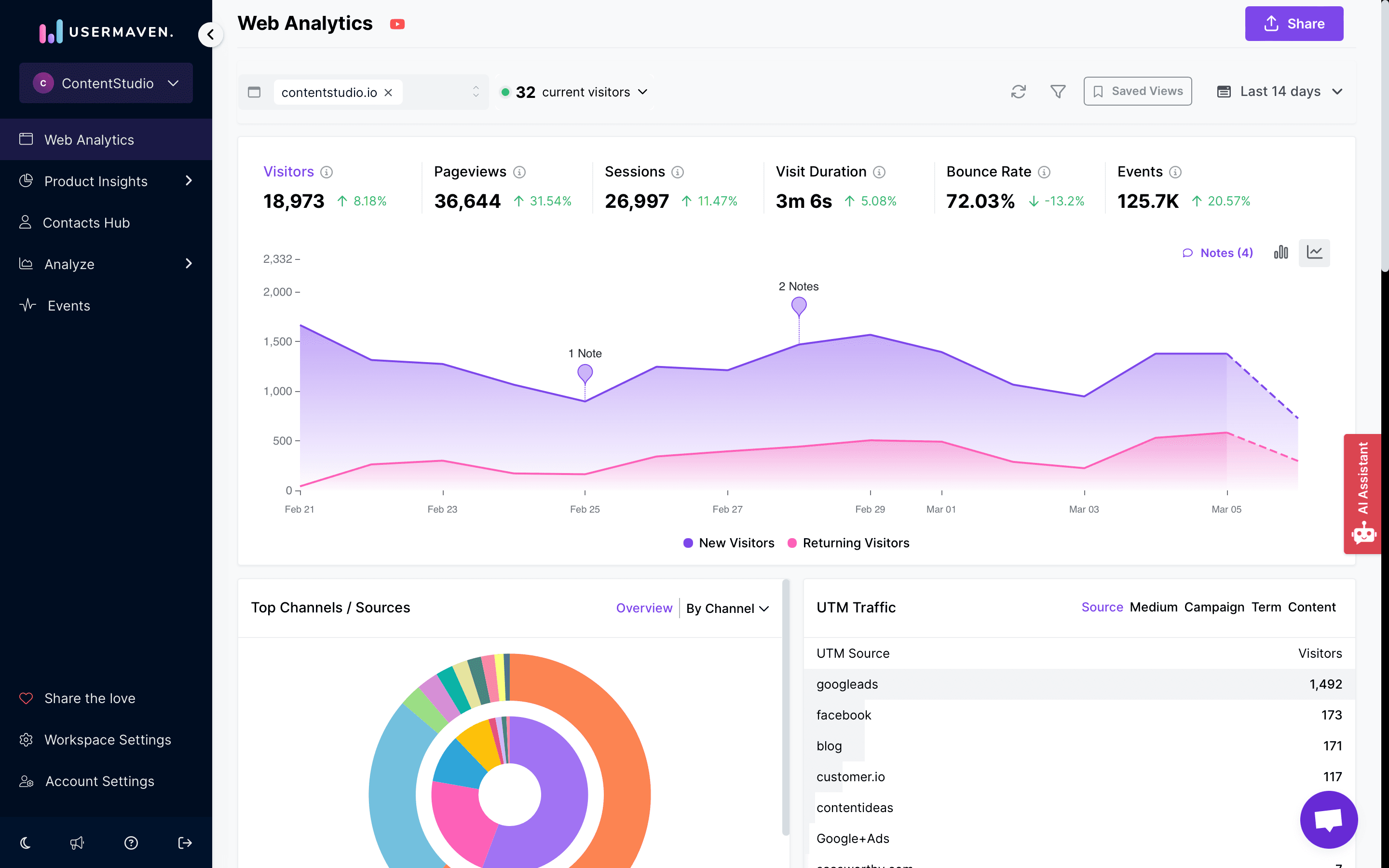
Usermaven combines web and product analytics with multi-touch attribution in a single self-serve platform, positioning it closer to a unified analytics suite than a CRM-first attribution tool. This makes it a strong fit for product-led organisations that need visibility into both acquisition and in-product behavior, and a comparatively weaker fit for sales-led B2B teams whose primary reporting requirement is CRM-connected revenue attribution.
Core Capabilities
- Fully transparent, self-serve pricing structure. Plan tiers are published on the vendor’s site, allowing finance and marketing teams to budget without initiating a sales process.
- Unified acquisition and product analytics. Attribution data sits alongside in-app usage metrics in a single interface, which benefits product-led teams tracking the complete path from initial ad click to product activation.
- AI-assisted pattern detection. The platform shows attribution and behavioral trends automatically, reducing the need for a dedicated analyst to construct every report manually.
- Usage-based pricing rather than per-seat licensing. Cost scales with platform usage rather than headcount, which keeps total spend more predictable as a marketing or product team grows.
Limitations
- CRM and pipeline synchronisation is comparatively shallow. Organisations that require deal-level revenue attribution synced directly into Salesforce or HubSpot pipeline stages will find Ruler Analytics, AttributeIQ, or Factors.ai better aligned to that requirement.
- Less suited to long, multi-stakeholder sales cycles. Sales-led B2B teams whose reporting is structured around CRM opportunity stages rather than web and product events may find the underlying data model does not map cleanly to their existing revenue reporting.
- A smaller integration ecosystem than category incumbents. Teams with an established stack built around Salesforce, Marketo, or other enterprise systems should verify integration depth before standardising on the platform.
Pricing
Growth is $84 per month on annual billing. Scale is $199 per month. Both tiers include multi-touch attribution alongside standard web and product analytics, with no separate attribution module or add-on fee required.
4. Google Analytics
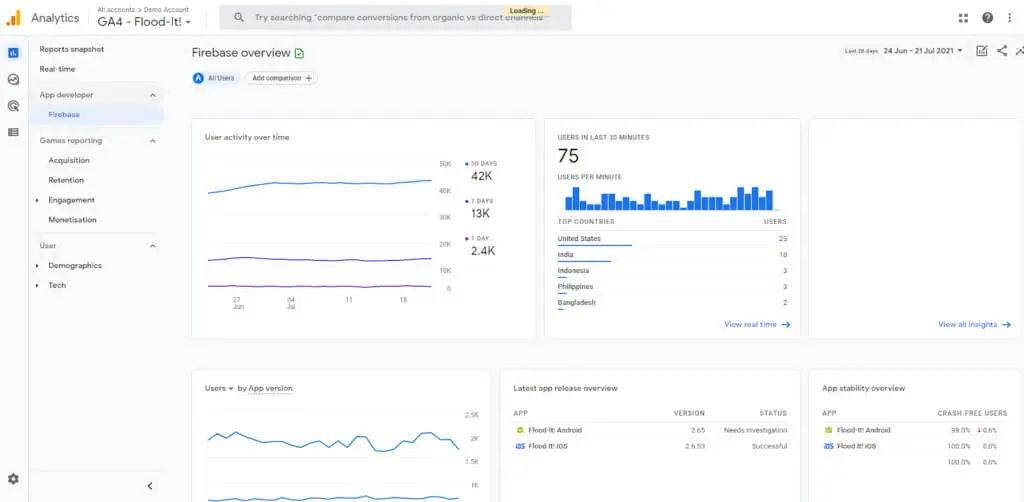
Google Analytics 4 is the free baseline layer for behavioral attribution in most B2B stacks. It uses data-driven attribution by default for event-scoped reporting and also supports model comparison and path analysis, making it useful for understanding how channels assist conversions rather than just where the last click happened.
Core Capabilities
- Data-driven attribution by default. GA4 uses data-driven attribution for event-scoped reporting, which distributes credit based on observed conversion paths instead of relying only on a rigid last-click rule.
- Model comparison and path analysis. The interface supports attribution reporting that helps marketers compare how different models assign credit across the buyer journey, which is useful when evaluating assisted conversions.
- Free entry point. GA4 has no software license cost, which makes it a practical first layer for teams that need basic attribution without adding another paid platform.
- Works well as a behavioral layer. It is strongest for understanding traffic, content performance, and campaign influence before CRM-level revenue reporting is added.
Limitations
- Not a CRM-native revenue attribution system. GA4 can show behavioral influence, but it does not natively replace a CRM-based view of pipeline, opportunity creation, or closed-won revenue.
- Requires clean implementation to be useful. Poor event setup, inconsistent UTM naming, or weak conversion definitions can make the reporting misleading even when the model itself is sound.
- Less useful for executive revenue reporting. For CMO-level pipeline questions, GA4 usually works best as one layer in a broader measurement stack rather than the final source of truth.
Pricing
GA4 is free to use, making it the most practical starting point for teams that want a credible attribution baseline without adding software cost to an already lean B2B stack.
5. Ruler Analytics
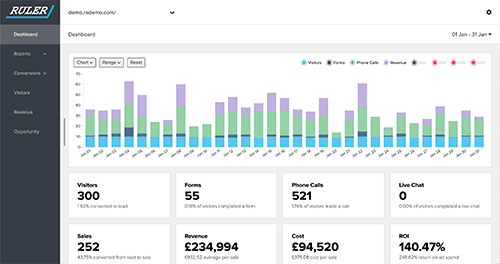
Ruler Analytics built its reputation around a use case that many attribution platforms only partially address: connecting inbound phone calls and form submissions to revenue recorded in the CRM. For B2B organisations where sales conversations happen over the phone rather than through self-serve signups, this provides a clearer view of which marketing efforts generate qualified pipeline and closed revenue.
Core Capabilities
- Native call tracking with campaign-level attribution. Inbound phone calls are matched to the specific website visitor, campaign, and keyword that generated them, and that conversion data is fed back into ad platforms to inform bid optimization.
- Six attribution models available concurrently. First-click, last-click, linear, time-decay, and other standard models can be viewed side by side, allowing revenue teams to compare how credit allocation shifts under different assumptions without re-running reports.
- Deep native integration across CRM and ad platforms. Salesforce, HubSpot, Pipedrive, and major advertising platforms are natively supported, enabling closed-loop reporting from first touch through to recognised revenue.
Limitations
- Pricing scales with website traffic rather than seats. Because cost is tied to monthly visit volume, an organisation experiencing organic traffic growth may move into a higher pricing tier without any corresponding increase in headcount or channel complexity.
- A 12-month contract is the standard commitment. Monthly billing is available, but the default agreement is an annual term, which offers less flexibility than the month-to-month structures common among newer entrants in this category.
- Onboarding requires a longer implementation window. Full setup typically spans several weeks and involves more direct vendor involvement than a self-serve platform, which some organisations may view as a benefit and others as friction depending on internal resourcing.
Pricing
Small Business is approximately £179 to £199 per month (roughly $225 to $250 USD) for sites generating around 5,000 monthly visits. Medium Business runs approximately £584 to £649 per month for approximately 50,000 monthly visits. Large Business is priced at approximately £999 to £1,149 per month for approximately 100,000 monthly visits, with custom pricing available above that threshold. Annual billing carries a modest discount relative to monthly terms.
6. HubSpot Marketing Hub
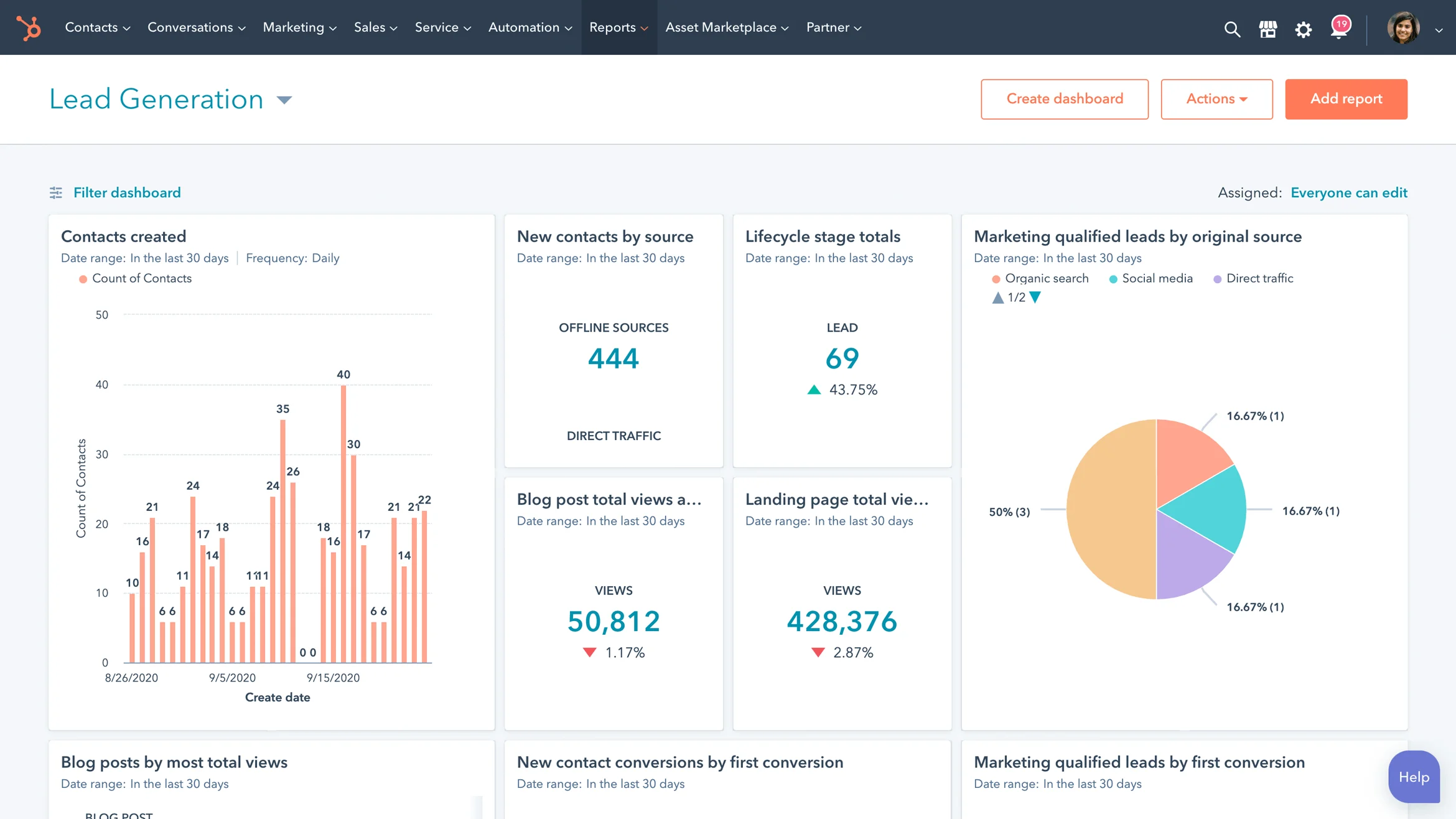
HubSpot Marketing Hub is a CRM-native system where attribution is embedded directly into marketing, sales, and revenue reporting. Instead of isolating marketing performance in a separate layer, HubSpot connects attribution data to contacts, deals, and closed revenue inside the CRM.
Core Capabilities
- CRM-native attribution reporting. Attribution is tied directly to contacts, deals, and revenue records. This makes it more suitable for pipeline and revenue analysis than tools focused only on web sessions or traffic data.
- Multiple attribution models supported. HubSpot provides several standard models, including first touch, linear, U-shaped, W-shaped, and full-path attribution (available in higher tiers). This allows teams to compare how credit is distributed across different interpretations of the customer journey.
- Built around campaigns and marketing assets. Reporting is structured around campaigns, content, and channels, helping teams understand which marketing activities contribute to downstream revenue rather than just early-stage engagement.
- Strong alignment with lifecycle tracking. Because attribution sits inside the CRM, it connects naturally to lead stages, opportunity progression, and revenue outcomes. This makes it easier to follow performance across the full funnel.
Limitations
- Attribution depth is tier-dependent. More advanced attribution features are only available on higher-tier plans. As a result, the effective cost of accessing full reporting capabilities is often higher than the entry-level pricing suggests.
- Best suited to HubSpot-native stacks. The value is strongest when HubSpot is already the primary CRM and marketing system. If key parts of the funnel sit in other tools, attribution coverage can become fragmented.
- Less flexible than warehouse-based setups. Teams that require highly custom attribution logic or advanced data modelling may find HubSpot limiting compared to more open, data-warehouse-first architectures.
- Relies on consistent CRM data quality. Attribution accuracy depends heavily on clean and complete CRM records. Inconsistent lifecycle stages, missing source data, or poor tracking discipline can distort reporting.
Pricing
Marketing Hub Professional starts at around $890/month, while Enterprise begins at approximately $3,600/month. The actual cost of using HubSpot for attribution depends on whether you need the more advanced reporting capabilities that sit in the higher-tier plans.
Recommended Reading: Why HubSpot’s Multi-Touch Attribution Isn’t Enough on Its Own
7. Factors.ai
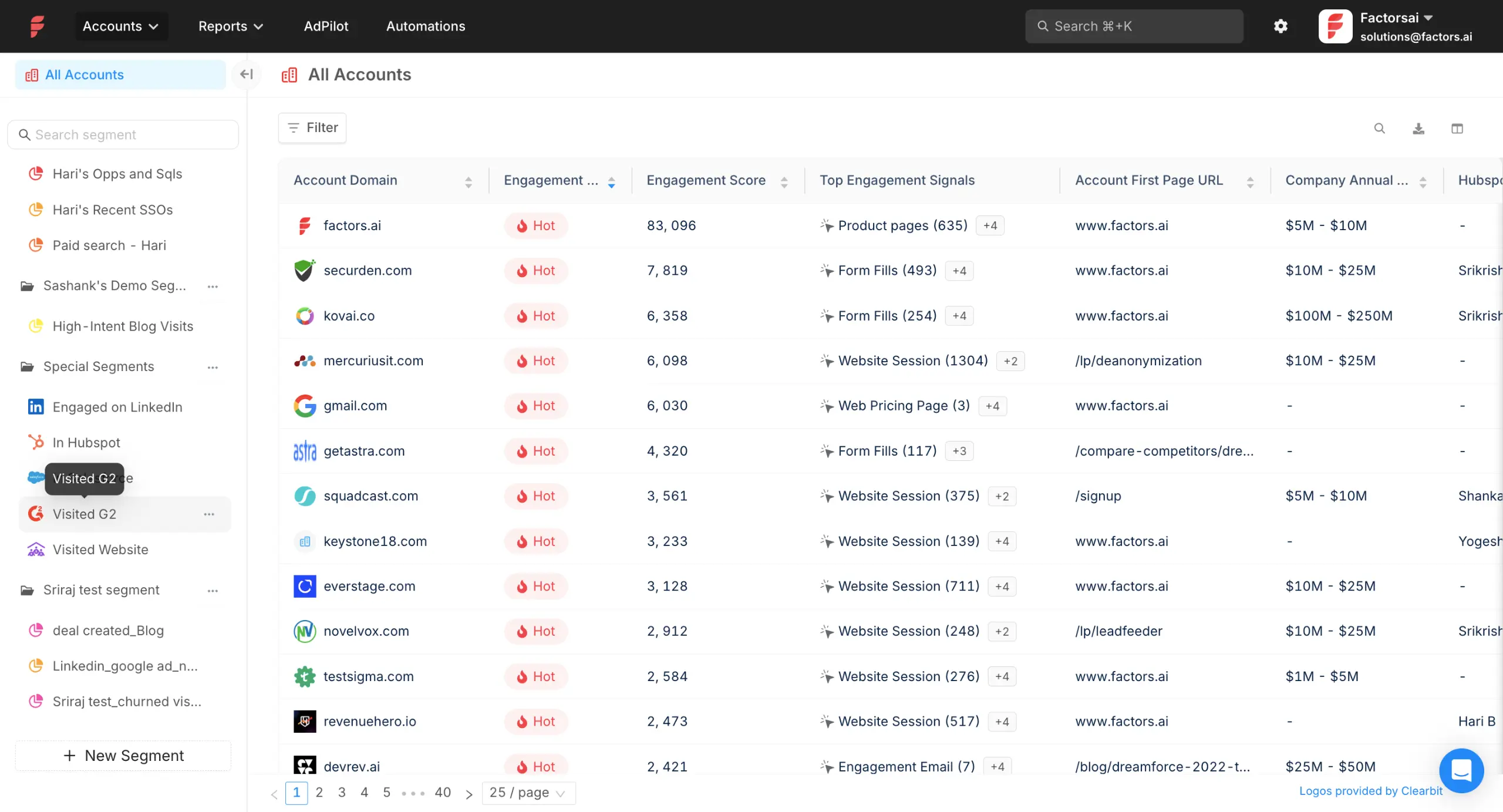
Factors.ai combines multi-touch attribution with account-based intent data, bringing signals from platforms like LinkedIn and G2 into its scoring and reporting layer. Rather than operating as a pure attribution tool, it sits in the overlap between attribution and ABM, which adds clear value for teams running structured account-based programs but introduces additional complexity for organisations focused only on core attribution use cases.
Core Capabilities
- Attribution across contacts and accounts. Multi-touch attribution is applied at both contact and account level, making it suitable for B2B buying cycles where multiple stakeholders influence a single deal.
- Integrated intent signal enrichment. Engagement data from LinkedIn and G2 is incorporated directly into account scoring. This combines attribution reporting with intent detection without requiring a separate data provider.
- Native CRM sync with HubSpot and Salesforce. Attribution and intent data flow directly into existing CRM workflows, allowing teams to work from pipeline systems rather than switching between reporting tools.
Limitations
- Limited pricing transparency. Pricing is no longer publicly listed. Earlier tiers were reported at around $399/month and $999/month, but current plans require a sales conversation, which reduces visibility compared to more self-serve tools.
- Add-ons can significantly increase total cost. Features such as LinkedIn Adpilot and Interest Groups are sold separately and may cost as much as the base subscription, meaning actual monthly spend can increase quickly once ABM features are enabled.
- Broader scope may not fit lean teams. The platform is designed for organisations running formal ABM programs. For teams focused solely on multi-touch attribution, the ABM layer may introduce additional cost and operational complexity without being fully necessary.
Pricing
Factors.ai includes a free tier that allows identification of up to 200 companies per month, which is typically used for initial testing and validation. The last publicly available pricing for paid plans placed the Basic tier at around $399/month, covering up to 3,000 identified companies and 5 user seats, while the Growth tier was around $999/month for higher volume usage and up to 10 users. Since then, pricing for all paid plans has moved to a sales-led model, so final costs are confirmed through direct engagement.
Which Attribution Platform Is Right for Your B2B Team?
Price is only one variable in an attribution evaluation. Once you’ve narrowed the market to tools within budget, the more important question becomes fit.
A product that works well for a Salesforce-centric RevOps team may introduce unnecessary complexity for a business operating entirely inside HubSpot. Likewise, a platform designed for broad multi-touch reporting may be the wrong investment if most pipeline originates from a single acquisition channel.
These four questions will help you filter the list down to the tools that fit your situation.
Which systems sit at the centre of your revenue operations?
Attribution platforms derive their value from how well they integrate with the systems that already hold customer, campaign, and revenue data, so forcing a platform into an incompatible stack rarely produces a better outcome.
AttributeIQ makes the most sense for organisations running GA4 alongside HubSpot and looking for multi-touch attribution without adding another layer of infrastructure. For Salesforce-led environments, Ruler Analytics and Factors.ai provide a more natural fit through native Salesforce integration, while GA4 remains a practical baseline for organisations that are not yet ready to invest beyond first-party analytics.
Where does the majority of pipeline actually originate?
Attribution software tends to perform best when it reflects the primary way a business acquires customers rather than attempting to optimise every possible use case equally.
Teams investing heavily in LinkedIn and paid acquisition may find Fibbler’s company-level engagement reporting more valuable than a traditional journey analysis, particularly where account identification forms part of the sales process. Businesses that rely on inbound calls as part of qualification or conversion should consider Ruler Analytics, which extends attribution beyond digital form fills. Where pipeline is distributed across paid media, organic search, email, referrals, and direct traffic, broader multi-touch platforms such as AttributeIQ and Usermaven generally provide a more representative view of marketing performance.
How should attribution be delivered to the business?
Reporting architecture is often overlooked during product evaluations, yet it has a significant impact on adoption. Some organisations prefer attribution to exist as a dedicated analytical layer, while others expect reporting to remain embedded within the CRM.
AttributeIQ, Usermaven, Fibbler, and Ruler Analytics all provide standalone reporting environments designed specifically for attribution analysis. HubSpot Marketing Hub follows a different model by presenting attribution directly within CRM records, allowing marketers and sales teams to analyse campaigns alongside contacts, companies, and deals. That approach reduces context switching but also places greater reliance on consistent CRM governance and data quality.
Is attribution the objective, or is account intelligence equally important?
Most products in this category focus on one outcome: identifying which marketing activities influence pipeline and revenue. For many B2B organisations, that level of visibility is sufficient.
AttributeIQ, Usermaven, Fibbler, and Ruler Analytics are primarily dedicated attribution platforms. Factors.ai extends beyond attribution by combining journey reporting with account-level intent signals. That additional capability is particularly relevant for mature account-based marketing programmes, although it becomes materially more compelling on the platform’s higher-tier plans than its entry-level offering.
Frequently Asked Questions
Most of these tools solve overlapping problems at different price points, so the fastest way to find the right one is usually to test it against your own data rather than compare feature lists. If you're running GA4 and HubSpot and want to see the content journey behind every closed deal, AttributeIQ is built for exactly that. Try it free with your own data and see whether it answers the question before you commit to anything bigger.