The most affordable Dreamdata alternatives are AttributeIQ, Fibbler, Usermaven, Ruler Analytics, and Factors.ai. AttributeIQ is the strongest fit for B2B teams that need pipeline and revenue attribution, while Fibbler focuses on LinkedIn attribution, Usermaven on privacy-focused analytics, Ruler Analytics on calls and offline conversions, and Factors.ai on account-based marketing and buyer intent.
Why Dreamdata’s Pricing Leaves B2B Teams Looking for Alternatives
Dreamdata is a strong fit for companies with clean data, established RevOps processes, and enough pipeline volume to justify enterprise attribution software. But for leaner teams, the upfront contract, CRM preparation, and ongoing costs create too much uncertainty before value is proven.
That concern shows up repeatedly in buyer reviews
1. High Upfront Commitments with No Proof of Concept
The highest barrier to entry is the leap of faith required to access Dreamdata’s core attribution capabilities. While a free tier exists for basic web analytics, unlocking true multi-touch attribution, revenue insights, and advanced reporting requires a paid annual contract.
What one buyer said:
“They didn’t have any sort of a trial, and 1 year expensive contract without any proof of concept was too risky.” — Marketing Operations Manager (Capterra)
2. Time to Value and the CRM Implementation Tax
Buying Dreamdata is only the first hurdle; getting it to yield actionable insights requires serious internal alignment. Reviewers consistently flag that Dreamdata’s output is entirely dependent on how clean your underlying CRM data is inside Salesforce or HubSpot.
The same reviewer on the realities of onboarding:
“If your CRM health is poor, then no magic will happen...” — Marketing Operations Manager (Capterra)
3. Pricing Out Smaller Marketing Teams
Dreamdata’s pricing model scales based on Monthly Tracked Users (MTUs) and CRM account volume. As your database grows, your software costs rise alongside it, regardless of whether your actual reporting needs have changed.
That pricing structure is why some smaller teams hesitate to commit:
“Dreamdata seems pretty expensive ($500+ a month). Don’t think my boss will go for that tbh. Are there any other dreamdata alternatives” — Reddit User (r/EntrepreneurRideAlong)
Bottom Line
Dreamdata makes sense if you’ve got a clean CRM, a RevOps team, and budget that can absorb a five-figure annual contract. If you don’t have all three, the entry price is hard to justify before you’ve even seen the pipeline it’s supposed to prove.
5 Affordable Dreamdata Alternatives, Compared by Price and Fit
For teams that need pipeline visibility without Dreamdata’s cost and complexity, several alternatives offer a more practical balance between attribution depth, implementation effort, and price.
1. AttributeIQ
Property
Attribution
Account
jent@nexa.com

Page Influence
Track page-level impact on pipeline volume and closed-won revenue performance.
Total Pipeline
£40.80k
Total Journeys
22
Top High-Value Page
/b2b-sales-lead-scoring
Most Balanced Page
/sales-rep-onboarding
Pipeline by Conversion Event
All pipeline · click an event to filter the journeys below
Pipeline Share
Share of pipeline by conversion event
£40.80k
Pages by Influenced Pipeline
Why AttributeIQ Is a Good Dreamdata Alternative
Dreamdata provides extensive B2B attribution capabilities, but many teams evaluating alternatives are not looking for a full data warehouse to build and maintain. They just need clear answers around pipeline contribution, content performance, and marketing ROI.
AttributeIQ is built around those core attribution requirements. It connects GA4 and HubSpot data to show which channels, pages, and campaigns contribute to pipeline and closed-revenue. Once a visitor converts, it also shows intent signals like repeat visits and high-value page engagement, so sales and marketing can see which contacts are heating up instead of relying on lead score alone. Pricing starts at $149/month, with teams typically seeing usable attribution data within 24–48 hours.
Core Features
Journey Explorer gives you a timeline for every converting contact: which pages they visited, in what order, from which channel, with time-on-page for each. You can see that Daniel at Orbitly found your attribution guide via organic search on March 19th, came back through LinkedIn four days later to read a case study, then hit pricing directly before requesting a demo on March 24th.
Board Summary pulls page and channel attribution into one clean, exportable report. Instead of pulling numbers from three different dashboards and stitching them into a deck by hand, you get pipeline-by-content-and-channel numbers ready to export as a PPTX for your next board meeting.
Property
Attribution
Management
Account
jane@nexa.com
Board Summary
Export a board-ready summary of marketing’s influence on pipeline and revenue.
Q2 2026 · Board Summary · 1 Apr 2026 – 30 Jun 2026
Qualified Pipeline
£4.1M
from 47 contacts
Total Revenue
£1.27M
from 14 closed deals
Avg Closed Deal
£90.7k
from 14 closed deals
Top Account
Nexa
£340k influenced
Buyer Intent Tracking adds real-time intent signals on top of your attribution data. You can set alert rules so that the moment a known HubSpot contact visits a high-intent page, like pricing for the third time, or a case study the night before a renewal, you get a Slack notification right away, no dedicated admin required to build or maintain the rule.
Pricing Structure
AttributeIQ offers simple flat monthly pricing across three tiers: Starter, Pro, and Agency. Every plan includes a 14-day free trial with no credit card required, allowing teams to evaluate attribution capabilities before committing. Full pricing breakdown →
See which channels and content influence pipeline and revenue
AttributeIQ connects every buyer touchpoint to closed-won deals, giving marketing teams complete attribution visibility.
2. Fibbler
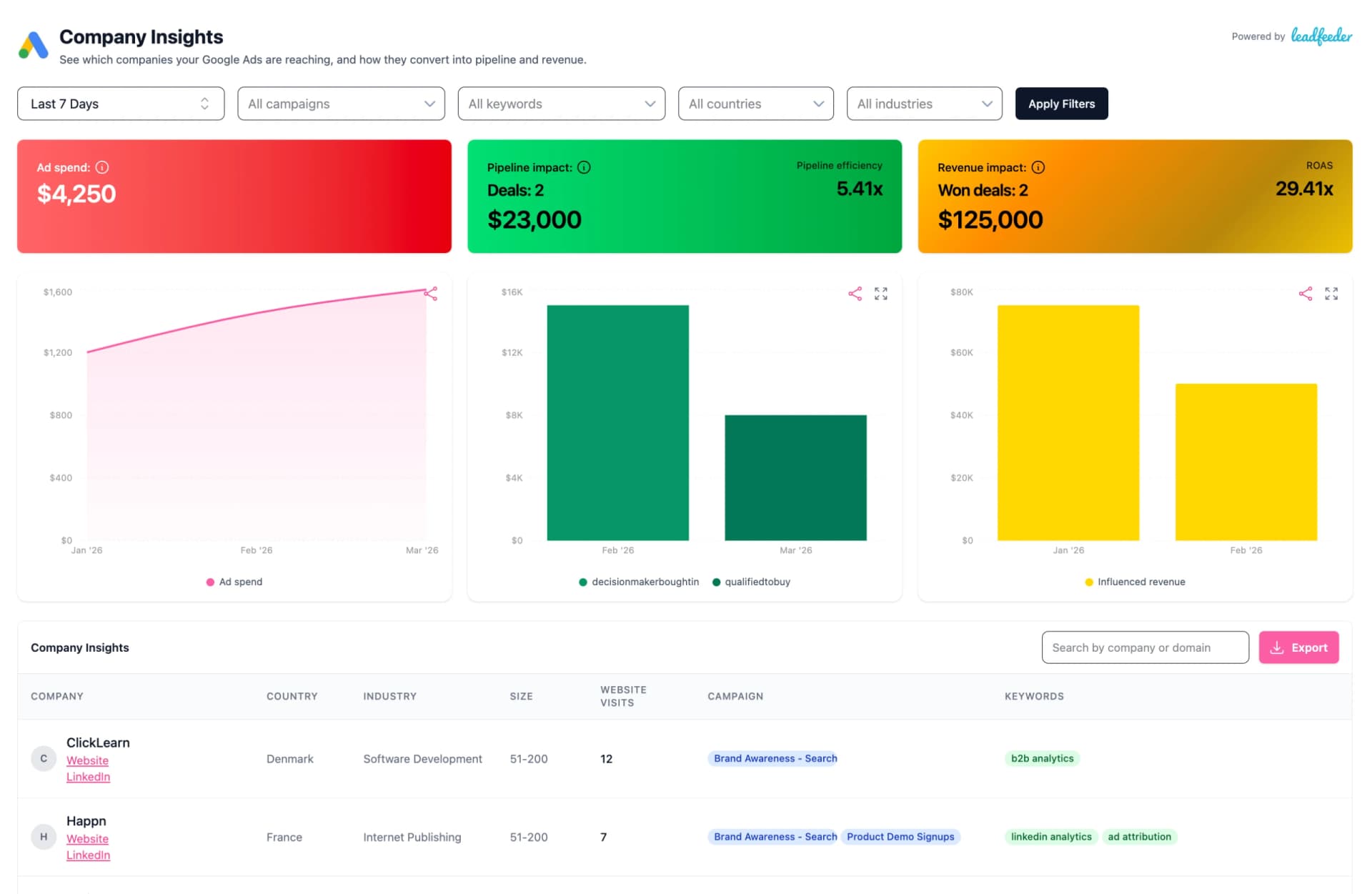
Why Fibbler Is a Good Dreamdata Alternative
Dreamdata treats LinkedIn as one channel among many in a broader multi-touch model. If LinkedIn is where most of your paid budget and pipeline actually comes from, that breadth works against you, you get click-level attribution instead of the account-level view-through data that explains why a campaign worked. Fibbler exists specifically to answer that narrower, higher-stakes question.
Key Strengths
- Company-level LinkedIn engagement tracking: Measures which accounts viewed your ads, how often they engaged, and then connects that activity to closed-won deals.
- Customer journey timelines: Shows the full LinkedIn activity sequence for each account leading up to deal creation, including paid and organic touchpoints.
- Lift analysis: Compares close rate, ACV, and sales cycle length between LinkedIn-touched deals and untouched deals, so you can quantify channel impact.
- Native CRM sync: Integrates with HubSpot, Salesforce, Attio, and Pipedrive, with Clay, Slack, and Zapier support for routing account signals into outbound workflows.
Pricing
Fibbler starts at $89/month (Growth plan) and goes up to $159/month (Agency). Google Ads attribution is available as a separate add-on at $59/month. All plans include a 30-day free trial with no credit card required, notably longer than the proof-of-concept window Dreamdata offers.
3. Ruler Analytics
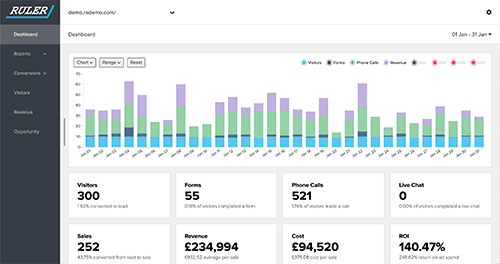
Why Ruler Analytics Is a Good Dreamdata Alternative
Dreamdata excels at analysing digital buyer journeys, but those journeys often stop at online interactions. For businesses where qualified leads still convert through phone conversations, Ruler Analytics fills that gap by attributing inbound calls back to the marketing source that generated them and syncing those outcomes into HubSpot or Salesforce.
Key Strengths
- Call tracking via dynamic number insertion: Attributes inbound phone leads to the channel and campaign that drove them, with call recordings and missed call alerts for faster sales follow-up.
- Multiple attribution models: Supports first-click, last-click, linear, and W-shaped models, with marketing mix modelling to capture offline and impression-based contribution.
- CRM writeback: Pushes revenue data into HubSpot, Salesforce, and other connected CRMs, attaching campaign and channel history to each contact and opportunity.
- Broad integrations: Connects with 1,000+ tools through Zapier, Webhooks, and SQL, with native support for Google Analytics, Google Ads, Bing Ads, Facebook Ads, LinkedIn, and Looker.
Pricing
Ruler Analytics pricing is tiered by monthly website traffic. The Small Business plan starts at £199/month for up to 5,000 visits, with Medium Business at £649/month (50,000 visits) and Large Business at £1,149/month (100,000 visits). Annual billing carries a roughly 10% discount. There is no free tier, but even the entry tier sits well below Dreamdata’s five-figure annual minimum.
4. Factors.ai
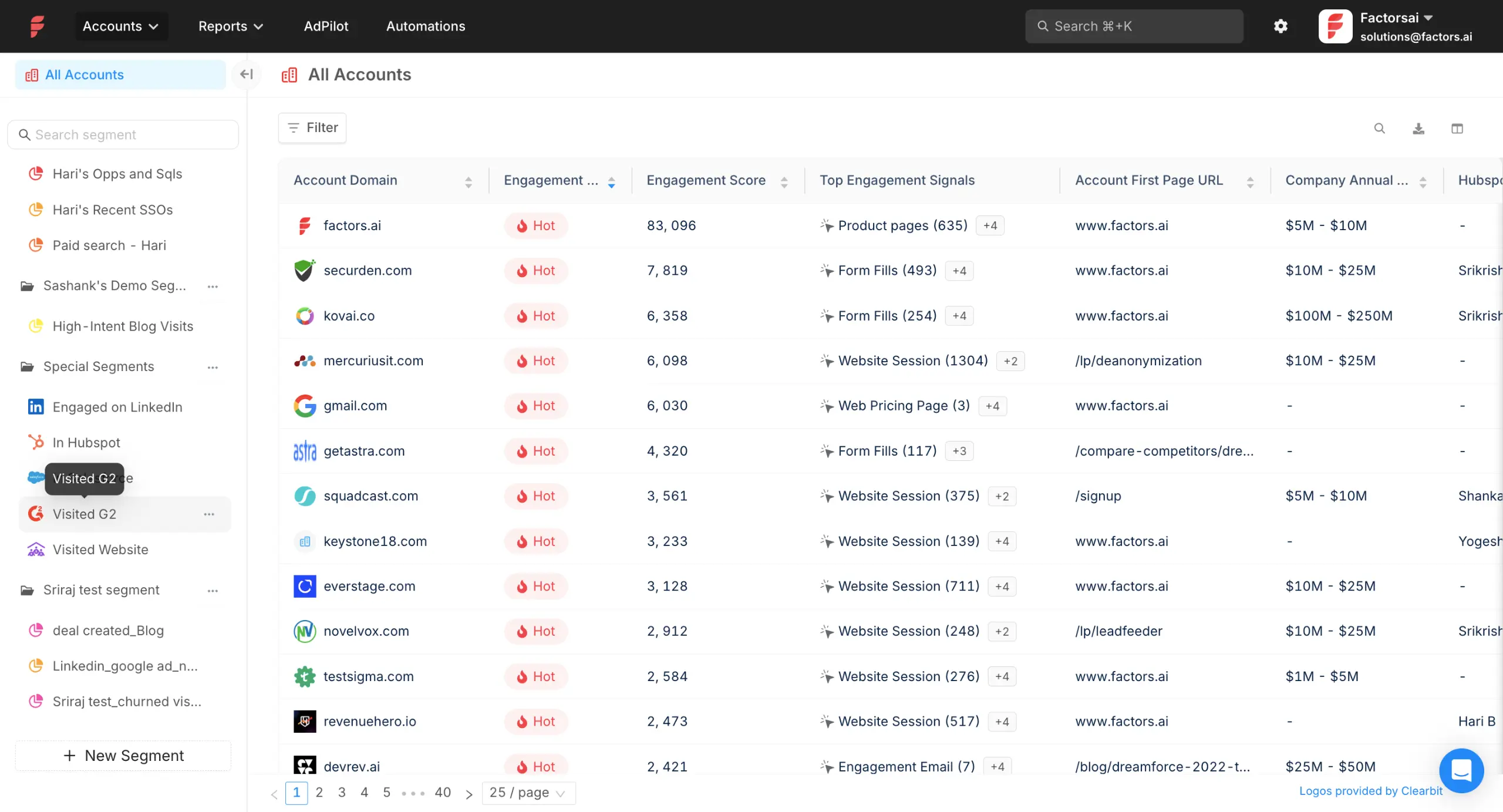
Why Factors.ai Is a Good Dreamdata Alternative
For ABM teams, the challenge is not only understanding which accounts influenced pipeline, but identifying which accounts are showing buying intent before an opportunity exists. Factors.ai extends beyond attribution by combining account journeys with intent data, enabling teams to detect active demand signals and trigger targeted engagement earlier in the sales cycle.
Key Strengths
- Website visitor identification: De-anonymises company-level traffic in real time, showing which organisations are on your site and which pages they are viewing before they ever convert.
- Buyer intent data: Pulls signals from G2, Bombora, and third-party sources, then combines them with first-party engagement to prioritise accounts actively researching a solution.
- AdPilot workflows: Pushes high-intent account lists into LinkedIn and Google Ads for retargeting, closing the loop between account intelligence and paid media execution.
- Native CRM sync: Integrates with Salesforce, HubSpot, Marketo, Pardot, and Outreach, with Slack alerts and workflow automation so sales teams act on high-intent signals without checking another dashboard.
Pricing
Factors.ai starts at $399/month for the Basic plan covering account identification. Multi-touch attribution and LinkedIn AdPilot sit behind higher tiers and paid add-ons, with a fully-loaded Growth setup running $2,000+/month depending on configuration. A free plan is available for basic website visitor identification. Annual contracts are standard, though the entry point is still a fraction of Dreamdata’s typical first-year cost.
5. Usermaven
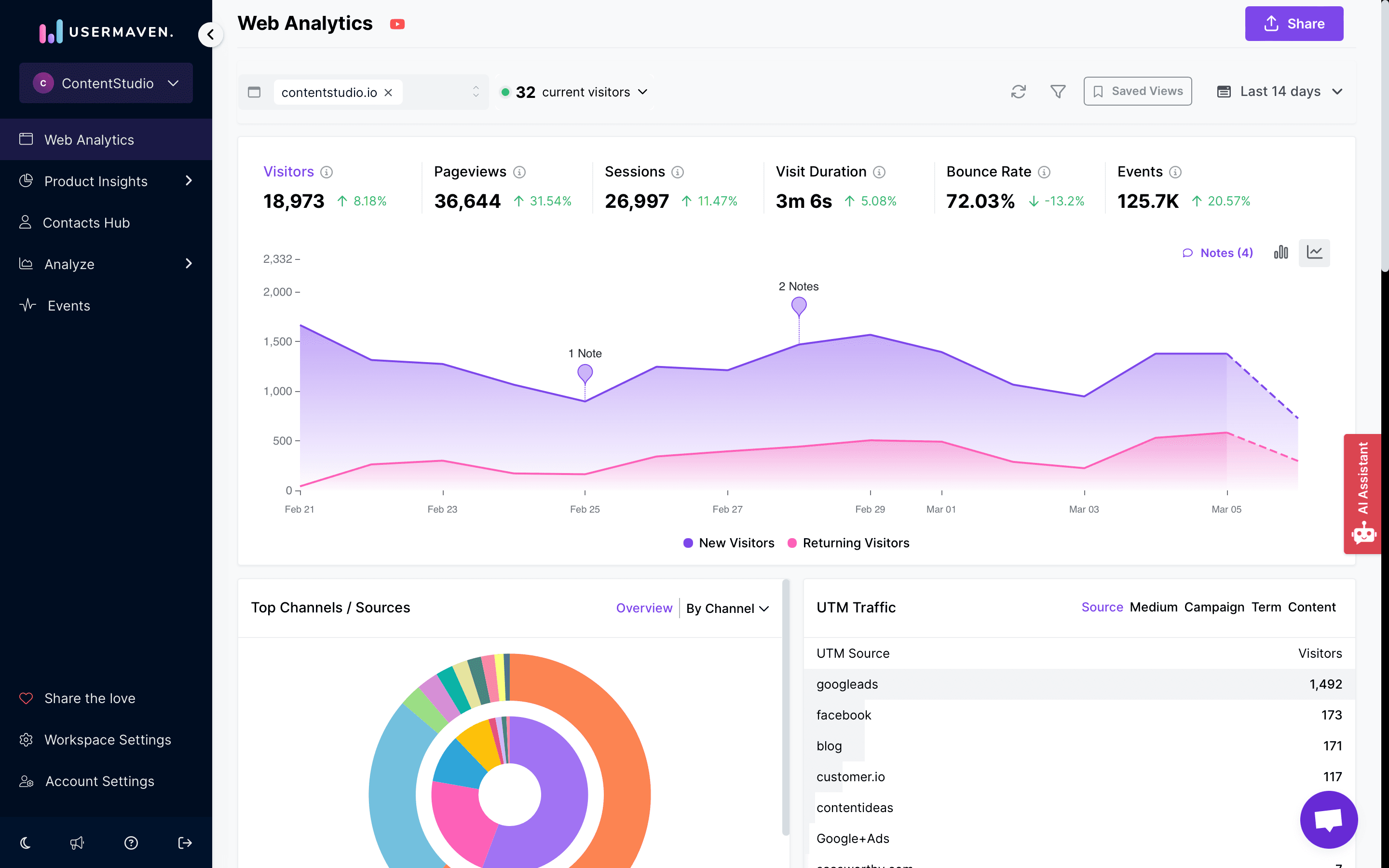
Why Usermaven Is a Good Dreamdata Alternative
Dreamdata relies heavily on the quality and availability of digital interaction data for attribution analysis, while increasing privacy restrictions continue to make traditional tracking more challenging. Usermaven uses cookieless, first-party data collection to maintain visibility into website and product activity without relying on third-party identifiers. Combined with unlimited seats and built-in product analytics, it provides a broader analytics workflow for teams looking beyond attribution alone.
Key Strengths
- Cookieless tracking: Uses first-party data to deliver more reliable traffic and conversion data, especially in privacy-heavy environments and on iOS.
- Multiple attribution models: Offers seven models on the Scale plan, including first-touch, last-touch, linear, time-decay, U-shaped, W-shaped, and full-path.
- Product and website analytics: Combines acquisition and in-product behaviour in one interface, so SaaS teams do not have to stitch together separate tools.
- Unlimited seats: Gives every stakeholder access on paid plans without per-user cost pressure or licence negotiation.
Pricing
Usermaven has a free Starter plan (25,000 events/month). Paid plans start at $84/month (Growth) for website and product analytics, with the Scale plan at $199/month adding multi-touch attribution and ad integrations. All paid plans include unlimited users and a 14-day free trial.
How to Choose the Right Dreamdata Alternative for Your Team in 2026
You’ve just seen five of the strongest Dreamdata alternatives on the market. Here’s how to actually choose the right attribution platform for your team.
Is your primary attribution question about content performance or account intelligence?
- Content & pipeline performance: AttributeIQ or Usermaven are purpose-built for this, both trace which pages and channels influence pipeline and revenue, at a fraction of Dreamdata’s cost and setup time.
- Account-level intent & ABM: Factors.ai is the closer fit. It layers real-time buyer intent and account identification on top of attribution, a capability Dreamdata doesn’t offer natively.
Do you have meaningful offline conversions?
- Phone calls & offline conversions: Ruler Analytics is the only platform in this set built to attribute inbound calls back to their marketing source, coverage Dreamdata lacks entirely.
- Fully digital funnel: Ruler's core differentiator doesn't apply—focus on AttributeIQ, Fibbler, or Usermaven instead.
How clean is your CRM data?
Dreamdata, at every tier, assumes reasonably clean CRM hygiene and consistent UTM tracking. G2 reviewers repeatedly flag this as the deciding factor in whether the platform delivers value quickly or drags on for weeks.
- Messy or inconsistent data: AttributeIQ and Usermaven work with what GA4 and HubSpot already have, they don’t require a cleanup project before you see meaningful attribution.
- Clean, well-structured CRM: You can consider any tool on this list, your data hygiene won’t be the bottleneck.
Do you need attribution within days or weeks?
Time-to-value is one of the most cited frustrations with Dreamdata in G2 reviews, with users reporting 2–8 weeks before seeing reliable output. If your team can’t absorb that runway, this should shape your shortlist directly.
- Immediate (24–48 hours): AttributeIQ, Usermaven, and Fibbler produce usable attribution views within 24 to 48 hours of connecting your accounts.
- Short-term (1–2 weeks): Ruler Analytics typically takes 1 to 2 weeks, still well ahead of Dreamdata’s reported timeline.
- Weeks to months: Factors.ai sits in the middle, faster than Dreamdata but slower than the immediate-tier tools, depending on account-intent complexity.
Frequently Asked Questions
You don’t need a six-figure contract or dedicated RevOps resource just to prove marketing ROI to your board. If your priority is fast setup, clean content attribution, and real-time sales alerts, AttributeIQ gives you the answers you need in less than 48 hours.
Spin up the 14-day free trial on your live stack and see which pages are actually influencing pipeline before signing another annual contract.