The best buyer intent software depends entirely on which type of intent data you need to track. We evaluated the leading platforms across three distinct categories:
- First-Party (Website behavior): AttributeIQ, Leadfeeder, Warmly
- Second-Party (Review site activity): G2 Buyer Intent, TrustRadius, Capterra
- Third-Party (Off-site market research): Bombora, 6sense, Demandbase
How We Categorised the Best Buyer Intent Tracking Software for 2026
Buyer intent platforms vary significantly in the type of signals they capture and the buyers they help you identify. For this comparison, we’ve grouped the leading tools by their primary data source: first-party website behaviour, second-party marketplace activity, and third-party research signals.
This makes it easier to compare platforms based on the type of buying insight your team needs.
1. Best for First-Party Buyer Intent Tracking (On-Site & Website Visitor Intelligence)
First-party intent data is collected directly from your own website, CRM, and marketing programs. It is the highest-confidence, most privacy-compliant intent data available because it tracks known or deanonymised accounts exhibiting high-intent behaviours on your pages.
AttributeIQ
Best for: B2B teams on HubSpot that want granular, real-time buyer intent alerts to prioritise high-value accounts.
AttributeIQ transforms first-party website behavior into actionable sales intelligence in real time. Instead of forcing reps to manually track account activity, AttributeIQ automates timing by flagging precise buyer behavior, such as an account revisiting your pricing page three times in a week or an inactive lead browsing key enterprise use-case pages.
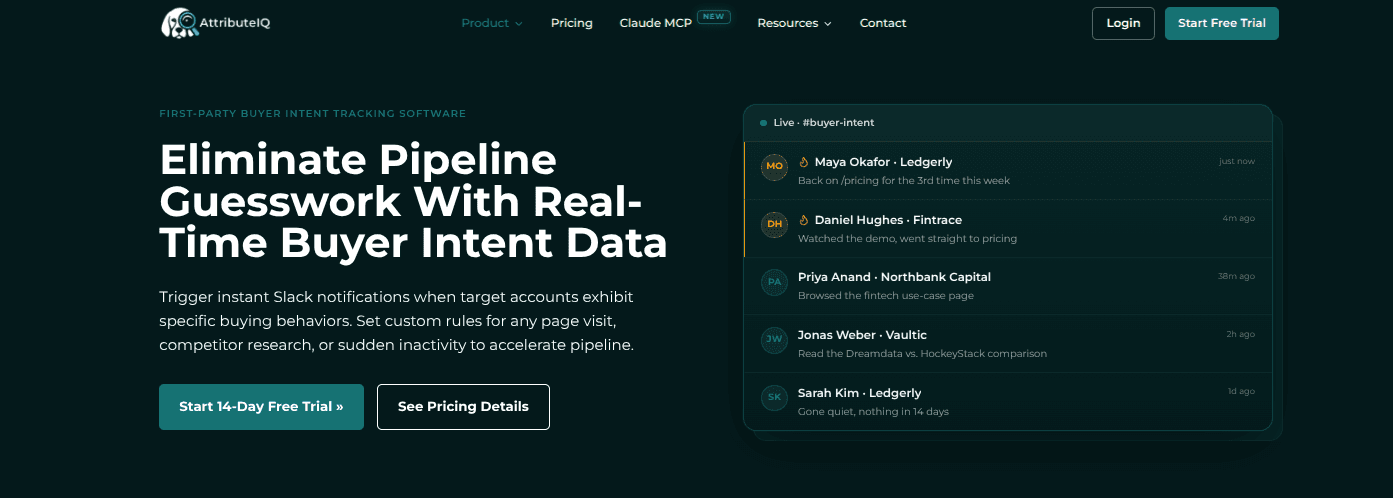
Where AttributeIQ Stands Out
Traditional intent tools often rely on vague third-party data or require heavy enterprise implementations. AttributeIQ connects natively with HubSpot and GA4 in under 15 minutes, giving teams immediate visibility into active target accounts without complex onboarding.
Pros
- Fully custom alert rules: Build multi-condition triggers combining exact URLs, visit velocity, and lifecycle status, such as “visited /pricing 3x in 7 days while contact status is SQL”.
- Real-time speed-to-lead notifications: Push real-time notifications directly to the assigned owner via Slack, the exact second a threshold is breached.
- Zero-overhead stack deployment: Connects natively to existing HubSpot and GA4 setups with zero custom engineering required, making first-party intent tracking operational in under 15 mins.
Cons
- Requires known contacts for person-level intent: AttributeIQ can only track a visitor once they’ve submitted a form and become a known HubSpot contact, activity before that point isn’t tied to their identity.
- Less value for low-traffic websites: Teams with limited website visitors or fewer known contacts may not generate enough behavioural signals to justify intent tracking.
Pricing
Buyer intent tracking is available on the Pro plan at £149/month, including custom alert rules, real-time Slack notifications, and high-intent activity tracking.
Identify accounts showing increased buying intent across your website
AttributeIQ routes real-time intent alerts to Slack and account owners the instant a known contact revisits a key page. Connect HubSpot and start capturing buyer intent signals within 24 hours.
Try it free for 14 days →Leadfeeder (by Dealfront)
Best for: B2B sales teams that want to identify anonymous website visitors and build account lists from company-level intent signals.
Leadfeeder helps sales and marketing teams identify which companies are visiting their website by matching anonymous traffic with firmographic data. This gives reps a clearer view of active accounts and helps them prioritise outreach based on real website activity.
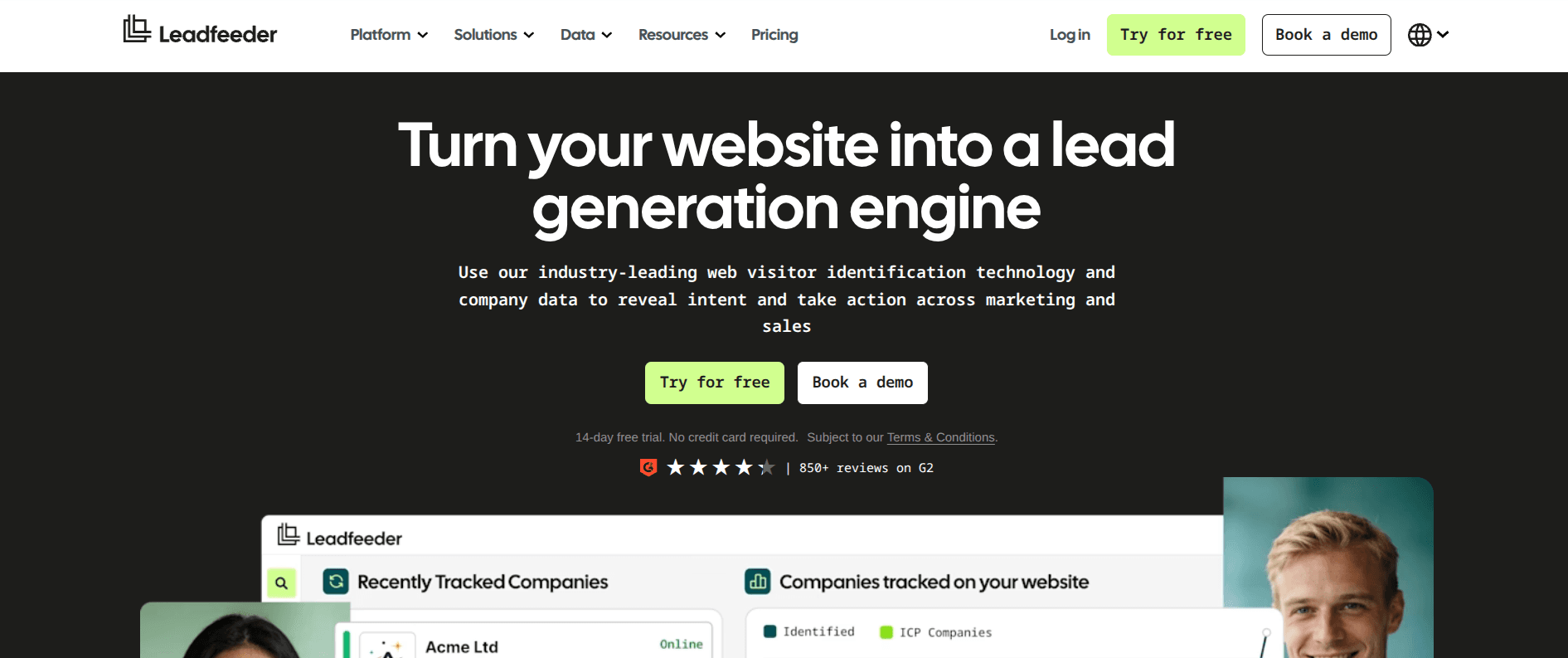
Where Leadfeeder Stands Out
Leadfeeder stands out for its simplicity and focus on sales-ready filtering. It automatically filters out ISP traffic and irrelevant bots, giving sales reps a clean feed of companies actively engaging with specific product or blog content.
Pros
- Company Visitor Identification: Matches anonymous website visitors with company profiles, helping teams understand which accounts are researching their products.
- Account Activity Feeds: Creates filtered views of companies based on website behaviour, industry, location, page visits, and engagement level.
- CRM & Sales Integrations: Pushes identified company activity into platforms like HubSpot, Salesforce, and Pipedrive for sales follow-up.
- Traffic Filtering: Removes irrelevant activity such as bots and internal traffic to keep account signals cleaner.
Cons
- Limited person-level visibility: Leadfeeder primarily identifies companies, not the specific individuals researching your product.
- Less focused on behavioural intent depth: Teams looking for detailed buyer journeys or custom intent triggers may need a more specialised platform.
Pricing
Leadfeeder offers a limited free tier, with paid plans starting around €139/month. Pricing varies based on website traffic volume, number of users, and data requirements.
Warmly
Best for: Outbound teams that want to identify individual website visitors and trigger immediate sales engagement.
Warmly identifies specific people visiting your site, enriches their contact data, and triggers immediate outreach, all without manual effort from your sales team.
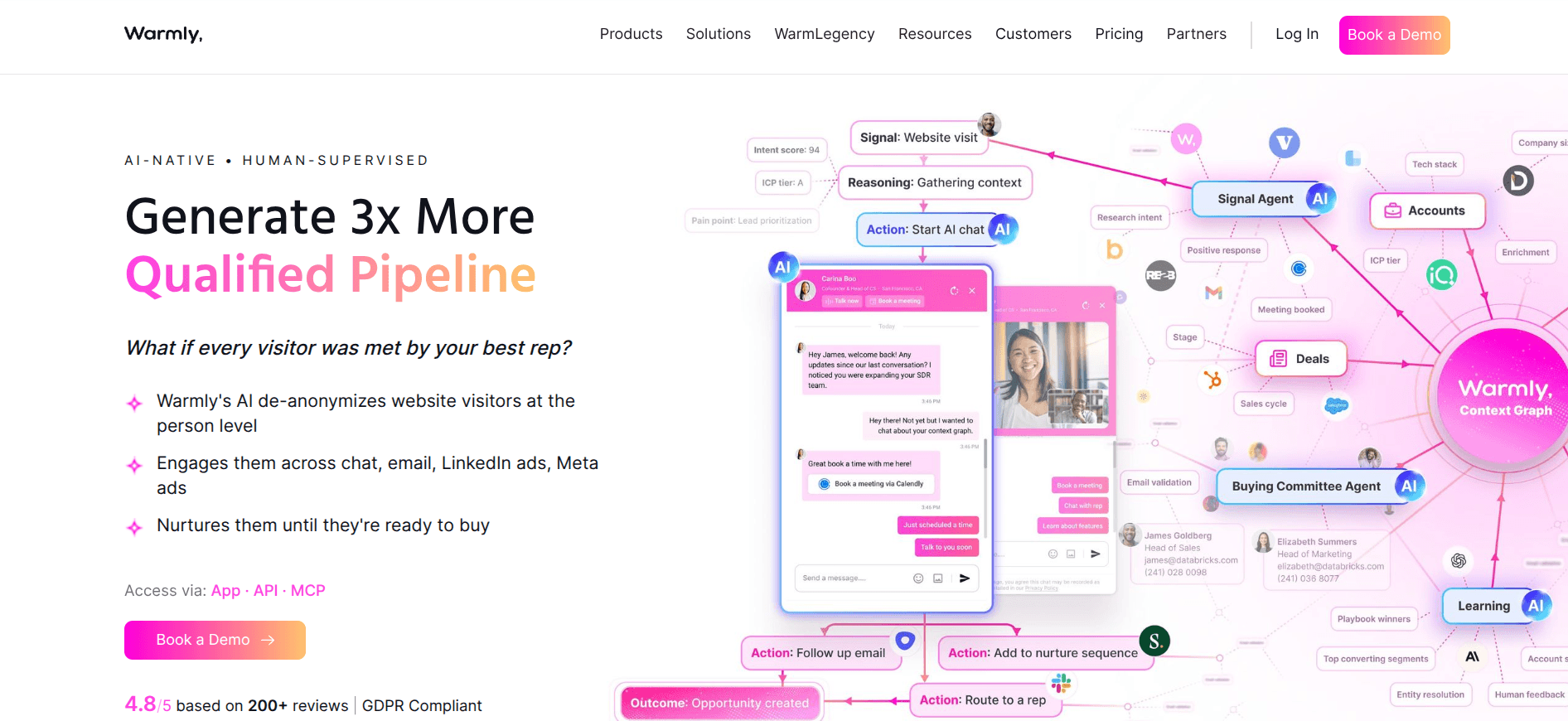
Where Warmly Stands Out
Warmly excels at real-time orchestration for outbound-heavy teams. It identifies individuals on your site, looks up their verified email and LinkedIn profiles, and automates instant engagement touchpoints so reps can act on intent right away.
Pros
- Strong person-level identification: Goes beyond company matching by helping teams identify individual prospects behind website activity.
- Automated engagement: Triggers personalised emails, chat messages, or LinkedIn actions based on real-time on-site behaviour, reducing manual follow-up work.
Cons
- Higher price point: Starts around $199/month, which can be steep for smaller teams or those with lower traffic volumes.
- Relies on third-party data: Enrichment accuracy depends on external databases, which may not always have complete or up-to-date contact information.
- Can feel intrusive: Person-level tracking and automated outreach may come across as aggressive to some website visitors.
Pricing
Warmly pricing typically starts around $199/month, with costs scaling based on enrichment credits, traffic volume, and automation requirements.
2. Best for Second-Party Buyer Intent Tracking (Review-Site & Marketplace Intent)
Second-party intent data is derived from software marketplaces, peer review platforms, and partner ecosystems where buyers actively research, compare, and review solutions. This is late-stage evaluation data, it tells you when an account is actively comparing your product against competitors.
G2 Buyer Intent
Best for: Enterprise B2B software companies that need visibility into bottom-funnel evaluation and competitor comparison behaviour.
G2 Buyer Intent is widely considered the gold standard for second-party review-site intent. Since G2 is where buyers go to read reviews, evaluate software categories, and compare competitor solutions head-to-head, its intent signals represent high-conviction purchasing behaviour from accounts already deep in the decision process.
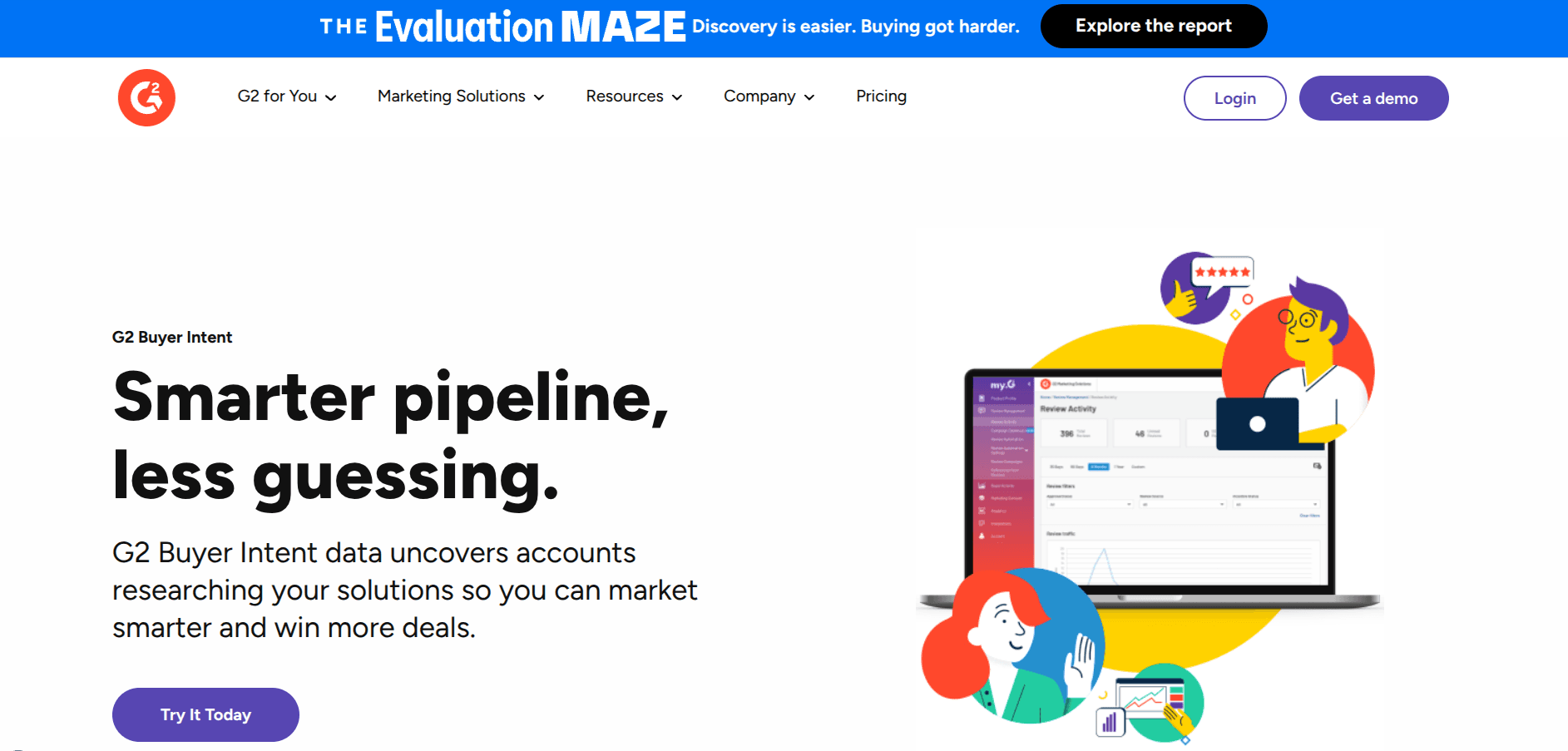
Where G2 Stands Out
G2 intent stands out because of its specificity. When an account reads reviews of your product, visits your pricing page on G2, or views a comparison page between you and a named competitor, it signals an active evaluation cycle that traditional web tracking simply cannot capture.
Pros
- Competitor comparison intelligence: Flags accounts actively researching your direct competitors on the G2 marketplace, giving you insight into who’s evaluating you against alternatives.
- Bottom-funnel signal strength: G2 visitors are typically further along in the buying journey than general website visitors, making these leads more sales-ready.
- Native CRM and Slack integration: Passes intent signals directly into Salesforce, HubSpot, and Slack so revenue teams can act on buying signals in real time.
Cons
- Premium pricing model: Sold as an annual add-on to your G2 profile, making it a significant investment that’s out of reach for smaller organisations.
- Limited to G2 activity only: Provides no visibility into behaviour on your own website or other third-party review sites, giving an incomplete picture of buyer intent.
- Data is second-party: Relies on G2’s own ecosystem of user behaviour, which may not represent all buyer segments, particularly in niche or emerging categories.
Pricing
G2 Buyer Intent is sold as an annual add-on to your G2 profile, with pricing scaling based on product category competitiveness and data feed requirements. Enterprise custom pricing available.
TrustRadius Buyer Intent
Best for: Enterprise B2B tech companies that need verified, high-trust buyer research signals from authenticated professionals.
TrustRadius Buyer Intent helps B2B teams identify accounts actively evaluating software through verified reviews, product comparisons, and detailed buyer research. It gives sales and marketing teams visibility into companies already exploring solutions, competitors, and specific product requirements.
Where TrustRadius Stands Out
TrustRadius stands out by focusing on high-quality buyer research rather than broad web activity. Its verified reviewer network provides stronger context around evaluation intent, helping enterprise teams prioritise accounts that are actively comparing solutions and building buying cases.
Pros
- Verified buyer signals: Tracks accounts engaging with comprehensive product reviews and pricing discussions, ensuring leads are genuine enterprise buyers.
- Buyer committee visibility: Reveals multiple stakeholders from the same target account researching solutions simultaneously, giving you insight into the full decision-making unit.
- ABM-ready data feeds: Integrates directly into major marketing automation platforms to power targeted account-based campaigns with high-confidence intent data.
Cons
- Enterprise-only pricing: Custom quote-based pricing with annual contracts makes it inaccessible for mid-market or growing teams.
- Limited to TrustRadius ecosystem: Only captures intent within TrustRadius’s platform, missing behaviour on your own website, review sites, and other third-party sources.
- No real-time alerting: Provides intent feeds rather than instant notifications, meaning sales teams may not act on signals while they’re still fresh.
Pricing
Custom, quote-based enterprise pricing structured around annual contracts and data feed access. Contact TrustRadius directly for a tailored quote.
Capterra (Gartner Digital Markets) Vendor Intent
Best for: B2B software vendors that need broad market visibility across Gartner’s network of software discovery platforms.
Part of the Gartner Digital Markets network, Capterra Vendor Intent tracks millions of software buyers actively searching for solutions across Capterra, Software Advice, and GetApp. It gives vendors a wide-lens view of market demand and category-level research behaviour.
Where Capterra Stands Out
Capterra offers unmatched reach across SMB and mid-market software buyers who use directory platforms to shortlist vendors before making contact. Its scale makes it particularly valuable for companies targeting high-volume, transactional segments.
Pros
- Massive market reach: Tracks buyers across three major software directories, Capterra, Software Advice, and GetApp, giving you broad visibility into category demand.
- Category-level demand analytics: Measures shifts in buyer interest across your software category, helping marketing teams align content and spend with market momentum.
- Integrated with Gartner Digital Markets: Seamlessly connects with your existing directory listings and paid placement strategy, making it easy to act on intent signals.
Cons
- Limited to SMB/mid-market: Heavily skewed toward smaller organisations, making it less valuable for enterprise-focused vendors targeting large accounts.
- No real-time alerts: Provides aggregated intent feeds rather than instant notifications, meaning sales teams can’t act on signals while they’re still fresh.
- Tied to directory spend: Access to intent data often requires significant investment in directory sponsorships or PPC programs, making it a package deal rather than a standalone solution.
Pricing
Custom pricing models, often bundled with directory sponsorship packages, PPC programs, or dedicated annual intent data contracts. Contact Gartner Digital Markets for a tailored quote.
3. Best for Third-Party Buyer Intent Tracking (Market-Wide Research & Surge Networks)
Third-party intent data tracks off-site research activity across publisher networks, news sites, and industry blogs. It helps you discover in-market accounts long before they ever visit your website.
Bombora
Best for: Enterprise revenue teams that need portable, third-party topic surge data to fuel existing CRM, marketing automation, or ABM infrastructure.
Bombora operates the largest B2B intent data co-operative in the world, tracking content consumption across thousands of professional publisher websites. It identifies accounts experiencing a “surge” in content consumption around specific topics relative to their historical baseline, giving teams early signals of active research and consideration.
Where Bombora Stands Out
Bombora is a pure data provider rather than an all-in-one execution platform. This makes it exceptionally flexible: you can ingest its topic surge data into Salesforce, HubSpot, 6sense, or custom data warehouses to fuel your existing workflows without being locked into a single vendor’s execution layer.
Pros
- Topic surge scoring: Measures when an account’s consumption of specific keyword topics spikes above normal baseline levels, signalling active research and consideration.
- Massive publisher co-op: Access exclusive B2B readership data across thousands of verified industry sites, giving you visibility into accounts that aren’t visiting your own website.
- Portable data feeds: Integrates smoothly into virtually any CRM, MAP, or sales intelligence tool, making it a flexible foundation for multi-channel ABM programs.
Cons
- Topic-only signals: Provides topic-level surge data but not page-level or behavioural granularity, making it harder to distinguish between research and purchase intent.
- No real-time alerts: Intent data is delivered in batches rather than real-time, meaning sales teams may receive signals days after an account showed interest.
- Enterprise pricing commitment: Requires significant annual investment and is typically sold as an enterprise data contract, making it inaccessible for mid-market teams.
Pricing
Custom annual enterprise contracts priced based on the number of topics tracked, data volume required, and integration needs. Contact Bombora directly for a tailored quote.
6sense
Best for: Enterprise marketing and RevOps teams that need a unified platform combining predictive analytics, multi-source intent, and cross-channel orchestration.
6sense is a heavy-duty enterprise ABM and intent platform. It aggregates third-party intent data, including Bombora, deanonymizes anonymous website traffic, applies AI-driven predictive analytics, and automates multi-channel account engagement across advertising, email, and sales workflows.
Where 6sense Stands Out
6sense differentiates itself through its predictive AI engine, which categorises accounts into buying stages: Target, Awareness, Consideration, Decision, Purchase. This tells revenue teams not just who is showing intent, but precisely where they are in the buying journey, enabling stage-appropriate engagement.
Pros
- Predictive buying stage scoring: Uses AI to determine whether an account is in early research, active evaluation, or purchase decision, helping teams prioritise accordingly.
- Multi-source intent aggregation: Combines third-party surge data, review-site activity, and first-party web engagement into a single, unified intent score.
- Full-funnel orchestration: Automates display ads, email sequences, and sales tasks based on account movement, creating a cohesive cross-channel experience.
Cons
- Significant investment required: Enterprise pricing starting at $40,000+ annually makes it inaccessible for mid-market or growing teams.
- Operations-heavy implementation: Requires dedicated RevOps resources to configure, maintain, and fully leverage the platform’s capabilities.
- Black-box AI scoring: Predictive models can feel opaque, making it difficult for teams to understand why accounts are scored a certain way or troubleshoot anomalies.
Pricing
Enterprise-grade pricing typically starting upwards of $40,000+ per year, with additional costs for data enrichment, integrations, and dedicated support. Requires an annual contract and dedicated operations resources to manage effectively.
Demandbase
Best for: Enterprise B2B organisations running sophisticated Account-Based Experience (ABX) strategies across global markets and complex buying committees.
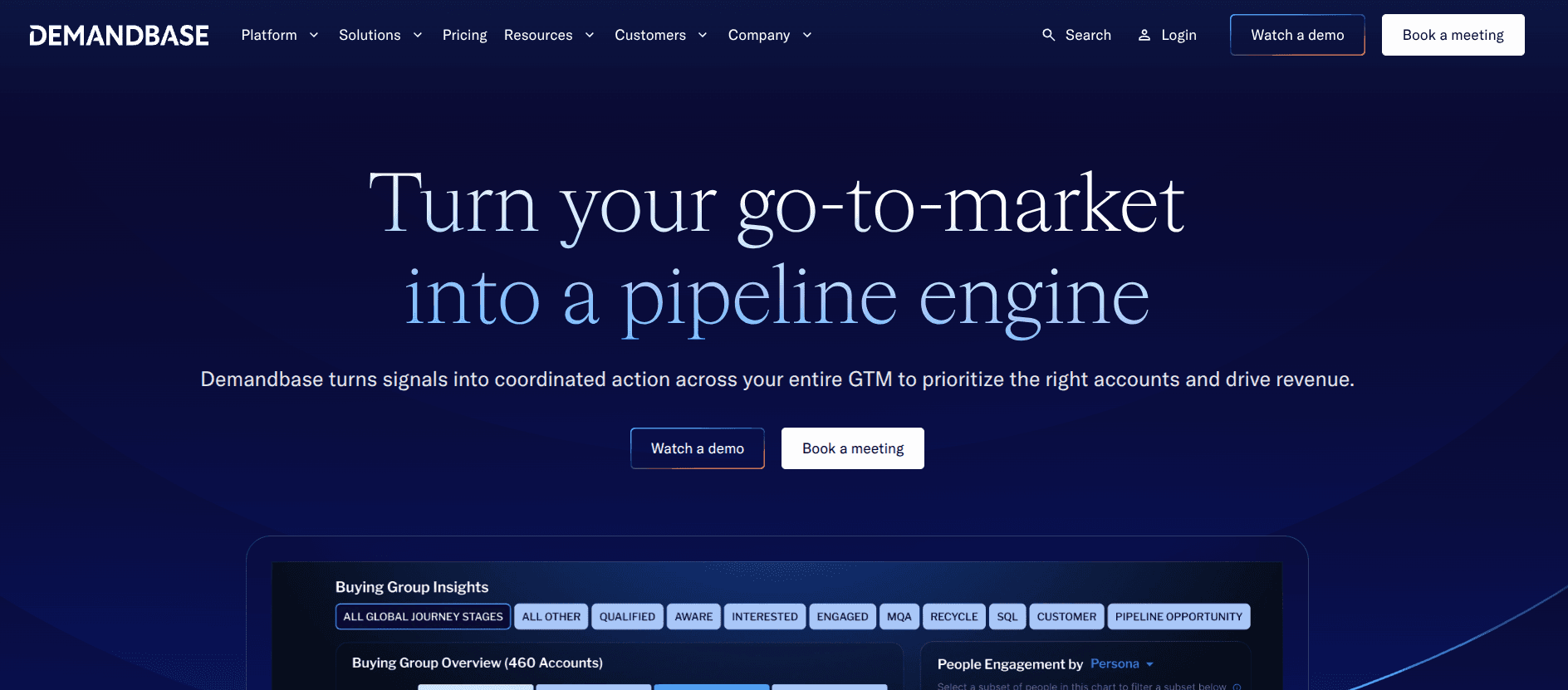
Demandbase unifies account-based advertising, web personalisation, sales intelligence, and third-party intent data into one enterprise marketing suite. Built for teams that need to orchestrate multi-channel engagement at scale, from targeted ads to personalised web experiences to sales outreach.
Where Demandbase Stands Out
Most intent platforms show data but leave teams to figure out what to do next. Demandbase solves this by wiring intent signals directly into account-based advertising and sales alerts, so marketing and revenue teams can act on high-value account activity immediately.
Pros
- Unified intent and engagement: Blends third-party market research signals with first-party account engagement metrics into a single, actionable view.
- ABX advertising orchestration: Automatically serves targeted ads to accounts showing active research surge in your solution category, reducing manual campaign management.
- Sales intelligence integration: Equips sales reps with contextual account insights directly inside their CRM workflow, eliminating the need to switch between tools.
Cons
- Enterprise price point: Significant investment starting at $35,000–$70,000+ annually, putting it out of reach for mid-market and growing teams.
- Complex implementation: Requires substantial onboarding, configuration, and ongoing management from dedicated marketing and RevOps resources.
- No person-level tracking: Focuses on account-level intelligence rather than identifying specific individuals, limiting sales personalisation.
Pricing
Custom enterprise pricing models typically ranging from $35,000 to $70,000+ per year based on database size, advertising spend integration, module selection, and support requirements. Annual contracts required.
How to Choose the Best Buyer Intent Tracking Software for Your Team
If you’ve reviewed the options above and still aren’t sure which tool fits, start by clarifying the specific problem you’re trying to solve, align it with the appropriate intent data type, and select a leading vendor built for that use case.
The Problem You’re Trying to Solve
The Right Intent Data
Best-In-Class Vendors
“We don’t know which of our website visitors are ready to buy right now.”
First-PartyOn-Site Behavior
AttributeIQ or Leadfeeder
“We keep losing deals to competitors because we don’t know who’s researching them on review sites.”
Second-PartyMarketplace Intent
G2 Buyer Intent or TrustRadius
“We have long sales cycles and need to identify accounts months before they reach out to us.”
Third-PartyOff-Site Surge Data
Bombora or 6sense
Pro tip: Many mature teams combine all three types, first-party for real-time alerts, second-party for competitor intelligence, and third-party for early-stage discovery.
Frequently Asked Questions
Having access to intent data doesn’t mean much if it doesn’t lead to a timely conversation. AttributeIQ cuts out the dashboard clutter and delivers precise, high-intent alerts straight to Slack the moment a target account shows buying behaviour. Try it free for 14 days.