We reviewed the leading B2B content marketing ROI platforms for 2026 based on their ability to connect content investment with measurable business outcomes. The top picks are:
- AttributeIQ: Best for B2B SaaS teams that need to understand which content contributes to pipeline, revenue, and overall ROI.
- PathFactory: Best for enterprise teams with large content libraries that need deeper visibility into buyer engagement and content performance.
- Welcome (by Optimizely): Best for enterprise marketing teams managing complex content operations and large production budgets.
- HockeyStack: Best for RevOps teams that need a unified view of content, marketing channels, and revenue impact.
- Contently: Best for global brands measuring the value of large-scale content programs and organic content investments.
Best Content Marketing ROI Tools Comparison for 2026
Proving content ROI remains one of the hardest challenges for B2B teams. It’s easy to show how much content was published, how much traffic it generated, or how many leads it influenced. The harder question is whether those results justify the time, budget, and resources invested.
To close that gap, we reviewed the top content marketing ROI tools for 2026, highlighting the platforms best equipped to connect content performance with measurable returns.
Platform
Best Fit
How It Measures ROI
Data Sources
Setup
Starting Price
AttributeIQ
B2B SaaS teams that need to understand which content investments are generating pipeline and revenue
Calculates content ROI by comparing influenced revenue against production and distribution costs
GA4, HubSpot, custom cost inputs
<24 hours
£149/mo (~$189/mo)
PathFactory
Enterprise teams measuring whether content engagement accelerates buying journeys
Tracks content consumption signals, engagement depth, and influence on pipeline outcomes
CRM, marketing automation, web analytics
2–4 weeks
Custom ($60k+/yr)
Welcome (Optimizely)
Enterprise content teams managing large-scale production workflows and budgets
Links content investment, resource costs, and campaign outcomes to measure production efficiency
CRM, ERP, marketing automation
6–10 weeks
Custom
HockeyStack
RevOps teams connecting content, campaigns, and revenue data in one attribution layer
Maps content touchpoints and acquisition costs against closed-won revenue and ROAS
CRM, ad platforms, product analytics
1–2 days
Custom (~$1,400/mo)
Contently
Enterprise brands managing content programs that need to justify large investments
Measures content value through organic performance, audience engagement, and lead impact
CRM, web analytics, Contently network
4–6 weeks
Custom ($500–$2k+/mo)
1. AttributeIQ
Best for: B2B SaaS and demand gen teams on HubSpot and GA4 that need to trace content’s role in pipeline and closed-won revenue.
AttributeIQ is a multi-touch attribution platform built for B2B teams running on HubSpot and GA4. It connects behavioral data with CRM deal records to show which content played a role in closed-won deals, then factors in content costs to give teams a clearer picture of true ROI.
Property
Attribution
Account
jent@nexa.com

Page Influence
Track page-level impact on pipeline volume and closed-won revenue performance.
Total Pipeline
£40.80k
Total Journeys
22
Top High-Value Page
/b2b-sales-lead-scoring
Most Balanced Page
/sales-rep-onboarding
Pipeline by Conversion Event
All pipeline · click an event to filter the journeys below
Pipeline Share
Share of pipeline by conversion event
£40.80k
Pages by Influenced Pipeline
Pricing starts at £89/month on the Starter plan for multi-touch attribution across website content. The Pro plan at £149/month adds full CRM-connected closed-won revenue attribution, a Content ROI calculator, executive Board Summary PPTX exports, and buyer intent alerts triggered by prospect re-engagement. Both plans include a 14-day free trial with no credit card required. See full pricing.
Core Features
Journey Explorer traces the content interactions that happen throughout the buying journey, from first-touch content to return visits, high-intent pages, and conversion points. This gives teams a clearer view of how content contributes to revenue instead of relying on isolated attribution signals.
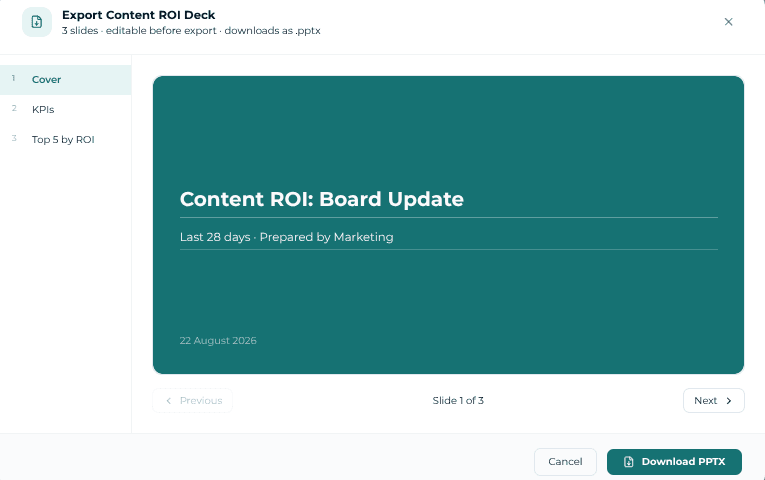
The Content ROI Deck exports a ready-made PPTX the moment you need it, cost per page, revenue influenced, and ROI ranked, built from whichever attribution model (First Touch, Last Touch, Multi-Touch) you’re currently viewing.
Buyer Intent Alerts give revenue operations real-time Slack visibility when decision-makers from active deals, stalled opportunities, or closed-won accounts revisit high-intent content like pricing or security pages, useful for prioritising follow-up while a specific asset is still driving interest.
Pros
- Content ROI tracking in under 24 hours. AttributeIQ connects GA4 content engagement data with HubSpot CRM records, allowing teams to see which articles, guides, and pages influenced opportunities and closed-won revenue without lengthy implementation cycles.
- Flexible attribution models for ROI analysis. Teams can evaluate content performance through first-touch, last-touch, and multi-touch attribution models to understand how different assets contribute throughout the buyer journey.
- Accessible pricing for B2B marketing teams. Starting at £149/month, AttributeIQ gives content and demand gen teams page-level ROI insights without the enterprise pricing typically associated with attribution platforms.
- Faster answers without manual reporting. Pro users can use Claude-powered analytics to explore questions about content influence and performance without building custom reports or digging through dashboards.
Cons
- Requires accurate content cost inputs. To calculate true ROI, teams need reliable data on content production and distribution costs. Without accurate cost tracking, ROI calculations will be limited to revenue influence rather than full return.
- Limited CRM ecosystem support. AttributeIQ is built primarily for teams using HubSpot and GA4. Organisations running Salesforce or other CRM ecosystems may need to evaluate available integrations before adopting the platform.
- No retroactive content journeys. AttributeIQ can only measure content interactions after tracking is installed, meaning teams cannot reconstruct historical buyer journeys from before setup.
Justify content spend with numbers finance can’t dispute
See how your articles, case studies, and guides influence revenue and ROI with AttributeIQ. Connect GA4 and HubSpot in under 24 hours, starting at £149/mo.
Try it free for 14 days →2. PathFactory
Best for: Enterprise B2B teams with large content libraries that need to understand how content engagement influences buyer progression, pipeline velocity, and revenue outcomes.
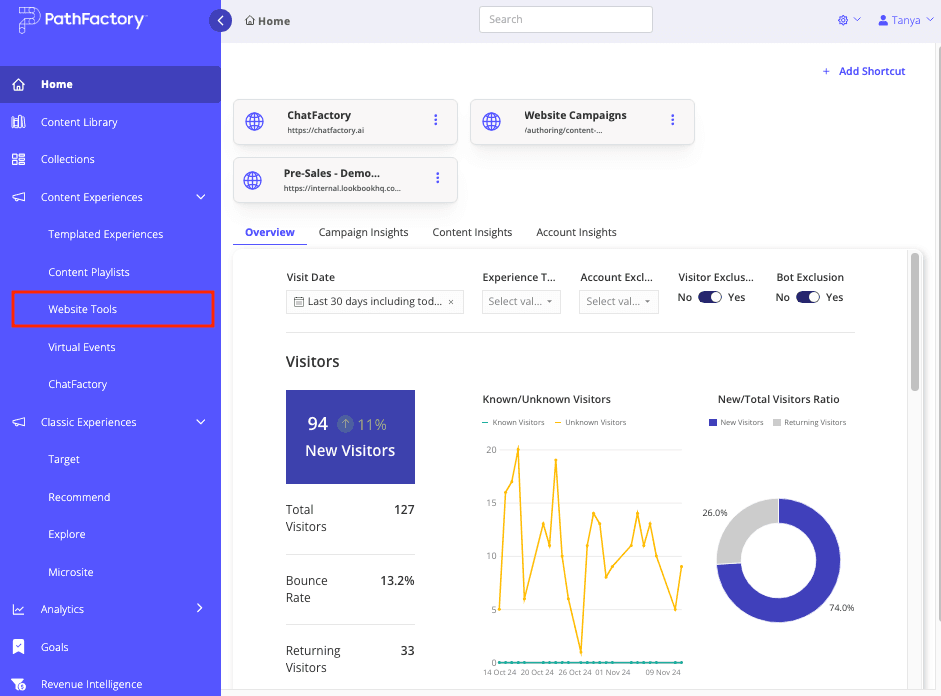
PathFactory is a content intelligence platform that tracks how buyers consume content, including reading time, asset engagement, and content journeys, then connects those signals with CRM data to understand which experiences help move prospects closer to purchase.
Pricing
Custom enterprise pricing, typically starting around $60,000+ per year, depending on content volume, integrations, and implementation requirements.
Core Features
- Content consumption tracking. Measures active engagement across assets, including reading time, video consumption, and content depth, giving teams a clearer view of buyer attention beyond pageviews and clicks.
- Enterprise content performance reporting. Connects content engagement data with CRM and marketing automation systems to understand how consumption patterns influence pipeline movement, sales cycles, and revenue outcomes.
- Content recommendations and journeys. AI-powered recommendations help buyers discover relevant resources, improving engagement with existing content libraries and helping teams maximise the value of their current assets.
Cons
- Enterprise pricing limits accessibility. Custom pricing, typically starting around $60,000+ per year, makes PathFactory better suited for larger organisations with dedicated content operations and analytics budgets.
- Requires significant content volume to deliver value. Teams with smaller content libraries or limited traffic may not generate enough engagement data for deeper insights and recommendations to become meaningful.
- Longer implementation process. Enterprise teams typically need more planning around content organisation, CRM integrations, and existing workflows before getting full value from the platform.
3. Welcome (by Optimizely)
Best for: Enterprise content teams that need to manage large-scale production workflows, track content investment, and understand how resources translate into marketing outcomes.
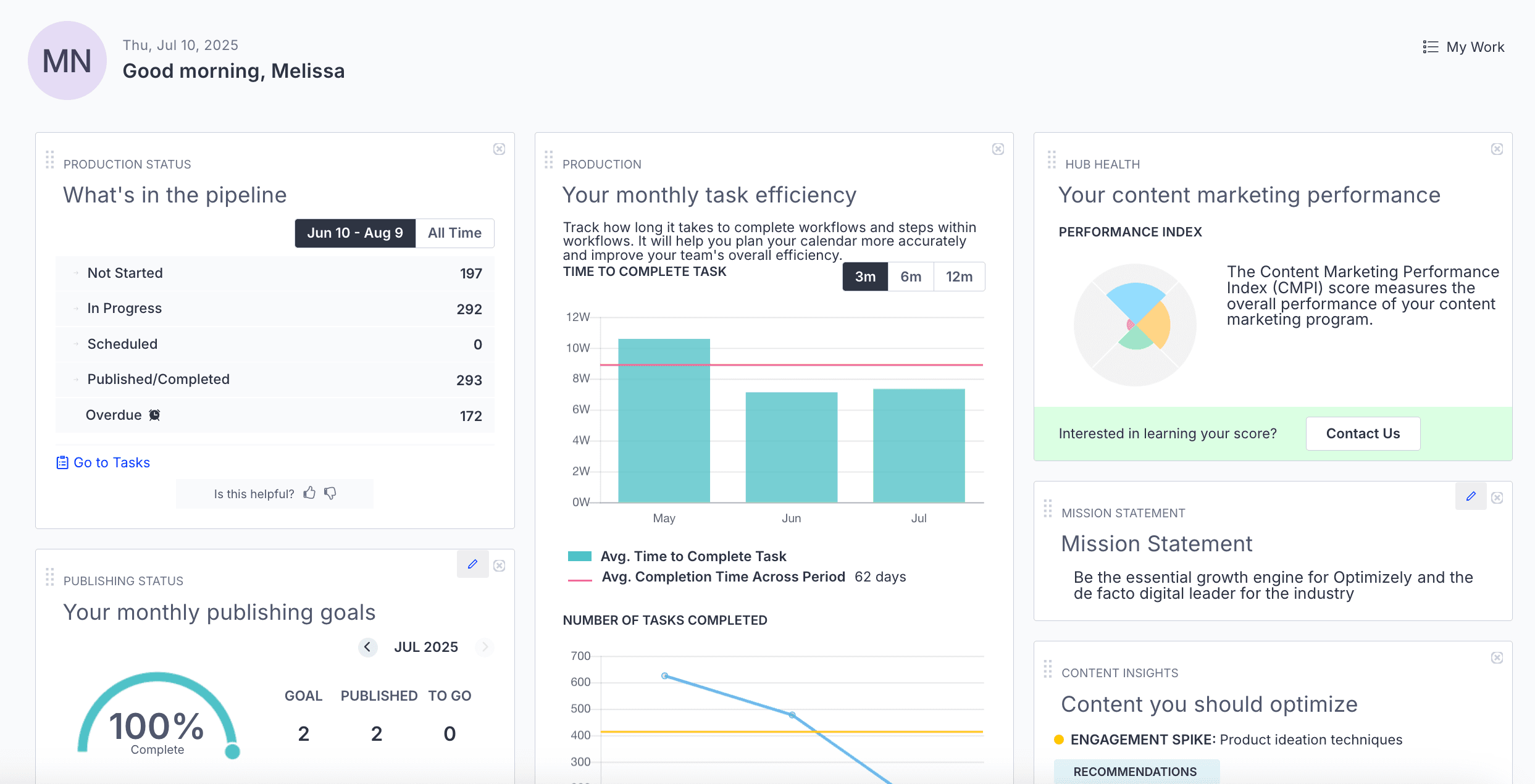
Welcome, formerly NewsCred and now part of Optimizely, is a content marketing platform built for organisations managing complex content operations. Its strength is connecting the production side of content, including internal resources, agency costs, and workflows, with campaign performance data, helping teams understand how their content investments are being used and where they are generating impact.
Pricing
Custom pricing based on team size, content volume, workflows, and implementation requirements.
Core Features
- Content investment tracking. Tracks production costs across internal teams, agencies, and freelancers, giving enterprise orgs visibility into where content budgets are being allocated.
- Campaign performance measurement. Connects content initiatives with marketing outcomes to help teams evaluate which campaigns and programs are delivering measurable results.
- Enterprise content operations. Combines planning, creation, approval workflows, and reporting in one platform, helping large teams manage content production at scale.
Cons
- Built for enterprise complexity. The breadth of workflow and resource management features can be excessive for teams looking only for lightweight content performance reporting.
- Requires operational maturity. Teams need established content processes and accurate resource tracking before the platform can provide a complete view of content efficiency.
- Less focused on individual asset attribution. Compared with dedicated attribution platforms, Welcome is stronger for managing content ops than analysing the ROI of specific pages or assets.
4. HockeyStack
Best for: B2B RevOps teams that need a unified view of how content, campaigns, advertising spend, and buyer interactions contribute to revenue outcomes.
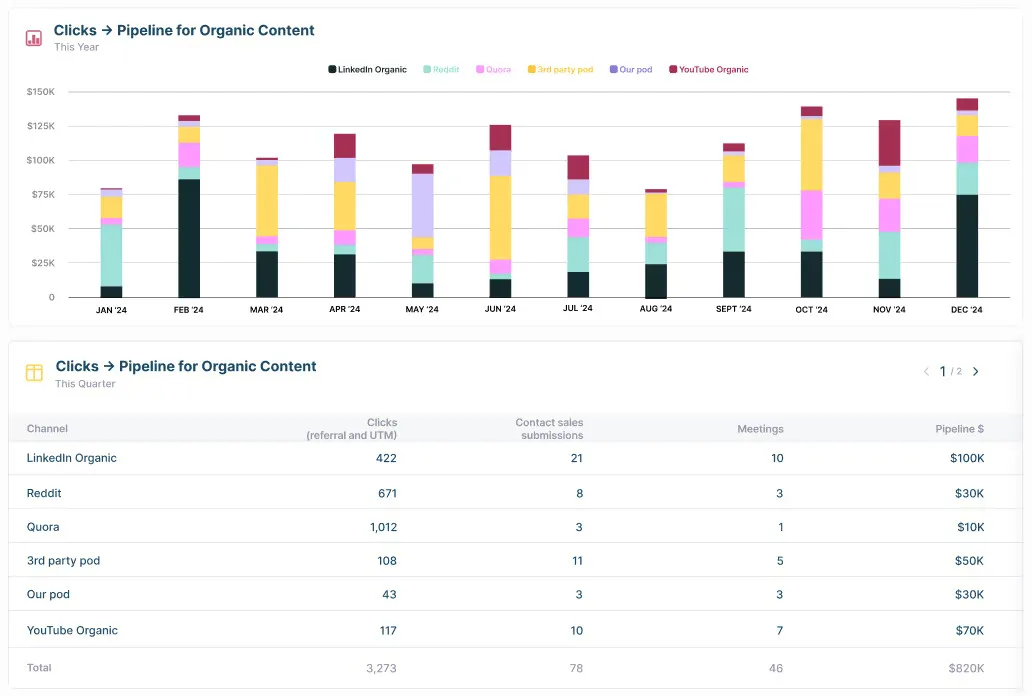
HockeyStack is a revenue analytics platform built for B2B teams that want to connect fragmented marketing data across the entire customer journey. It combines content engagement, campaign performance, advertising spend, and CRM outcomes to help teams understand which marketing investments are influencing revenue and where returns are being generated.
Pricing
Custom pricing, typically starting around $1,500/month depending on traffic volume, data sources, and reporting requirements.
Core Features
- Unified marketing ROI visibility. Combines ad spend, content engagement, and CRM revenue data into one view, helping teams understand which channels and investments are contributing to business outcomes.
- Full buyer journey tracking. Maps interactions across long B2B buying cycles, giving credit to early-stage content and campaigns that influence deals before conversion.
- Flexible revenue reporting. Lets teams analyse performance across different channels, campaigns, and touchpoints to understand where marketing investment is creating measurable returns.
Cons
- Requires a clear measurement framework. The flexibility of the platform means teams need defined goals and reporting requirements before building meaningful dashboards.
- Higher complexity for smaller teams. With broader data coverage comes more setup and maintenance, making it better suited for teams with dedicated RevOps resources.
5. Contently
Best for: Enterprise brands running large-scale content programs that need to manage production, measure content performance, and demonstrate the value of ongoing content investment.
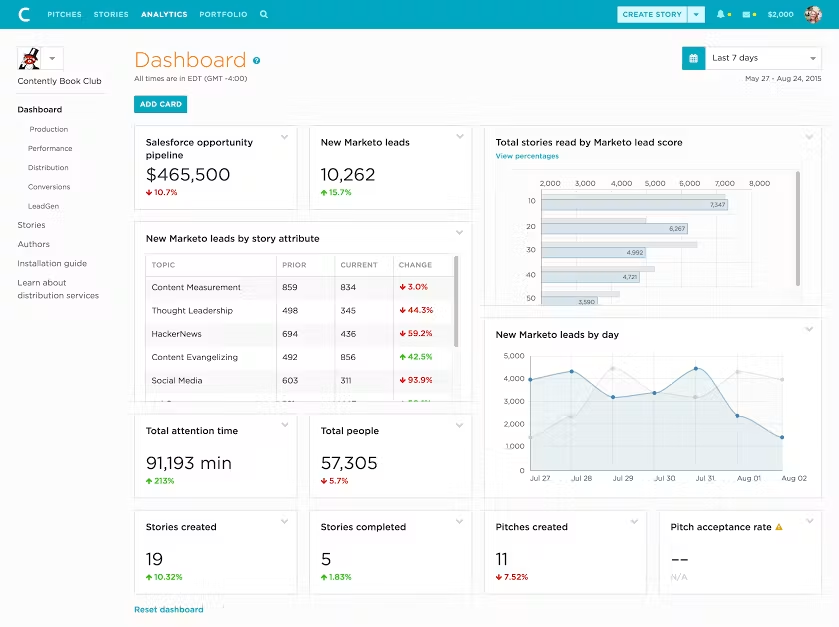
Contently is an enterprise content marketing platform that combines content operations, analytics, and access to a global freelance network. Its ROI approach focuses on showing the business value of content programs by measuring engagement, lead generation, and the equivalent value of organic traffic compared with paid acquisition costs.
Pricing
Custom enterprise pricing based on content volume, team requirements, analytics needs, and access to Contently’s talent network.
Core Features
- Content value measurement. Calculates the estimated value of organic content performance by comparing earned traffic against equivalent paid search costs, helping teams demonstrate the impact of SEO investments.
- Content performance analytics. Tracks engagement signals, audience behaviour, and lead gen across individual assets and larger content programs to identify what resonates with buyers.
- Enterprise content production management. Combines planning, workflow management, and access to a freelance talent network, helping large teams manage content creation at scale.
Cons
- Less focused on closed-won attribution. Contently provides strong content value metrics and performance reporting, but teams looking for detailed multi-touch revenue attribution may need a dedicated attribution platform.
- Designed for enterprise content teams. The platform's breadth, pricing, and production capabilities are better suited for organisations managing significant content operations rather than lean marketing teams.
How to Choose the Best Content ROI Software for Your Team
Now that we’ve broken down the top content ROI platforms on the market, here’s how to choose the right one for your team.
1. How granular does your cost tracking need to be?
- If you manage a sprawling network of freelancers and need to tie individual invoices directly to pipeline, an operational heavyweight like Welcome is your best bet.
- If you need a powerful attribution engine that effortlessly unifies your overall content investments with HubSpot and GA4 to reveal true ROI, AttributeIQ gives you the fastest path to a clear, defensible number.
2. How complex is your B2B sales cycle?
- If buyers read a dozen posts over several months before booking a demo, you need a tool that maps the full journey. HockeyStack and AttributeIQ both capture long-tail content touchpoints and attribute revenue to them.
- If the priority is proving how deep engagement with a single asset speeds up a deal, PathFactory is built specifically for that question.
3. What is your primary metric for return?
- If return means closed-won ARR measured against production cost, choose a platform with deep CRM integration, such as AttributeIQ or HockeyStack.
- If return means pipeline velocity, look at PathFactory. If it means saving money on paid ads by way of organic traffic, Contently’s Content Value model is built for that framing.
4. What are your implementation capabilities?
- Lean teams without a dedicated analytics hire should stay with out-of-the-box integrations like AttributeIQ or StoryChief, that take less than a day to set up.
- Teams with dedicated RevOps resourcing can absorb the 4-8 week custom data mapping that PathFactory or Welcome require.
Common Buying Mistakes When Evaluating Content ROI Platforms
Buying the wrong content ROI platform can create more reporting noise without improving budget decisions. The right platform should connect content performance to qualified pipeline, closed-won revenue, and the full cost of content production, not simply present more traffic metrics.
How to Get Value From Your Content ROI Software in the First 90 Days
Your first 90 days with a content ROI platform should focus on establishing the data foundation: connect your existing systems, define how content costs will be measured, and gradually build a credible view of how content contributes to pipeline and revenue.
Frequently Asked Questions
There’s no single best content ROI platform, just the one that fits your team’s setup and sales cycle. If you’re on HubSpot and GA4 and want to see which content actually drove revenue, the fastest way is to connect your data and look at closed-won deals. AttributeIQ does this in under 24 hours. Free for 14 days. Try it and see what you find.